






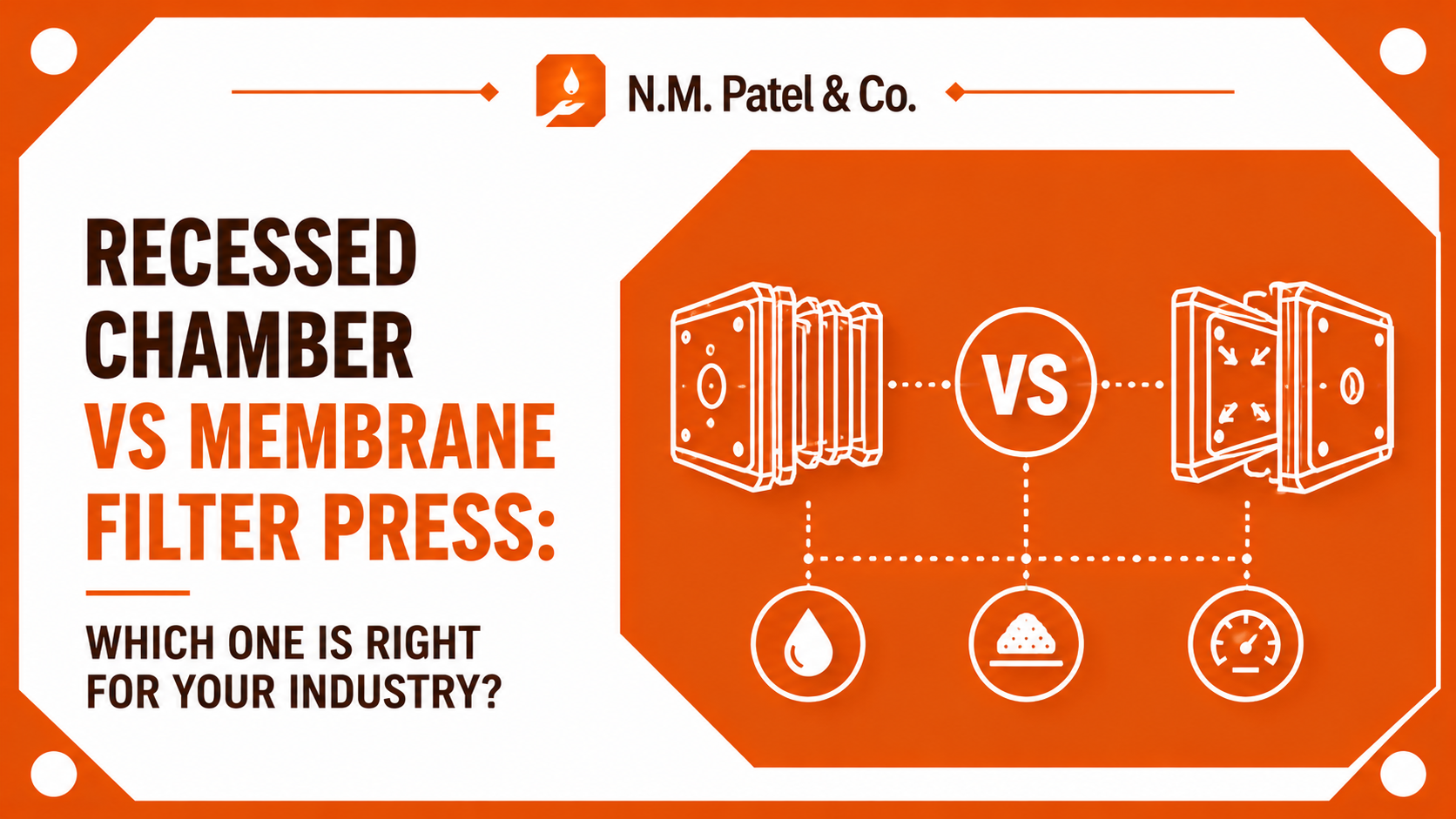
Choosing the right filter press is one of the most important decisions for industries that depend on efficient solid-liquid separation. Whether you operate an Effluent Treatment Plant (ETP), pharmaceutical facility, mining operation, or chemical manufacturing unit, selecting the appropriate filtration technology directly impacts productivity, operating costs, and sludge disposal expenses.
Two of the most widely used industrial filtration systems are the Recessed Chamber Filter Press and the Membrane Filter Press. While both perform the same primary function—separating solids from liquids—they differ significantly in design, operating method, moisture reduction, and overall performance.
In this guide, we’ll compare Recessed Chamber vs Membrane Filter Press machines to help you determine which solution best fits your industrial application.
What Is a Recessed Chamber Filter Press?
A Recessed Chamber Filter Press consists of recessed filter plates that create chambers where slurry is pumped under pressure.
As pressure increases:
- Liquid passes through the filter cloth.
- Solids remain inside the chamber.
- A filter cake gradually forms.
- Once filtration is complete, the plates open and the cake is discharged.
This design is one of the most commonly used filtration systems because of its simplicity, durability, and cost-effectiveness.
What Is a Membrane Filter Press?
A Membrane Filter Press follows the same filtration process initially but includes an additional squeezing stage.
After the filtration cycle:
- Flexible membrane plates inflate using water or compressed air.
- Extra pressure compresses the filter cake.
- More liquid is removed.
- The filter cake becomes significantly drier.
This secondary compression improves filtration efficiency and reduces disposal costs.
Recessed Chamber vs Membrane Filter Press: Key Differences
| Feature | Recessed Chamber Filter Press | Membrane Filter Press |
| Filtration Method | Pressure Filtration | Pressure + Membrane Squeezing |
| Cake Dryness | Moderate | Very High |
| Moisture Content | Higher | Lower |
| Cycle Time | Standard | Slightly Longer |
| Operating Cost | Lower | Higher |
| Initial Investment | Lower | Higher |
| Energy Consumption | Lower | Slightly Higher |
| Automation Options | Available | Available |
| Sludge Disposal Cost | Higher | Lower |
| Best For | General Industrial Applications | High-Value Filtration Applications |
Working Principle Comparison
Recessed Chamber Filter Press
The slurry enters the filtration chambers under pressure.
During filtration:
- Solids accumulate inside the chambers.
- Filtrate exits through filter cloth.
- Pressure gradually builds.
- Cake forms naturally.
Once complete, the press opens and removes the filter cake.
The process is straightforward and reliable.
Membrane Filter Press
The filtration stage begins exactly like a recessed chamber press.
However, after cake formation:
- Membranes expand.
- Additional squeezing pressure is applied.
- Remaining moisture is forced out.
- Cake density increases.
- Filtration efficiency improves.
This additional stage creates significantly drier filter cakes.
Advantages of a Recessed Chamber Filter Press
Businesses often choose recessed chamber systems because they offer:
- Lower purchase cost
- Simple operation
- Easy maintenance
- Reliable performance
- Long service life
- Lower energy consumption
- Suitable for most industrial applications
These machines provide excellent value for standard filtration requirements.
Advantages of a Membrane Filter Press
Membrane systems provide several performance benefits:
- Higher cake dryness
- Reduced moisture content
- Lower sludge disposal costs
- Better product recovery
- Faster downstream drying
- Improved filtration efficiency
- Reduced transportation costs for sludge
They are particularly beneficial where sludge disposal costs are high.
Which Industries Prefer Recessed Chamber Filter Presses?
Recessed Chamber Filter Presses are commonly used in:
- Effluent Treatment Plants (ETP)
- Sewage Treatment Plants (STP)
- Textile Industry
- Chemical Manufacturing
- Electroplating Plants
- Ceramic Industry
- Paper Mills
- Food Processing
- Municipal Wastewater Treatment
These industries often require reliable, cost-effective filtration rather than maximum cake dryness.
Which Industries Use Membrane Filter Presses?
Membrane Filter Presses are preferred by industries requiring maximum moisture reduction.
Common applications include:
- Pharmaceutical Manufacturing
- Mining
- Specialty Chemicals
- Pigment Production
- High-Value Mineral Processing
- Food & Beverage Industry
- Biotechnology
- Fine Chemical Manufacturing
These industries benefit from lower moisture content and improved product recovery.
Cost Comparison
Recessed Chamber Filter Press
Advantages include:
- Lower capital investment
- Lower maintenance cost
- Reduced operating expenses
Suitable for businesses with standard filtration needs.
Membrane Filter Press
Although the initial investment is higher, businesses often save money through:
- Reduced sludge disposal
- Lower drying costs
- Better product recovery
- Higher production efficiency
For many industries, long-term savings outweigh the higher purchase price.
Maintenance Comparison
Recessed Chamber Filter Press
Maintenance includes:
- Filter cloth replacement
- Plate cleaning
- Hydraulic inspection
- Routine servicing
Overall maintenance is relatively simple.
Membrane Filter Press
In addition to standard maintenance:
- Membrane inspection
- Membrane pressure testing
- Air or water system maintenance
- Periodic membrane replacement
Proper preventive maintenance ensures long-term performance.
How to Choose the Right Filter Press
Consider the following factors before selecting a machine:
Slurry Characteristics
Evaluate:
- Solid concentration
- Particle size
- Chemical properties
- Viscosity
Desired Cake Dryness
If maximum dryness is essential, a membrane filter press is generally the better option.
Budget
For standard industrial applications, recessed chamber filter presses provide excellent value.
Production Capacity
High-capacity facilities often benefit from automated membrane systems.
Sludge Disposal Costs
When sludge transportation and disposal costs are significant, investing in membrane technology can provide substantial long-term savings.
Common Buying Mistakes
Avoid these common mistakes:
- Selecting equipment based only on price
- Ignoring moisture reduction requirements
- Underestimating future production capacity
- Choosing the wrong plate size
- Overlooking maintenance support
- Purchasing from inexperienced manufacturers
Working with an experienced supplier helps avoid costly mistakes.
Why Choose NMP Patel & Co.?
At NMP Patel & Co., we design and manufacture reliable filtration systems tailored to the needs of diverse industries across India.
Our product range includes:
- Recessed Chamber Filter Press
- Membrane Filter Press
- Fully Automatic Filter Press
- Hydraulic Filter Press
- Filter Plates
- Filter Cloths
- Filter Press Spare Parts
- Customized Filtration Solutions
- Installation & Commissioning
- Preventive Maintenance Support
As a trusted membrane filter press manufacturer India, we help businesses improve filtration efficiency, reduce operational costs, and achieve long-term reliability.
People Also Search For
- Chamber filter press vs membrane filter press
- Membrane filter press working
- Recessed chamber filter press
- Filter press comparison
- Industrial filter press machine
- Fully automatic filter press
- Filter press manufacturer India
- Filter press applications
- Membrane plate filter press
- Wastewater filter press
People Also Ask
What is the difference between a recessed chamber filter press and a membrane filter press?
A recessed chamber filter press performs pressure filtration only, while a membrane filter press includes an additional squeezing stage that removes more moisture from the filter cake, resulting in a drier output.
Which filter press provides better cake dryness?
A membrane filter press generally produces a drier filter cake because flexible membrane plates apply additional pressure after the initial filtration process.
Is a membrane filter press worth the higher investment?
For industries with high sludge disposal costs or where lower moisture content is critical, the long-term savings from improved cake dryness and reduced handling expenses often justify the higher initial investment.
Which industries commonly use recessed chamber filter presses?
Recessed chamber filter presses are widely used in wastewater treatment, chemical processing, textiles, ceramics, paper manufacturing, food processing, and municipal applications.
How do I choose the right filter press for my business?
The right choice depends on factors such as slurry characteristics, required cake dryness, production capacity, automation needs, available budget, and long-term operating costs.
Frequently Asked Questions
Can a membrane filter press replace a recessed chamber filter press?
In many applications, yes. However, the decision depends on process requirements, desired moisture reduction, and economic considerations. A detailed evaluation of your filtration process is recommended before upgrading.
Which filter press requires less maintenance?
Recessed chamber filter presses generally require less maintenance because they have fewer moving components and do not include membrane squeezing systems.
Are both filter press types available with automation?
Yes. Both recessed chamber and membrane filter presses can be configured with hydraulic systems, PLC controls, automatic plate shifting, cake discharge mechanisms, and other automation features.
Which filter press is better for pharmaceutical and chemical industries?
Membrane filter presses are often preferred because they provide superior cake dryness, higher product recovery, and improved filtration efficiency—important factors in pharmaceutical and specialty chemical production.
Why choose NMP Patel & Co. for industrial filtration solutions?
NMP Patel & Co. offers engineered filtration systems designed for performance, reliability, and long-term value. From machine selection and customization to installation and after-sales support, our team works closely with customers to deliver filtration solutions that match their operational and production requirements.
Conclusion
When comparing Recessed Chamber vs Membrane Filter Press, there is no one-size-fits-all solution. A recessed chamber filter press offers a cost-effective, durable, and reliable option for standard industrial filtration, while a membrane filter press delivers superior cake dryness, better product recovery, and lower sludge disposal costs for more demanding applications.
The best choice depends on your industry’s filtration goals, production capacity, budget, and long-term operational requirements. By carefully evaluating these factors and partnering with an experienced manufacturer, you can invest in a filtration system that maximizes efficiency and supports sustainable growth.
If you’re looking for expert guidance and high-performance industrial filtration equipment, NMP Patel & Co. provides customized filter press solutions backed by engineering expertise, quality manufacturing, and dependable after-sales service.