






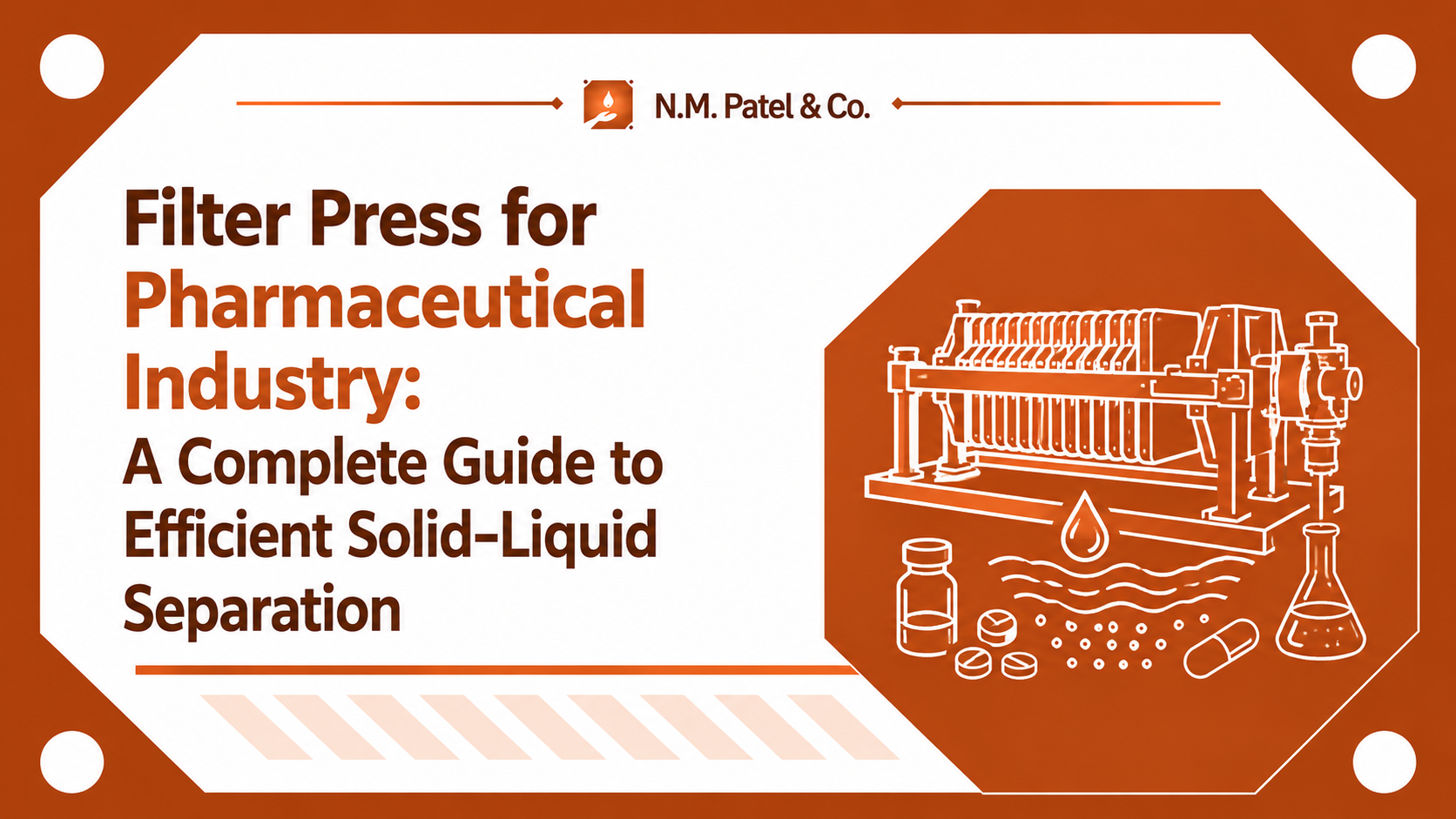
The pharmaceutical industry demands exceptional precision, consistency, and compliance at every stage of production. From manufacturing Active Pharmaceutical Ingredients (APIs) to processing intermediates and recovering valuable compounds, efficient solid-liquid separation is a critical process that directly impacts product quality and operational efficiency.
One of the most trusted solutions for pharmaceutical filtration is the filter press. Designed to deliver high filtration efficiency, low product loss, and reliable performance, filter presses play an essential role in pharmaceutical manufacturing plants worldwide.
In this guide, we’ll explore how a filter press for pharmaceutical industry applications works, its benefits, common types, selection criteria, maintenance practices, and why choosing the right filtration partner is essential for long-term success.
Why Filtration Is Critical in Pharmaceutical Manufacturing
Pharmaceutical production involves multiple filtration stages where liquids, suspensions, and chemical mixtures must be separated with precision.
Effective filtration helps manufacturers:
- Improve product purity
- Recover valuable ingredients
- Reduce contamination risks
- Enhance process efficiency
- Meet regulatory quality standards
- Reduce waste generation
A reliable filter press ensures these objectives are achieved consistently across production cycles.
What Is a Pharmaceutical Filter Press?
A pharmaceutical filter press is a pressure filtration system used to separate solids from liquids during pharmaceutical manufacturing.
It consists of filter plates, filter cloths, and a hydraulic closing mechanism that forms sealed chambers. Slurry is pumped into these chambers under pressure. The liquid passes through the filter media, while solids remain inside to form a filter cake.
Depending on the application, the recovered solid or the clarified liquid may be the desired final product.
How Does a Filter Press Work in Pharmaceutical Applications?
The process follows a controlled sequence.
Step 1 – Slurry Preparation
The pharmaceutical slurry containing suspended solids is prepared according to the production process.
Step 2 – Chamber Filling
A feed pump transfers the slurry into the filter press chambers under controlled pressure.
Step 3 – Filtration
As pressure builds:
- Liquid passes through the filter cloth.
- Solids remain trapped.
- A uniform filter cake forms.
Step 4 – Filtrate Collection
The clarified liquid is collected through dedicated outlet channels for further processing or reuse.
Step 5 – Cake Discharge
After filtration, the press is opened and the filter cake is removed safely before the next production cycle.
Types of Filter Presses Used in the Pharmaceutical Industry
Different pharmaceutical processes require different filtration technologies.
Plate and Frame Filter Press
Suitable for:
- Batch production
- Laboratory applications
- API manufacturing
- Small to medium production volumes
Advantages
- Simple construction
- Easy maintenance
- Cost-effective operation
Recessed Chamber Filter Press
One of the most commonly used filter presses in pharmaceutical manufacturing.
Benefits
- Better sealing
- Higher operating pressure
- Faster filtration
- Improved cake handling
Membrane Filter Press
Ideal for applications requiring very low cake moisture.
Advantages
- Higher solids recovery
- Reduced drying time
- Improved filtration efficiency
- Better product yield
Fully Automatic Filter Press
Recommended for high-volume pharmaceutical plants.
Benefits include:
- Automated plate shifting
- Reduced manual handling
- Improved operator safety
- Consistent production cycles
Applications of Filter Press in Pharmaceutical Industry
Filter presses are used across various pharmaceutical processes.
API Manufacturing
Efficient separation of active pharmaceutical ingredients from process liquids.
Antibiotic Production
Recovery of fermentation products while maintaining process efficiency.
Herbal Extract Processing
Clarification of botanical extracts used in herbal medicines and nutraceuticals.
Chemical Intermediates
Filtration during synthesis of pharmaceutical intermediates.
Solvent Recovery
Recovery and reuse of valuable solvents to reduce operating costs.
Wastewater Treatment
Treatment of pharmaceutical effluents before discharge or recycling.
Benefits of Using a Filter Press in Pharmaceutical Manufacturing
High Product Purity
Pressure filtration effectively removes suspended solids, improving the quality of the final product.
Low Product Loss
Efficient filtration minimizes the loss of valuable pharmaceutical materials.
Consistent Filtration Performance
Uniform filtration ensures repeatable production quality across batches.
Improved Process Efficiency
Reliable filtration reduces processing time and increases plant productivity.
Cost Savings
Benefits include:
- Reduced waste
- Lower disposal costs
- Solvent recovery
- Longer equipment life
Flexible Operation
Filter presses can be customized to suit different pharmaceutical formulations and production capacities.
Key Features to Look for in a Pharmaceutical Filter Press
When selecting an industrial filter press for pharma, consider the following:
Corrosion-Resistant Construction
Materials should withstand aggressive chemicals and cleaning agents.
Hygienic Design
Equipment should allow easy cleaning and minimize contamination risks.
High-Quality Filter Cloth
Proper cloth selection improves filtration efficiency and product quality.
Leak-Proof Operation
Reliable hydraulic sealing prevents product loss and contamination.
Automation Options
Automatic plate shifting and control systems improve productivity and reduce manual intervention.
Easy Maintenance
Accessible components reduce downtime during servicing.
Factors to Consider Before Buying
Choosing the right filter press requires evaluating several process parameters.
Product Characteristics
Consider:
- Particle size
- Viscosity
- Temperature
- Chemical composition
Production Capacity
Select equipment that supports both current and future manufacturing volumes.
Filtration Requirements
Determine whether the process prioritizes:
- Product recovery
- Clarified liquid
- Dry filter cake
Regulatory Compliance
Ensure equipment materials and design comply with pharmaceutical manufacturing standards.
After-Sales Support
Reliable maintenance and spare parts availability are essential for uninterrupted production.
Maintenance Best Practices
Routine maintenance helps maintain consistent filtration performance.
Daily
- Inspect filter cloths
- Remove residual cake
- Check hydraulic pressure
- Verify leak-free operation
Weekly
- Clean filter plates
- Inspect seals
- Lubricate moving parts
Monthly
- Examine hydraulic components
- Replace worn cloths if necessary
- Inspect feed system
Preventive maintenance minimizes downtime and extends equipment life.
Common Challenges and Solutions
| Challenge | Possible Cause | Solution |
| Slow Filtration | Clogged filter cloth | Clean or replace cloth |
| Leakage | Worn seals | Replace sealing components |
| Uneven Cake Formation | Improper slurry distribution | Inspect feed system |
| High Moisture Content | Inadequate filtration pressure | Optimize operating parameters |
| Reduced Productivity | Poor maintenance | Implement preventive maintenance schedule |
Why Choose N.M. Patel & Co.?
With decades of experience in industrial filtration, N.M. Patel & Co. provides advanced filter press solutions for pharmaceutical manufacturers across India.
Our product portfolio includes:
- Plate & Frame Filter Press
- Recessed Chamber Filter Press
- Membrane Filter Press
- Fully Automatic Filter Press
- Hydraulic Filter Press
- Filter Press Spare Parts
- Filter Cloths
- Customized Filtration Systems
- Installation & Commissioning
- Preventive Maintenance & Technical Support
As a trusted pharmaceutical filter press manufacturer India, we work closely with pharmaceutical companies to deliver customized filtration systems that improve efficiency, product quality, and operational reliability. Our focus on engineering excellence, durable construction, and responsive after-sales support makes us a preferred partner for pharmaceutical filtration applications.
People Also Search For
- filter press for pharmaceutical industry
- pharmaceutical filter press manufacturer India
- industrial filter press for pharma
- API filtration equipment
- membrane filter press for pharmaceuticals
- pharmaceutical filtration systems
- chamber filter press
- filter press supplier India
- pharmaceutical process filtration
- industrial filtration equipment
People Also Ask
Why is a filter press used in the pharmaceutical industry?
Filter presses are used to separate solids from liquids during pharmaceutical production, improving product purity, recovering valuable materials, and enhancing overall process efficiency.
Which filter press is best for pharmaceutical applications?
The ideal filter press depends on the process. Plate and frame, recessed chamber, membrane, and fully automatic filter presses are commonly selected based on production capacity and filtration requirements.
Can filter presses recover pharmaceutical products?
Yes. Filter presses help recover valuable APIs, intermediates, catalysts, and solvents while minimizing product loss.
How do I choose the right pharmaceutical filter press?
Evaluate product characteristics, production capacity, regulatory requirements, automation needs, and after-sales support before selecting equipment.
Why choose N.M. Patel & Co.?
N.M. Patel & Co. manufactures high-quality pharmaceutical filter press systems backed by decades of engineering expertise, customized solutions, dependable technical support, and reliable after-sales service.
Frequently Asked Questions
Are filter presses suitable for sterile pharmaceutical processes?
Filter presses are primarily used for process filtration and solid-liquid separation. Sterile filtration requirements depend on the specific manufacturing process and applicable regulatory standards.
Which industries besides pharmaceuticals use filter presses?
Filter presses are also widely used in chemical processing, food and beverage manufacturing, mining, wastewater treatment, ceramics, and textile industries.
How often should filter cloths be replaced?
Replacement intervals depend on product characteristics, operating conditions, and maintenance practices. Regular inspection ensures optimal filtration performance.
Can pharmaceutical filter presses be customized?
Yes. Filter presses can be customized in terms of plate size, filtration area, construction materials, automation level, and operating pressure to meet specific production requirements.
Does N.M. Patel & Co. provide customized pharmaceutical filtration solutions?
Yes. N.M. Patel & Co. offers customized filter press systems designed to match pharmaceutical manufacturing processes, capacity requirements, and operational goals.
Conclusion
A filter press for pharmaceutical industry applications is an essential investment for manufacturers seeking reliable solid-liquid separation, improved product purity, and efficient production processes. Whether used for API manufacturing, solvent recovery, herbal extracts, or wastewater treatment, the right filter press can significantly enhance productivity while reducing waste and operating costs.
At N.M. Patel & Co., we combine decades of filtration expertise with precision engineering to deliver customized filter press solutions tailored to the needs of pharmaceutical manufacturers. From equipment selection and installation to technical support and preventive maintenance, we help businesses achieve consistent performance, regulatory confidence, and long-term operational success.