






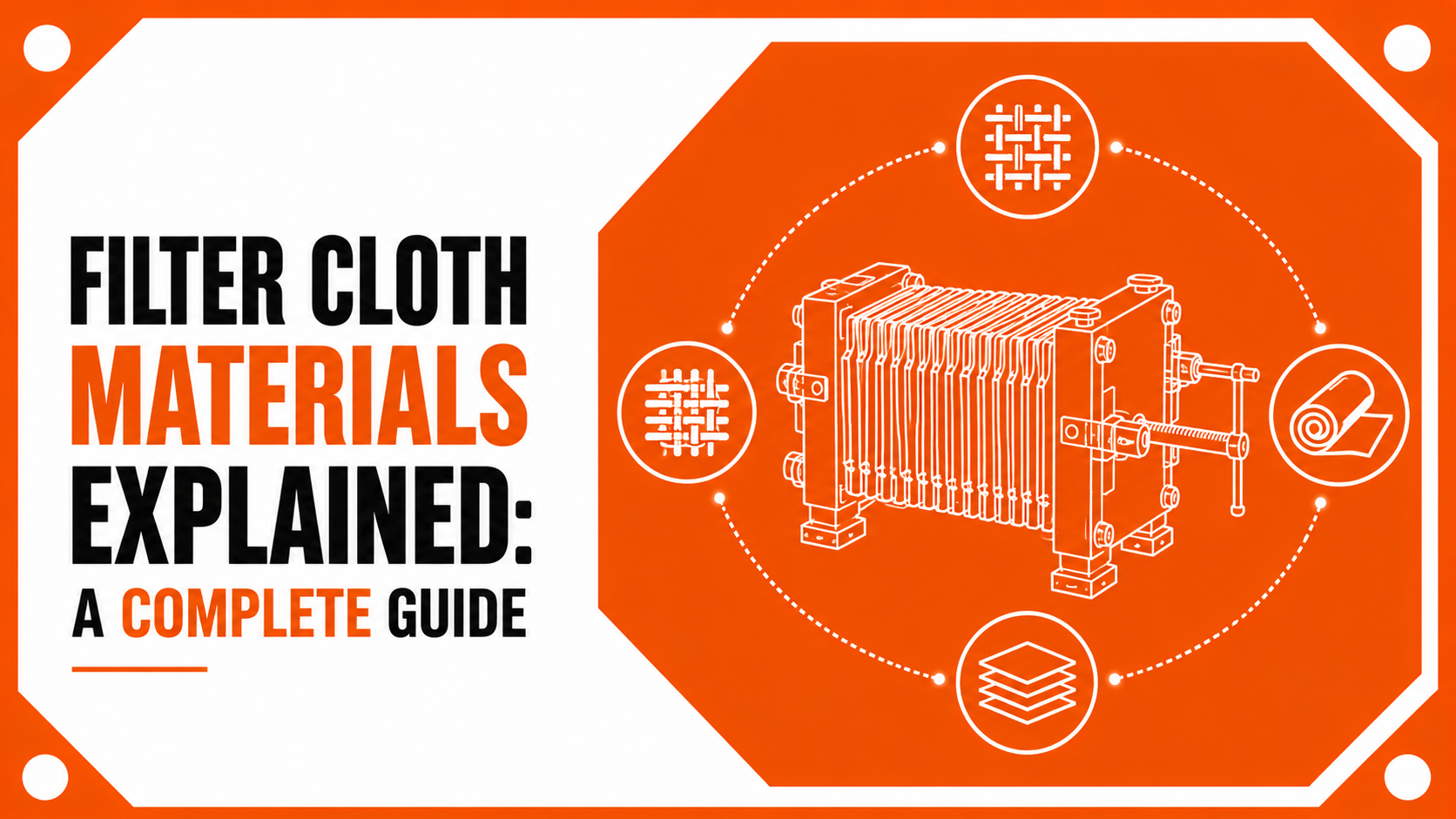
A filter press is only as effective as the filter cloth it uses. While the filter press provides the mechanical pressure required for solid-liquid separation, the filter cloth performs the actual filtration. Selecting the wrong cloth material can lead to poor filtration efficiency, lower product quality, longer filtration cycles, and increased maintenance costs.
Every industry has unique filtration requirements. A cloth suitable for pharmaceutical manufacturing may not perform well in mining, while wastewater treatment applications require different characteristics than food processing.
Understanding different filter cloth materials helps industries improve filtration performance, extend equipment life, and reduce operating costs.
In this guide, we’ll explain the most commonly used filter press cloth material types, their advantages, applications, and how to choose the right one for your process.
What Is a Filter Press Cloth?
A filter press cloth is a specially woven fabric installed between the filter plates and the slurry inside a filter press.
Its main functions are to:
- Retain solid particles
- Allow liquid to pass through
- Support filter cake formation
- Maintain filtration efficiency
- Improve product quality
The choice of cloth material directly affects filtration speed, clarity, cake release, and overall equipment performance.
Why Is Filter Cloth Material Important?
The correct filter cloth helps achieve:
- Faster filtration cycles
- Better filtrate clarity
- Higher solids recovery
- Reduced cloth clogging
- Easy cake release
- Longer cloth life
- Lower operating costs
Using the wrong material can result in premature wear, poor filtration performance, and increased downtime.
Common Filter Cloth Materials
Several materials are commonly used in industrial filter presses.
The most popular include:
- Polypropylene (PP)
- Polyester (PET)
- Nylon (Polyamide)
- Cotton
- Specialty Fabrics
Each material offers different properties depending on the process requirements.
1. Polypropylene (PP) Filter Cloth
Polypropylene is the most widely used filter cloth material in industrial filtration.
Key Features
- Excellent chemical resistance
- Lightweight
- Low moisture absorption
- High durability
- Cost-effective
- Good cake release
Best Applications
- Chemical Industry
- Pharmaceutical Industry
- Wastewater Treatment
- Mining
- Food Processing
- Electroplating
Advantages
- Resistant to acids and alkalis
- Long service life
- Suitable for a wide range of chemicals
- Excellent filtration performance
2. Polyester (PET) Filter Cloth
Polyester cloth offers excellent mechanical strength and dimensional stability.
Key Features
- High tensile strength
- Good abrasion resistance
- Excellent dimensional stability
- Good heat resistance
Best Applications
- Mining
- Cement Industry
- Ceramics
- Food Processing
- Industrial Sludge Dewatering
Advantages
- Strong fabric construction
- Long operational life
- Suitable for high-pressure filtration
3. Nylon (Polyamide) Filter Cloth
Nylon filter cloth provides excellent flexibility and wear resistance.
Key Features
- High abrasion resistance
- Excellent elasticity
- Smooth surface
- Good mechanical strength
Best Applications
- Mining
- Mineral Processing
- Heavy Industrial Filtration
Advantages
- Excellent durability
- Good cake release
- Long service life under abrasive conditions
4. Cotton Filter Cloth
Cotton remains useful in selected filtration applications.
Key Features
- Natural fiber
- Good permeability
- Suitable for moderate temperatures
Best Applications
- Food Industry
- Beverage Processing
- Specialty Filtration
Limitations
- Lower chemical resistance
- Shorter lifespan than synthetic fabrics
- Higher moisture absorption
5. Specialty Filter Cloths
Some industries require specially engineered filter fabrics.
Examples include:
- PTFE-coated cloth
- Antistatic cloth
- Heat-resistant fabrics
- Multi-layer woven cloths
- Custom composite materials
These are designed for demanding industrial environments where standard materials may not perform adequately.
Comparison of Filter Cloth Materials
| Material | Chemical Resistance | Abrasion Resistance | Temperature Resistance | Best Applications |
| Polypropylene | Excellent | Good | Moderate | Chemicals, Pharma, Wastewater |
| Polyester | Good | Excellent | High | Mining, Ceramics, Food |
| Nylon | Moderate | Excellent | Moderate | Mining, Heavy Industry |
| Cotton | Low | Moderate | Moderate | Food & Beverage |
| Specialty Fabrics | Excellent | Excellent | High | Customized Industrial Processes |
Factors to Consider When Choosing Filter Cloth Materials
Selecting the right filter cloth involves more than choosing a fabric type.
Slurry Characteristics
Evaluate:
- Particle size
- Solid concentration
- Viscosity
- Chemical composition
Chemical Compatibility
The cloth should resist degradation from acids, alkalis, solvents, and other process chemicals.
Operating Temperature
Higher temperatures require materials capable of maintaining strength and filtration performance.
Particle Retention
The pore size should match the filtration requirements without unnecessarily slowing filtration.
Cake Release
Efficient cake release reduces cleaning time and increases production efficiency.
Mechanical Strength
High-pressure applications require cloths with excellent tensile and abrasion resistance.
How Weave Pattern Affects Filtration
In addition to material selection, the weave pattern influences performance.
Common weave styles include:
Plain Weave
- Fine filtration
- High particle retention
- Good dimensional stability
Twill Weave
- Improved flexibility
- Better cake release
- Higher flow rates
Satin Weave
- Smooth surface
- Easy cleaning
- Excellent cake discharge
The ideal weave depends on the filtration process and product characteristics.
Industries Using Different Filter Cloth Materials
Filter cloths are used across numerous industries.
Pharmaceutical Industry
- API filtration
- Chemical intermediates
- Solvent recovery
Chemical Industry
- Pigments
- Fine chemicals
- Catalysts
- Specialty chemicals
Food & Beverage
- Sugar processing
- Beverage clarification
- Edible oils
- Starch production
Mining
- Mineral concentrates
- Tailings
- Ore processing
Wastewater Treatment
- Sludge dewatering
- Industrial effluent treatment
Textile Industry
- Dye recovery
- Process filtration
Signs Your Filter Cloth Needs Replacement
A worn filter cloth can reduce productivity and affect filtration quality.
Common signs include:
- Slow filtration
- Cloudy filtrate
- Frequent leakage
- Damaged fabric
- Poor cake release
- Excessive clogging
- Visible tears or abrasion
Routine inspection helps prevent unexpected downtime.
Filter Cloth Maintenance Tips
Proper maintenance significantly extends cloth life.
Daily
- Remove residual cake
- Wash cloth after use
- Inspect for damage
Weekly
- Check stitching
- Inspect sealing surfaces
- Clean clogged pores
Monthly
- Perform deep cleaning
- Replace damaged cloths
- Inspect plate alignment
Good maintenance improves filtration efficiency and reduces replacement costs.
Common Buying Mistakes
Avoid these mistakes when selecting filter cloths.
Choosing Based Only on Price
Low-cost cloths often wear out faster and reduce filtration efficiency.
Ignoring Chemical Compatibility
Incorrect material selection can result in premature failure.
Overlooking Temperature Requirements
High temperatures can damage unsuitable fabrics.
Selecting the Wrong Pore Size
Incorrect pore size affects filtration quality and production speed.
Ignoring Supplier Support
Technical guidance is valuable for selecting the correct cloth for specific applications.
Why Choose N.M. Patel & Co.?
With decades of experience in industrial filtration, N.M. Patel & Co. supplies high-quality filter press systems and filter cloth solutions for industries across India.
Our offerings include:
- Plate & Frame Filter Press
- Recessed Chamber Filter Press
- Membrane Filter Press
- Fully Automatic Filter Press
- Premium Filter Cloths
- Filter Press Spare Parts
- Customized Filtration Solutions
- Installation & Commissioning
- Preventive Maintenance
- Technical Support
As a trusted industrial filter cloth manufacturer India, we help customers select the most suitable filter cloth material based on slurry characteristics, operating conditions, and production goals. Our focus on quality, durability, and engineering expertise ensures reliable filtration performance across a wide range of industrial applications.
People Also Search For
- filter cloth materials
- filter press cloth material types
- industrial filter cloth manufacturer India
- polypropylene filter cloth
- polyester filter cloth
- filter press cloth selection
- industrial filtration cloth
- filter cloth supplier India
- filter press spare parts
- filtration media guide
People Also Ask
Which material is best for filter press cloth?
The best material depends on the application. Polypropylene is widely used because of its excellent chemical resistance, while polyester is preferred for high-strength applications and nylon performs well in abrasive environments.
How long does a filter press cloth last?
The lifespan depends on operating conditions, slurry composition, maintenance practices, and filtration pressure. Regular inspection and proper cleaning help maximize service life.
Why is polypropylene commonly used?
Polypropylene offers excellent resistance to chemicals, low moisture absorption, good durability, and cost-effective performance, making it suitable for many industrial filtration processes.
How do I choose the right filter cloth?
Consider slurry characteristics, particle size, chemical compatibility, temperature, operating pressure, and desired filtration performance before selecting a cloth material.
Why choose N.M. Patel & Co.?
N.M. Patel & Co. provides premium-quality filter press cloths, customized filtration solutions, engineering expertise, and dependable technical support to help industries achieve efficient and reliable filtration.
Frequently Asked Questions
Can the same filter cloth be used for all industries?
No. Different industries require different cloth materials based on chemical compatibility, operating conditions, and filtration requirements.
Does filter cloth affect filtration speed?
Yes. Fabric material, weave pattern, and pore size all influence flow rate, particle retention, and overall filtration efficiency.
How often should filter cloths be cleaned?
Cleaning frequency depends on the process. Regular cleaning after each filtration cycle helps prevent clogging and maintains consistent performance.
Can filter cloths be customized?
Yes. Filter cloths can be customized in terms of material, weave, pore size, dimensions, and stitching to match specific industrial applications.
Does N.M. Patel & Co. supply customized filter cloths?
Yes. N.M. Patel & Co. supplies customized filter cloths and complete filtration solutions tailored to individual process requirements and industry applications.
Conclusion
Selecting the right filter cloth material is just as important as choosing the right filter press. The appropriate cloth improves filtration efficiency, enhances product quality, extends equipment life, and reduces operating costs. Whether your process requires the chemical resistance of polypropylene, the strength of polyester, the abrasion resistance of nylon, or a specialized filtration fabric, matching the cloth to your application is essential for achieving consistent results.
At N.M. Patel & Co., we combine decades of filtration expertise with high-quality filter cloth manufacturing to help industries optimize their filtration processes. From selecting the ideal filter cloth material to providing complete filter press solutions and technical support, we are committed to delivering reliable, efficient, and long-lasting filtration systems for businesses across India.