






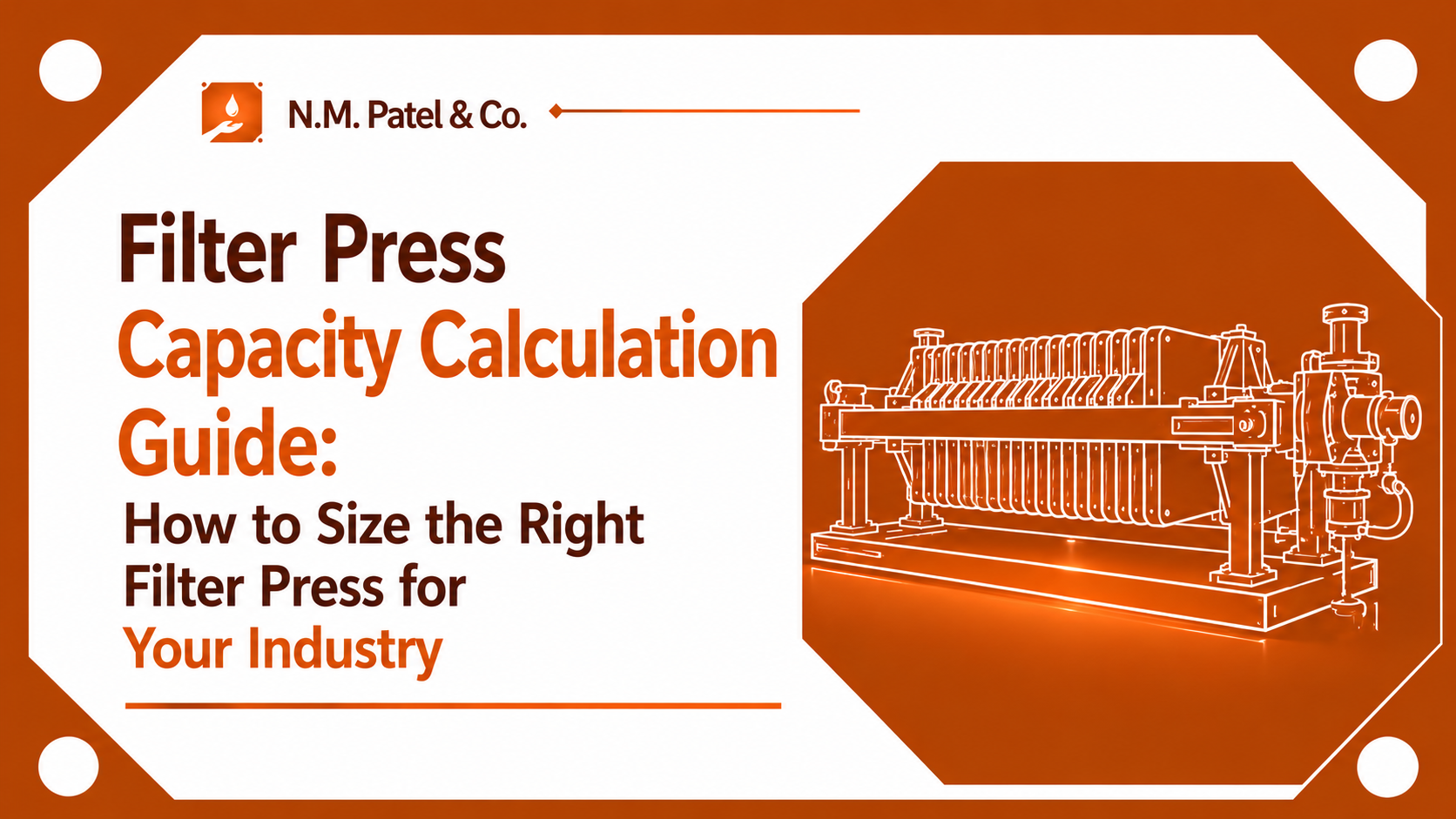
Selecting the correct filter press capacity is one of the most important decisions when designing or upgrading an industrial filtration system. An undersized filter press can create production bottlenecks, while an oversized machine increases capital investment and operating costs.
Proper sizing ensures consistent filtration performance, efficient cake formation, lower energy consumption, and maximum return on investment.
At N.M. Patel & Co., we help industries select the most suitable filter press through detailed process evaluation, slurry testing, and application engineering. Instead of relying on machine size alone, capacity calculations consider the complete filtration process to deliver the best long-term performance.
This guide explains the factors that influence filter press capacity, the basic calculation methods, and practical tips for selecting the right machine.
What Is Filter Press Capacity?
Filter press capacity refers to the amount of slurry a filter press can process within a specific period while producing the required filter cake dryness and filtrate quality.
Capacity is generally evaluated using:
- Slurry volume per batch
- Filtration cycle time
- Daily processing requirement
- Filter chamber volume
- Filtration area
- Cake discharge time
These parameters together determine the overall productivity of a filter press.
Why Capacity Calculation Is Important
Correct capacity calculation helps:
- Prevent production delays
- Improve filtration efficiency
- Reduce operating costs
- Optimize equipment investment
- Lower energy consumption
- Extend equipment life
- Improve cake dryness
- Increase plant productivity
A properly sized filter press supports both current production and future expansion.
Key Factors Affecting Filter Press Capacity
1. Slurry Characteristics
The properties of the slurry have the greatest impact on filtration performance.
Important characteristics include:
- Solid concentration
- Particle size
- Particle shape
- Slurry viscosity
- Temperature
- pH value
- Compressibility of solids
Even two plants processing similar materials may require different filter press sizes due to differences in slurry properties.
2. Filtration Area
The available filtration area directly affects processing capacity.
A larger filtration area allows:
- Higher throughput
- Faster filtration
- Greater solids handling
- Improved production efficiency
However, increasing filtration area beyond actual process requirements may not always improve overall performance.
3. Chamber Volume
Filter chamber volume determines how much solid material can accumulate during each filtration cycle.
Larger chamber volumes generally produce:
- Thicker filter cakes
- Longer filtration cycles
- Higher batch capacity
Selecting the correct chamber depth depends on process objectives and production requirements.
4. Cake Moisture Requirement
Applications requiring very dry filter cakes often need additional squeezing using membrane filter presses.
Lower cake moisture may increase cycle time but reduce disposal or drying costs.
Balancing these factors is an important part of capacity planning.
5. Filtration Pressure
Higher operating pressure can increase filtration efficiency for certain slurries.
However, excessive pressure may:
- Compress the cake excessively
- Reduce filtration speed
- Increase equipment wear
Proper pressure selection depends on laboratory slurry testing.
6. Cycle Time
Overall capacity depends on the complete filtration cycle, including:
- Plate closing
- Slurry filling
- Filtration
- Membrane squeezing (if applicable)
- Air blowing
- Plate opening
- Cake discharge
- Cloth cleaning
Reducing non-filtration time often provides significant productivity improvements.
Basic Filter Press Capacity Formula
A simplified way to estimate production capacity is:
Capacity = Chamber Volume × Number of Filtration Cycles per Day
In practice, engineers also evaluate:
- Daily slurry volume
- Solids concentration
- Required cake thickness
- Filtration rate
- Operating pressure
- Machine availability
- Downtime
- Future production growth
Because every application is unique, detailed engineering calculations provide the most accurate equipment selection.
Information Required Before Selecting a Filter Press
Before recommending a filter press, engineers typically collect:
- Slurry composition
- Percentage of solids
- Particle size distribution
- Daily production volume
- Required filtration time
- Desired cake moisture
- Required filtrate clarity
- Operating temperature
- Chemical compatibility
- Available installation space
Providing accurate process information results in better machine performance and lower operating costs.
Importance of Slurry Testing
Slurry testing is one of the most valuable steps in filter press selection.
Laboratory testing helps determine:
- Actual filtration rate
- Cake permeability
- Filter cloth selection
- Operating pressure
- Chamber depth
- Machine configuration
- Cycle time
- Expected production capacity
Rather than relying on assumptions, slurry testing ensures the equipment matches real operating conditions.
Common Mistakes in Capacity Selection
Many buyers make sizing decisions based only on production volume.
Common mistakes include:
- Ignoring slurry characteristics
- Selecting the lowest-cost machine
- Underestimating future expansion
- Choosing incorrect filter cloth
- Ignoring automation requirements
- Skipping slurry testing
- Overlooking maintenance accessibility
These mistakes often lead to reduced productivity and higher operating expenses.
Capacity Optimization Tips
To maximize filter press performance:
- Perform slurry testing before purchase
- Select the appropriate filter cloth
- Choose the correct chamber depth
- Optimize filtration pressure
- Automate repetitive operations
- Schedule preventive maintenance
- Monitor filtration cycles
- Replace worn filter cloths promptly
Small improvements in cycle efficiency can significantly increase annual production.
Industries That Require Accurate Capacity Calculations
Proper sizing is essential across many industries.
Chemical Industry
- Pigments
- Resins
- Specialty chemicals
Pharmaceutical Industry
- API production
- Fine chemicals
- Product recovery
Food Processing
- Sugar
- Edible oils
- Starch
- Beverage clarification
Mining & Minerals
- Tailings dewatering
- Mineral concentrates
- Metal recovery
Wastewater Treatment
- Industrial sludge
- Municipal sludge
- Effluent treatment
Ceramics & Pigments
- Clay processing
- Ceramic slurry
- Pigment manufacturing
Why Choose N.M. Patel & Co.?
For nearly 90 years, N.M. Patel & Co. has helped industries optimize filtration performance through customized engineering and application-specific filter press solutions.
Our capabilities include:
- Process Evaluation
- Slurry Sample Testing
- Capacity Calculations
- Custom Filter Press Design
- Recessed Chamber Filter Press
- Membrane Filter Press
- Plate & Frame Filter Press
- Automatic Filter Press Systems
- Filter Plates
- Filter Cloths
- Installation & Technical Support
Every recommendation is based on process data, ensuring customers receive the most efficient filtration solution for their application.
Why Industries Trust N.M. Patel & Co.
Customers choose us because of our:
- Nearly 90 years of filtration expertise
- 12,000+ successful installations
- Experienced application engineers
- Customized equipment design
- Modern manufacturing facilities
- Advanced automation options
- Comprehensive after-sales support
- Reliable spare parts availability
Our engineering-first approach helps customers maximize productivity while minimizing lifecycle costs.
People Also Search For
- filter press capacity calculation guide
- filter press sizing calculation
- filter press capacity formula
- filter press design calculation
- industrial filter press sizing
- filter press selection guide
- sludge dewatering calculation
- membrane filter press sizing
- filtration area calculation
- filter press engineering
People Also Ask
How is filter press capacity calculated?
Filter press capacity is determined using chamber volume, filtration area, slurry characteristics, filtration cycle time, solids concentration, and daily processing requirements. Laboratory slurry testing provides the most accurate sizing information.
Why is slurry testing important?
Slurry testing identifies filtration characteristics such as cake permeability, filtration rate, operating pressure, and suitable filter cloth selection, ensuring accurate equipment sizing.
Can one filter press handle multiple products?
Yes. With proper engineering and suitable filter cloth selection, a filter press can often process multiple slurry types, although operating conditions may require adjustment.
Does automation increase filter press capacity?
Automation reduces non-filtration time by speeding up plate opening, cake discharge, cloth washing, and system operation, increasing overall daily productivity.
Why choose N.M. Patel & Co.?
N.M. Patel & Co. combines decades of engineering expertise, slurry testing, customized equipment design, and complete filtration solutions to help industries achieve maximum filtration efficiency.
Frequently Asked Questions
How do I know which filter press size is right for my plant?
The correct size depends on slurry properties, daily production, required cake dryness, filtration time, and available installation space. Engineering calculations and slurry testing provide the most accurate recommendation.
Is a larger filter press always better?
No. Oversized machines increase investment and may operate inefficiently. Proper sizing balances production requirements with operating efficiency.
How can I increase filter press productivity?
Improve cycle efficiency through automation, optimized operating pressure, proper filter cloth selection, preventive maintenance, and regular performance monitoring.
Does N.M. Patel & Co. provide slurry testing?
Yes. N.M. Patel & Co. offers slurry sample evaluation and engineering support to recommend the most suitable filter press configuration for each application.
Can N.M. Patel & Co. customize filter press designs?
Absolutely. Machines can be customized based on filtration capacity, chamber size, plate configuration, automation level, operating pressure, and specific industry requirements.
Conclusion
Accurate filter press capacity calculation is essential for achieving efficient solid-liquid separation, reducing operating costs, and ensuring long-term equipment performance. Instead of relying solely on production volume, businesses should evaluate slurry properties, filtration area, cycle time, chamber volume, and process requirements before selecting a machine.
With nearly 90 years of filtration expertise, 12,000+ successful installations, and comprehensive engineering support—including slurry testing and customized equipment design—N.M. Patel & Co. helps industries choose the right filter press solution for maximum productivity, reliability, and return on investment.