





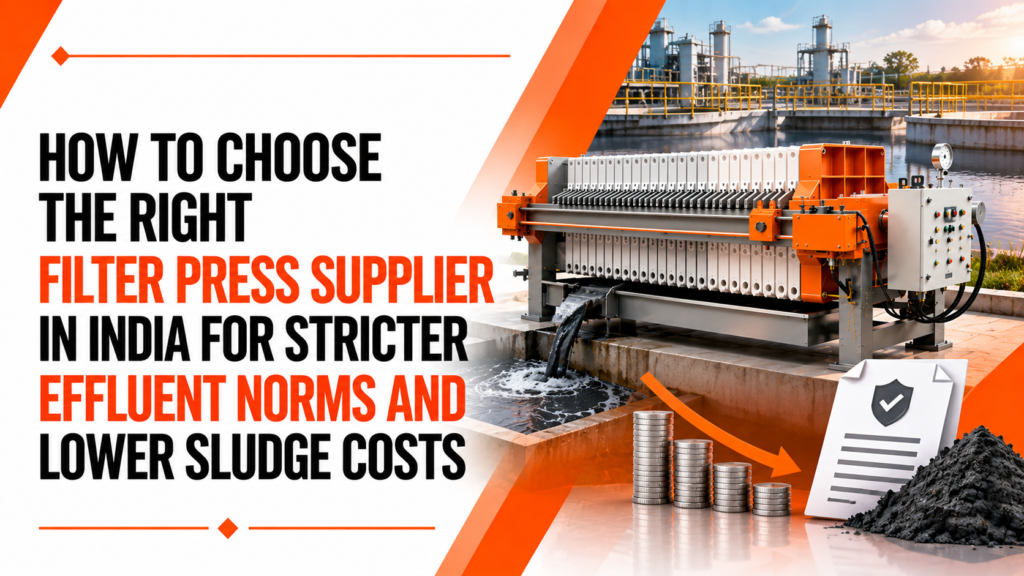
The right filter press supplier in India has four traits. It sizes your press from real slurry test data. It recommends the plate type your sludge actually needs. It matches automation to your shift pattern and labour costs. And it keeps spares and service engineers close enough to fix a breakdown in days, not weeks. If a supplier quotes a price without asking about your slurry, solids percentage and daily volume, keep looking.
Quick takeaways
- Ask for a slurry or lab filtration test before you accept any quote.
- Membrane presses cost more upfront but usually give drier cake and lower disposal costs.
- Automation pays back fastest in plants that run multiple shifts.
- Local spares availability matters as much as the machine price.
Why Choosing a Supplier Is Harder in 2026
Indian plants face more pressure on wastewater than ever. Pollution control boards are pushing many sectors, including textiles, chemicals, pharma and food processing, toward tighter discharge limits and Zero Liquid Discharge (ZLD). Landfills charge by weight, so wet sludge costs more to dispose of. And skilled operators are harder to keep.
So a filter press has become a compliance and cost decision, not just a piece of equipment. The supplier you pick decides how dry your cake gets, how much labour each cycle takes, and how much downtime you face.
The 7-Point Checklist for Evaluating Filter Press Suppliers in India
Work through these steps in order. Each one filters out suppliers who sell machines instead of solutions.
- Ask for slurry testing. A serious supplier will want a sample, or at least your solids concentration, particle size, pH and temperature. Sizing without this data leads to undersized presses and long cycle times.
- Check plate options. Your supplier should offer recessed chamber and membrane plates, and explain which suits your sludge. Polypropylene plates suit most corrosive and high-temperature applications.
- Match automation to your operation. Manual presses suit small batches. Hydraulic presses with automatic plate shifting suit medium volumes. Fully automatic systems with cloth washing suit continuous, high-volume plants.
- Review filter cloth expertise. The wrong cloth blinds quickly and ruins filtration rates. Ask which cloth material and weave they recommend, and why.
- Verify after-sales support. Ask where spares are stocked, the typical engineer response time, and whether they train your operators.
- Ask for references in your industry. A press that works for a ceramics unit may struggle with oily effluent. Ask to speak with a customer whose sludge resembles yours.
- Compare total cost of ownership. Add cloth replacement, power, labour, maintenance and sludge disposal to the purchase price. The cheapest press often costs the most over five years.
Filter Press Types Compared
Picking the right range of filter press models starts with understanding how each design performs.
| Filter Press Type | Best For | Cake Dryness | Upfront Cost | Labour Need |
| Plate and frame | Small batches, fine clarification, pharma | Moderate | Low | High |
| Recessed chamber | General effluent treatment, chemicals, mining | Good | Medium | Medium |
| Membrane (squeeze) | High-volume sludge, costly disposal, ZLD plants | Highest | High | Low to medium |
| Fully automatic | Continuous multi-shift operations | Depends on plate type | Highest | Lowest |
If disposal costs are a major line in your budget, a membrane filter press often justifies its higher price. The squeeze stage pushes out extra moisture after filling, so each tonne of cake carries less water to the landfill.
A Simple Supplier Scorecard You Can Use Today
Here’s a scoring method our team recommends to buyers. Rate each shortlisted supplier from 1 to 5 on every factor, then multiply by the weight.
| Factor | Weight | Why It Matters |
| Slurry testing and sizing | 25% | Prevents undersized or oversized presses |
| After-sales service and spares | 25% | Downtime costs more than the machine |
| Build quality and plate material | 20% | Decides lifespan and leak resistance |
| Industry references | 15% | Proves real-world performance |
| Price and payment terms | 15% | Important, but not the deciding factor |
A supplier scoring above 4 overall is usually a safe choice. Price sits last on purpose. Buyers who rank it first often end up replacing plates, cloths or hydraulics within two years.
Red Flags When Comparing Filter Press Supplier India Quotes
Walk away, or ask hard questions, if you notice any of these:
- The quote arrives within hours with no questions about your process.
- The supplier offers a single plate type for every application.
- Plate thickness, material grade and hydraulic pressure aren’t stated in writing.
- There’s no clear warranty on plates and the hydraulic power pack.
- Spares must be imported for every replacement.
A Real-World Example
Consider a mid-sized dyeing unit in Gujarat processing about 40 cubic metres of effluent sludge per day. Its old manual press needed two operators per shift, and wet cake drove up disposal bills. After a slurry test, switching to an automatic membrane press would cut operator hours, reduce cake moisture and shrink the volume trucked away each week. The higher machine cost would be balanced by lower running costs. This is the trade-off every buyer should calculate before signing a purchase order.
What Makes a Supplier a Long-Term Partner
The best suppliers think beyond the sale. They help with plant layout, recommend feed pumps and conditioning chemicals, and check in after commissioning. Look for a manufacturer that designs and fabricates in India, follows recognised quality standards, and can share inspection reports before dispatch. Manufacturing locally keeps lead times short and spares affordable.
Frequently Asked Questions
How do I find a reliable filter press supplier in India?
Shortlist manufacturers with industry references, ask each for slurry testing, and compare written specifications and after-sales terms side by side using a weighted scorecard.
What is the price of a filter press in India?
Price depends on plate size, number of plates, plate type, automation level and material of construction. A small manual press costs far less than a fully automatic membrane system. Always request a quote based on your actual slurry data.
Which is better, a membrane or a recessed filter press?
Membrane presses give drier cake and suit high disposal costs or ZLD targets. Recessed chamber presses are more economical for general effluent treatment with moderate dryness needs.
How long does a filter press last?
With good maintenance, the press frame can last many years. Plates and cloths are consumables. Their life depends on chemistry, temperature and how carefully the press is operated.
Can a filter press help with ZLD compliance?
Yes. A filter press removes suspended solids and dewaters sludge, which makes it a core stage in many ZLD and effluent treatment systems.
Get Your Filter Press Sized Correctly
A filter press is a long-term investment in compliance and operating cost. Share your slurry details with N M Patel & Co., and our engineers will recommend the right press size, plate type and automation level for your plant. Request a quote from our team and get a proposal built around your process, not a generic price list.