





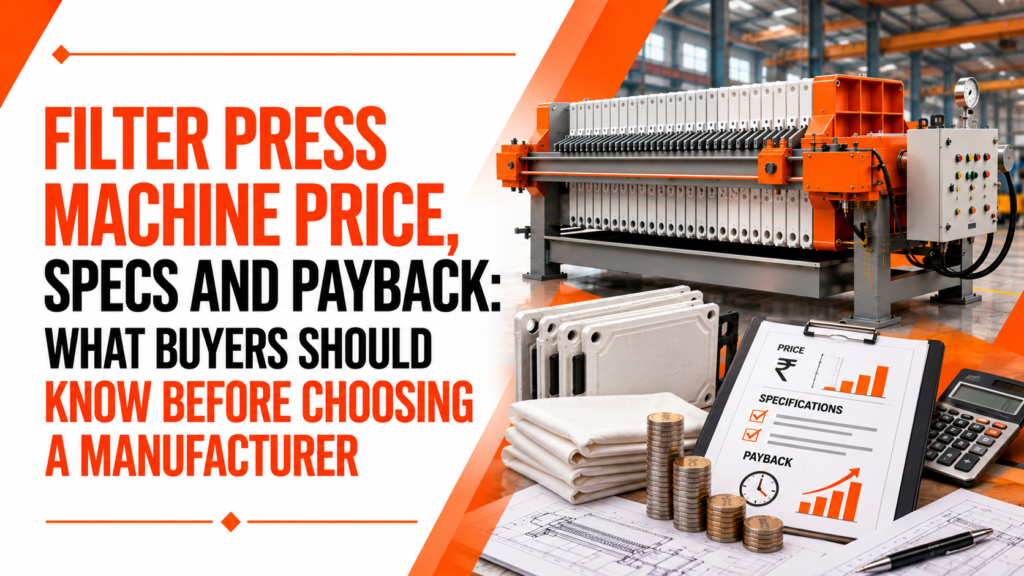
The price of a filter press machine depends on five factors:
- Plate size
- Number of plates
- Plate type (recessed or membrane)
- Automation level
- Material of construction
Any experienced filter press machine manufacturer in India will quote against these factors after reviewing your slurry data. Two machines with the same plate count can differ widely in price. The real question is not “what does it cost” but “what will it save over five years.”
At a glance
- Plate size and plate count set the base price.
- Membrane plates and full automation add the most cost, and also the most savings.
- A spec sheet tells you more about value than the headline price.
- Automatic presses in multi-shift plants often pay back within a few years.
How a Filter Press Machine Works in Five Steps
Knowing the cycle helps you understand where your money goes.
- Closing. A hydraulic cylinder presses the plate pack together and locks it.
- Filling. A feed pump pushes slurry into the chambers between the plates.
- Filtration. Liquid passes through the filter cloths and drains away as clear filtrate, while solids build up as cake.
- Squeezing (membrane presses only). The membranes inflate to press extra water out of the cake.
- Discharge. The press opens, plates shift, and the dry cake drops into a tray, bin or conveyor.
Each step can be manual or automated, and that choice drives a large share of the price.
What Drives Filter Press Machine Price
| Cost Driver | Options | Impact on Price |
| Plate size | Smaller lab and pilot sizes up to large industrial plates | High |
| Number of plates | Set by daily sludge volume and cycle time | High |
| Plate type | Recessed chamber, membrane, plate and frame | Medium to high |
| Automation | Manual, hydraulic, semi-automatic, fully automatic | High |
| Construction | Mild steel with coating, SS cladding, full stainless steel | Medium |
| Accessories | Feed pump, drip trays, cloth washing, cake conveyor | Low to medium |
The table shows why one price list can’t serve every buyer. A pigment plant and a municipal ETP may need presses of similar size with very different configurations.
How to Read a Filter Press Spec Sheet
When filter press machine manufacturers in India send a proposal, compare these figures side by side. Don’t stop at the total price.
| Spec | What It Means | What to Watch |
| Plate size | Plate dimensions, such as 630, 800, 1000 or 1200 mm | Larger plates mean fewer plates for the same area |
| Filtration area | Total cloth surface in square metres | Should match your daily solids load |
| Chamber volume | Total cake capacity per cycle | Decides how much sludge one cycle handles |
| Cake thickness | Depth of each cake | Thicker cakes take longer to filter |
| Feed pressure | Pressure at which slurry enters | Must suit plate rating and pump choice |
| Hydraulic closing | How the press locks | Look for automatic pressure holding |
| Plate material | Usually polypropylene | Confirm virgin PP and rated temperature |
If two quotes list very different filtration areas for the same duty, ask each manufacturer to explain its sizing. That one question often reveals which supplier tested your slurry and which one guessed.
A Worked Payback Example
Here’s how to estimate return on an automatic membrane press compared with a manual recessed press. The figures below are assumptions for illustration only. Replace them with your plant’s real numbers.
Labour savings. A manual press needs two operators per shift; an automatic press needs one. Across three shifts, that frees three positions. At an assumed ₹2.5 lakh per operator per year, the saving is ₹7.5 lakh a year.
Disposal savings. The plant produces 10 tonnes of cake a day and runs 300 days a year, which comes to 3,000 tonnes. Suppose the membrane squeeze cuts cake weight by 15 percent. That removes 450 tonnes, and at an assumed ₹2,000 per tonne, the saving is ₹9 lakh a year.
Total and payback. Combined savings come to about ₹16.5 lakh a year. If the automatic membrane press costs ₹25 lakh more than the manual option, payback is roughly 18 months.
The formula:
Payback (years) = Extra machine cost ÷ (Annual labour savings + Annual disposal savings)
Fewer cloth replacements and less downtime usually shorten payback further, though they are harder to estimate upfront.
Upgrade or Replace? A 2026 Question
With labour costs rising and effluent norms tightening, many plants are asking whether to buy a new press or modernise their existing one. A sound frame can often accept automatic plate shifters, a new hydraulic power pack, PLC controls or membrane plate conversion. Replacement makes more sense in three cases:
- The frame is corroded or bent.
- Daily volume has outgrown the press.
- Your new sludge needs a different plate size.
A good manufacturer will assess both options honestly instead of pushing a new machine every time.
Where Low-Priced Machines Cut Corners
A quote far below the others usually hides savings in places you won’t see on day one:
- Recycled or blended plate material that warps under heat and pressure.
- Thin frame sections that flex as closing force builds.
- Basic hydraulics without pressure holding, which keep the pump running constantly.
- No hydro test or trial run before dispatch.
- Cloths chosen on price rather than on your particle size.
Any one of these can wipe out the upfront saving within the first year of operation.
Frequently Asked Questions
What is the price of a filter press machine in India?
It depends on plate size, plate count, plate type, automation and construction material. Share your sludge volume and solids percentage with a manufacturer for an accurate quote.
Which filter press machine is best for wastewater treatment?
For high sludge volumes and costly disposal, a membrane press usually gives the best long-term value. Smaller ETPs with moderate volumes often do well with a recessed chamber press.
Can I automate my existing filter press machine?
Often yes. Automatic plate shifters, PLC controls and cloth washing can be retrofitted if the frame and plates are in good condition.
How do I choose between filter press machine manufacturers in India?
Compare spec sheets line by line, ask how each one sized your press, check test reports, and confirm spares and service support near your plant.
Get a Quote Built on Your Numbers
A filter press machine should be priced on your process, not a generic list. N M Patel & Co. engineers can review your slurry details, compare manual and automatic options, and show you the expected payback for your plant. Explore our filter press machine range or request a costed proposal from our team.