





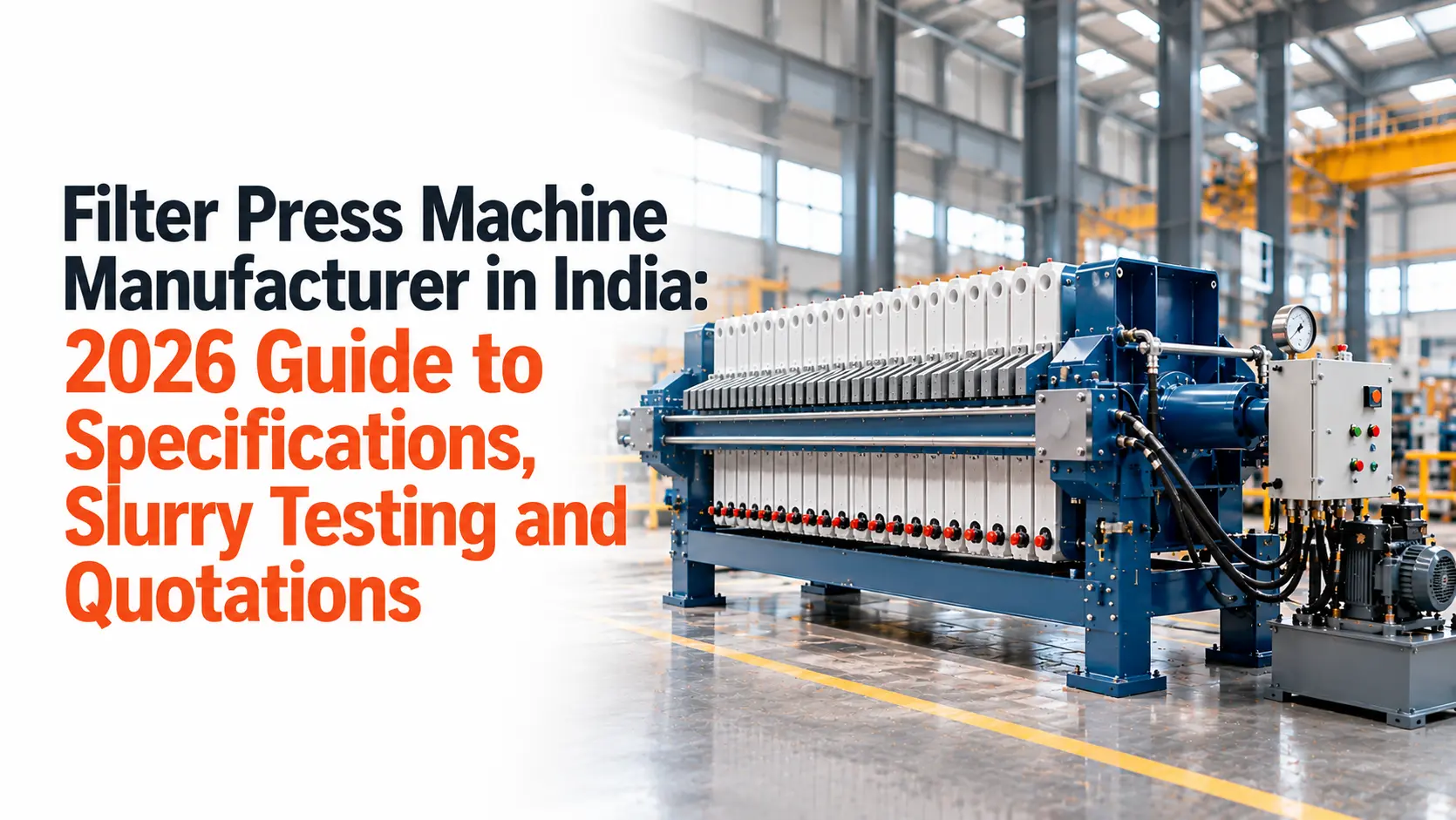
Searching for a filter press machine manufacturer in India? The most important step is not comparing machine prices immediately. It is defining the filtration requirements that determine equipment size, performance, operating cost, and long-term reliability.
A filter press separates suspended solids from liquids using pressure filtration. Industrial buyers commonly use these machines for wastewater treatment, chemical manufacturing, mining, pharmaceuticals, and other solid-liquid separation applications.
N.M. Patel & Co., based in Bilimora, Gujarat, manufactures industrial filter press systems and related filtration equipment. Established in 1935, the company reports more than 12,000 installations across its operating history.
This guide explains the specifications buyers should prepare, how to compare equipment, and what to include when requesting a filter press quotation.
Quick Answer: What Should You Check Before Buying a Filter Press?
Before contacting a filter press machine manufacturer, prepare the following information:
- Slurry composition and percentage of solids
- Required daily filtration capacity
- Target filter cake moisture
- Operating temperature and chemical compatibility
- Available installation space
- Desired automation level
- Required filtrate quality
- Operating hours and filtration cycle requirements
These details help engineers determine a suitable equipment configuration.
Buyers can explore the industrial filter press machine product range offered by N.M. Patel & Co. before discussing their applications.
How Does a Filter Press Machine Work?
A filter press uses a series of filter plates and filter media to separate solids from liquids.
The filtration process generally involves five stages.
1. Plate closing: The plate pack is secured using the machine’s closing mechanism.
2. Slurry feeding: A suitable pump introduces slurry into the filtration chambers.
3. Pressure filtration: Liquid passes through the filter cloth while retained solids accumulate inside the chambers.
4. Cake formation: Solid material progressively forms a filter cake as the filtration cycle continues.
5. Cake discharge: The machine opens after appropriate depressurization, allowing the retained solids to be removed.
Cycle times and filtration performance depend on slurry properties, available filtration area, pressure, cloth selection, and process conditions.
Filter Press Machine Specifications: What Buyers Must Compare
N.M. Patel & Co. publishes filtration equipment covering areas from 1 m² to 350 m², with listed operating pressures up to 25 bar across its range.
These are portfolio-level figures, not specifications applicable to every model.
| Specification | Why it matters |
| Filtration area | Influences available filtering surface and capacity |
| Chamber volume | Determines potential solids retention per cycle |
| Operating pressure | Must suit the slurry and equipment design |
| Plate material | Affects chemical and temperature compatibility |
| Filter cloth | Influences particle retention, resistance and cake release |
| Automation | Determines operator involvement |
| Feed pump | Affects slurry delivery and cycle control |
| Cake discharge | Influences handling requirements and turnaround time |
A properly specified machine should balance filtration throughput with cake dryness, operating efficiency, and maintenance needs.
Which Filter Press Configuration Should You Choose?
Different processes require different filter press configurations.
| Machine configuration | Common buying consideration |
| Recessed chamber filter press | General industrial solid-liquid separation |
| Membrane filter press | Applications requiring additional cake squeezing |
| Plate and frame filter press | Processes needing a plate-and-frame configuration |
| Semi-automatic filter press | Reduced manual effort for selected operations |
| Fully automatic filter press | Repetitive cycles with greater automation |
| Stainless steel filter press | Specific hygiene or material compatibility requirements |
| CGR filter press | Applications requiring improved sealing arrangements |
When Is a Membrane Filter Press Worth Considering?
A membrane filter press incorporates flexible membranes that compress the filter cake after initial filtration.
This additional squeezing stage may reduce residual cake moisture for suitable materials.
It can be useful where cake dryness influences disposal, transport, or downstream processing costs.
However, the achievable improvement depends on the slurry and operating conditions.
Review N.M. Patel & Co.’s membrane filter press solutions when evaluating applications with demanding cake moisture requirements.
Why Slurry Testing Matters Before Purchasing
One of the most useful ways to reduce equipment selection risk is to test representative slurry samples.
Two slurries with similar solids concentrations can behave differently during filtration because of particle size, compressibility, viscosity, and chemical composition.
What Can Slurry Testing Reveal?
Testing can help evaluate:
- Filtration rate
- Cake formation characteristics
- Residual cake moisture
- Filtrate clarity
- Cloth compatibility
- Filtration resistance
- Expected process performance
For example, fine, compressible solids may require a different filtration strategy from coarse mineral particles.
N.M. Patel & Co. offers industrial slurry sample testing to assess filtration behavior and support filter press, filter plate, and cloth selection.
Its published testing service includes recommendations for equipment configuration and estimated filtration performance.
Actual results should be established through representative testing rather than assumed from generic equipment ratings.
Filter Press Machine Manufacturers India: How to Compare Quotations
When evaluating filter press machine manufacturers in India, the lowest initial quotation may not represent the lowest total ownership cost.
Consider the following comparison.
| Quotation item | What to verify |
| Machine configuration | Manual, semi-automatic or automatic |
| Filter plates | Quantity, material and dimensions |
| Filter cloth | Material, specification and replacement availability |
| Feed system | Whether the pump is included |
| Automation | Included control functions and accessories |
| Installation | Supervision, commissioning and site responsibilities |
| Warranty | Coverage, exclusions and duration |
| Delivery | Manufacturing lead time and transport arrangements |
A quotation should clearly identify which components are included and which are optional.
Consider Total Cost of Ownership
Beyond the machine’s purchase price, evaluate electricity consumption, operator time, maintenance, filter cloth replacement, downtime, and cake disposal costs.
For a plant operating multiple cycles daily, even modest improvements in cycle duration or handling efficiency may influence long-term economics.
The savings must be calculated using actual plant data, not generalized claims.
Applications of Industrial Filter Press Machines in India
Filter presses support solid-liquid separation across different industrial sectors.
Wastewater and effluent treatment: Dewatering suitable sludge and reducing the volume of material requiring handling.
Chemical manufacturing: Separating process solids from liquid streams.
Mining and mineral processing: Recovering solids and managing process water.
Pharmaceutical manufacturing: Supporting selected filtration processes using appropriately specified equipment.
Food processing: Separating solids and liquids where materials and equipment meet applicable process requirements.
Dyes and pigments: Handling process slurries containing suspended particles.
Each application requires its own engineering assessment.
Why Consider N.M. Patel & Co.?
N.M. Patel & Co. is an established filter press machine manufacturer in India, headquartered in Bilimora, Gujarat.
Its published capabilities include:
- Manual and automated filter presses
- Recessed chamber and membrane systems
- High-pressure filtration equipment
- Filter plates and filtration cloth
- Automation and auxiliary systems
- Slurry sample testing
- Pilot filter press testing
- Filter press refurbishment
- Installation and commissioning assistance
The company reports a manufacturing history dating to 1935 and more than 12,000 installations.
For buyers, the practical advantage of an application-focused manufacturer is the ability to evaluate machine specifications alongside the slurry characteristics and required process performance.
How to Request an Accurate Filter Press Machine Quotation
Before requesting pricing, prepare a short technical specification.
Include your industry, slurry type, solids concentration, processing capacity, target cake dryness, operating temperature, and available plant utilities.
If you have existing filtration equipment, include current cycle times and operating problems.
These details help the manufacturer evaluate an appropriate configuration.
Contact N.M. Patel & Co.:
Location: Chimodia Naka, Near Railway Crossing, Bilimora, Gujarat 396321, India
Phone: +91 98250 84945 / +91 96241 85365
Email: nmp_ma_meera@yahoo.com
Contact N.M. Patel & Co. for a filter press quotation and discuss your industrial filtration requirements.
Frequently Asked Questions
1. Who is a filter press machine manufacturer in India?
N.M. Patel & Co. is a Gujarat-based manufacturer offering industrial filter presses, filtration plates, cloths, and related equipment.
2. What is the price of a filter press machine in India?
Pricing depends on filtration area, chamber volume, material, automation, accessories, and application requirements. Request a model-specific quotation.
3. Which filter press is suitable for industrial sludge dewatering?
Recessed chamber, membrane, and automated filter presses may be suitable, depending on sludge properties and the required cake moisture level.
4. What is the difference between a membrane and recessed chamber filter press?
A recessed chamber press relies on pressure filtration. A membrane press adds a squeezing stage that can further compress suitable filter cakes.
5. Can a filter press be customized for a specific application?
Yes. N.M. Patel & Co. publishes customized engineering and slurry testing services to support application-specific filtration configurations.
6. Why is filter cloth selection important?
Cloth selection affects particle retention, filtrate clarity, filtration resistance, cake release, and operating performance.
7. Does N.M. Patel & Co. provide slurry testing?
Yes. The company offers laboratory slurry testing and publishes information about pilot filtration testing.
Conclusion
Choosing a filter press machine manufacturer in India requires more than comparing machine prices or installation capacity.
Filtration area, slurry characteristics, pressure, automation, filter cloth compatibility, and cake moisture requirements all influence long-term performance.
N.M. Patel & Co. offers industrial filter press equipment and application-focused filtration services for businesses evaluating new or existing systems.
For a suitable machine recommendation, share your slurry specifications and required filtration capacity with N.M. Patel & Co. and request a technical quotation.