





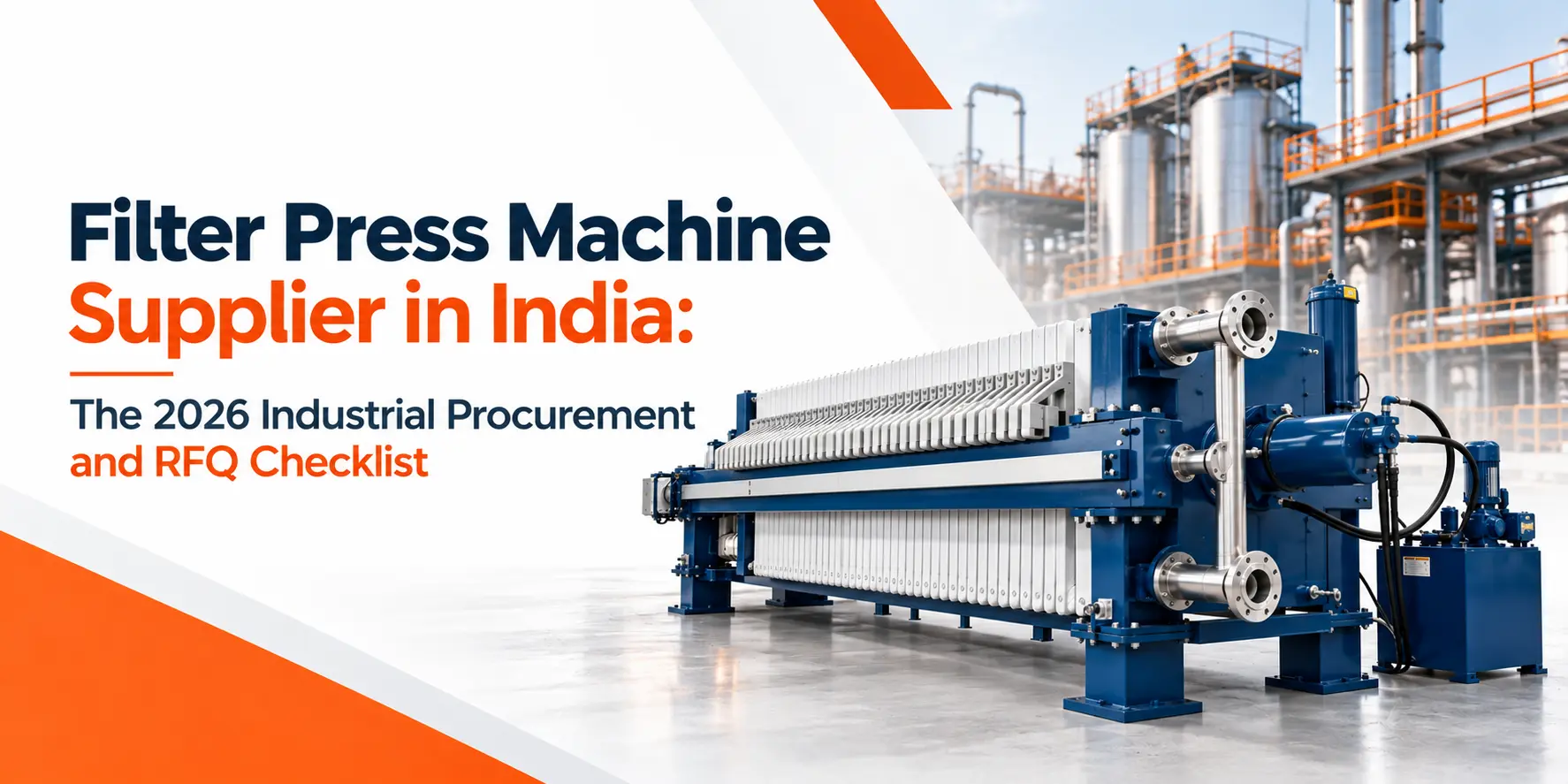
Choosing the right filter press machine supplier starts with understanding your filtration requirements, not comparing machine prices alone. Industrial buyers should evaluate slurry characteristics, filtration capacity, cake moisture requirements, plate materials, automation, and technical support before requesting a quotation.
A reliable filter press equipment manufacturer should help determine whether the proposed equipment can handle the intended process under actual operating conditions.
For procurement teams sourcing equipment in India, the following checklist explains what to verify, which documents to request, and how to reduce purchasing risks.
What Should You Check Before Contacting a Filter Press Machine Supplier?
Before approaching a supplier, prepare basic process information.
The most important requirements are:
- Slurry composition and solids concentration
- Required processing capacity per hour or day
- Operating temperature and chemical characteristics
- Desired filter cake moisture content
- Required filtrate quality
- Available installation space
- Preferred automation level
- Expected operating hours
These details allow suppliers to evaluate filtration requirements accurately.
For example, two factories processing similar daily slurry volumes may require different filter presses because their particle characteristics, solids concentrations, and operating schedules differ.
The correct equipment should be selected using process conditions rather than capacity estimates alone.
Filter Press Equipment Manufacturer: Understanding the Available Technologies
Industrial filter presses are available in different configurations. Each design addresses particular filtration requirements.
N.M. Patel & Co., a filter press manufacturer based in Bilimora, Gujarat, offers recessed, membrane, plate and frame, manual, semi-automatic, fully automatic, and specialized filter press systems.
Buyers can explore the company’s industrial filter press product range to identify potential configurations.
Filter Press Technology Comparison
| Filter press type | Main application consideration | Purchasing priority |
| Recessed chamber | General solid-liquid separation | Cake formation and filtration area |
| Membrane | Additional cake dewatering | Cake dryness and cycle efficiency |
| Plate and frame | Application-specific filtration | Chamber configuration |
| Semi-automatic | Partial mechanization | Operator requirements |
| Fully automatic | Repetitive industrial filtration | Automation and maintenance |
| Stainless steel | Selected chemical or hygienic processes | Material compatibility |
This comparison is a starting point. Final equipment selection should be based on technical assessment and, where necessary, filtration trials.
The 2026 Procurement Trend: Evaluate Operating Cost, Not Just Machine Price
Industrial procurement is increasingly focused on equipment performance across its working life.
For filter press purchases, the lowest quotation does not necessarily represent the lowest total ownership cost.
A cheaper machine may involve longer filtration cycles, additional manual work, more frequent cloth replacement, or higher maintenance requirements.
Buyers should compare:
- Initial machine and installation cost
- Filter cloth and plate replacement requirements
- Energy consumption during operation
- Expected maintenance and servicing
- Operator involvement per filtration cycle
- Filter cake handling and disposal costs
A useful purchasing metric is the total cost per unit of dry solids processed.
This helps compare alternatives that differ in throughput, energy consumption, and cake moisture.
Actual savings depend on the application and should be verified rather than assumed.
When Should You Choose a Membrane Filter Press?
Membrane filter presses are worth evaluating when reduced residual cake moisture is a significant operating requirement.
After conventional pressure filtration, flexible membrane plates apply additional squeezing force to the filter cake.
This can remove more liquid and improve dewatering performance in suitable applications.
N.M. Patel & Co. offers membrane filter press systems for industrial processes requiring additional cake squeezing.
However, membrane technology is not automatically the best option for every slurry.
The potential benefit should be evaluated against equipment cost, cycle time, slurry properties, and disposal requirements.
Why Slurry Testing Matters Before Selecting Equipment
A common procurement mistake is selecting a filter press based only on machine dimensions or advertised capacity.
Filtration behavior depends heavily on the material being processed.
Slurries containing fine particles can behave differently from those containing larger, more permeable solids.
Chemical composition, viscosity, and operating temperature may also affect equipment and filter media selection.
What Can a Filtration Trial Help Establish?
A properly designed trial may help determine:
- Filtration rate under tested conditions
- Cake formation characteristics
- Approximate cycle duration
- Filtrate clarity
- Achievable cake moisture
- Suitable filter media
N.M. Patel & Co. provides slurry sample testing services to support the evaluation of filtration requirements.
For critical applications, buyers should agree on representative samples and measurable acceptance criteria before proceeding with equipment selection.
Filter Press Machine Supplier India: The Essential RFQ Checklist
A well-prepared request for quotation helps manufacturers recommend more suitable equipment and reduces delays caused by missing technical information.
| RFQ requirement | Information to provide |
| Industry and application | Chemical, mining, wastewater, food processing, or other process |
| Slurry description | Material composition and particle characteristics |
| Solids concentration | Measured percentage with basis specified |
| Processing capacity | Required volume or mass per hour or batch |
| Operating conditions | Temperature, pressure constraints, and chemical compatibility |
| Cake requirements | Target moisture and disposal or recovery objectives |
| Automation | Manual, semi-automatic, or fully automatic |
| Utilities | Available electrical, hydraulic, pneumatic, and wash-water services |
| Installation | Space limitations and site location |
| Commercial requirements | Delivery expectations, documentation, testing, and support |
Buyers should also request clarity on what is included in the quotation.
For example, pumps, piping, control panels, discharge arrangements, installation supervision, and commissioning assistance may need to be itemized separately.
This creates a more accurate comparison between proposals.
How to Evaluate an Industrial Filter Press Supplier for Indian and International Projects
Domestic procurement and international equipment sourcing share many requirements, but logistics and documentation may differ.
For projects outside India, buyers should confirm transportation arrangements, relevant standards, installation responsibilities, spare parts access, and after-sales coordination.
Supplier evaluations should consider four factors.
1. Manufacturing Experience
Review the supplier’s established product range, engineering capabilities, and documented operating experience.
2. Customization Capability
Check whether the equipment can be configured for different slurry characteristics, materials, capacities, and automation needs.
3. Testing and Technical Support
Ask whether sample testing, pilot trials, and commissioning-related assistance are available.
4. Documentation and Commercial Clarity
Request technical drawings, scope-of-supply details, operating requirements, warranty conditions, and delivery terms as applicable.
A technically complete quotation is more valuable than an attractive price unsupported by specifications.
Why Consider N.M. Patel & Co. for Industrial Filter Press Equipment?
N.M. Patel & Co. is an Indian filtration equipment manufacturer established in 1935, with its manufacturing business based in Bilimora, Gujarat.
The company states that it has supplied more than 12,000 installations and offers industrial filtration equipment for applications including chemicals, pharmaceuticals, mining, food processing, and wastewater treatment.
Its product portfolio includes filter press machines, filter plates, filter cloths, and auxiliary systems.
The company also provides slurry testing, pilot filter press testing, refurbishment, and related technical services.
For industrial buyers, these capabilities provide several ways to assess equipment requirements before making a purchasing decision.
Need a filter press quotation for your plant?
Contact N.M. Patel & Co. with your slurry details, required filtration capacity, operating conditions, and project location to discuss suitable equipment options.
Frequently Asked Questions
Who is a filter press machine supplier in India?
N.M. Patel & Co. is a filter press manufacturer and supplier based in Bilimora, Gujarat, India. Its product portfolio includes multiple filter press configurations, filter plates, filter cloths, and filtration-related equipment.
What information does a filter press equipment manufacturer need for a quotation?
Manufacturers generally require slurry composition, solids concentration, process capacity, operating temperature, cake moisture requirements, and preferred automation level.
What is the difference between a recessed and membrane filter press?
A recessed filter press separates solids and liquids using pressure filtration. A membrane filter press adds a squeezing stage to further dewater the cake in suitable applications.
Can an Indian filter press supplier support international industrial projects?
Some Indian manufacturers serve international customers. Buyers should confirm export documentation, applicable technical standards, shipping arrangements, installation assistance, and after-sales support for their specific destination.
How do I select the correct filter press capacity?
Capacity should be determined using slurry volume, solids loading, filtration characteristics, cycle time, and operating hours. Representative testing can help validate sizing assumptions.
Is a fully automatic filter press always better?
Not necessarily. Automation can reduce manual intervention, but the commercial benefit depends on plant throughput, operating frequency, maintenance requirements, and labour availability.
Final Thoughts
Selecting a filter press machine supplier in India is an engineering and procurement decision that requires reliable process information.
The most effective purchasing process begins with identifying filtration requirements, evaluating equipment configurations, conducting appropriate trials, and requesting technically complete quotations.
For manufacturers and industrial plants, the objective should be equipment that meets verified process requirements while supporting manageable long-term operating costs.
Before placing an order, ensure the proposed filtration system has been evaluated against your actual application, not just a catalogue specification.