





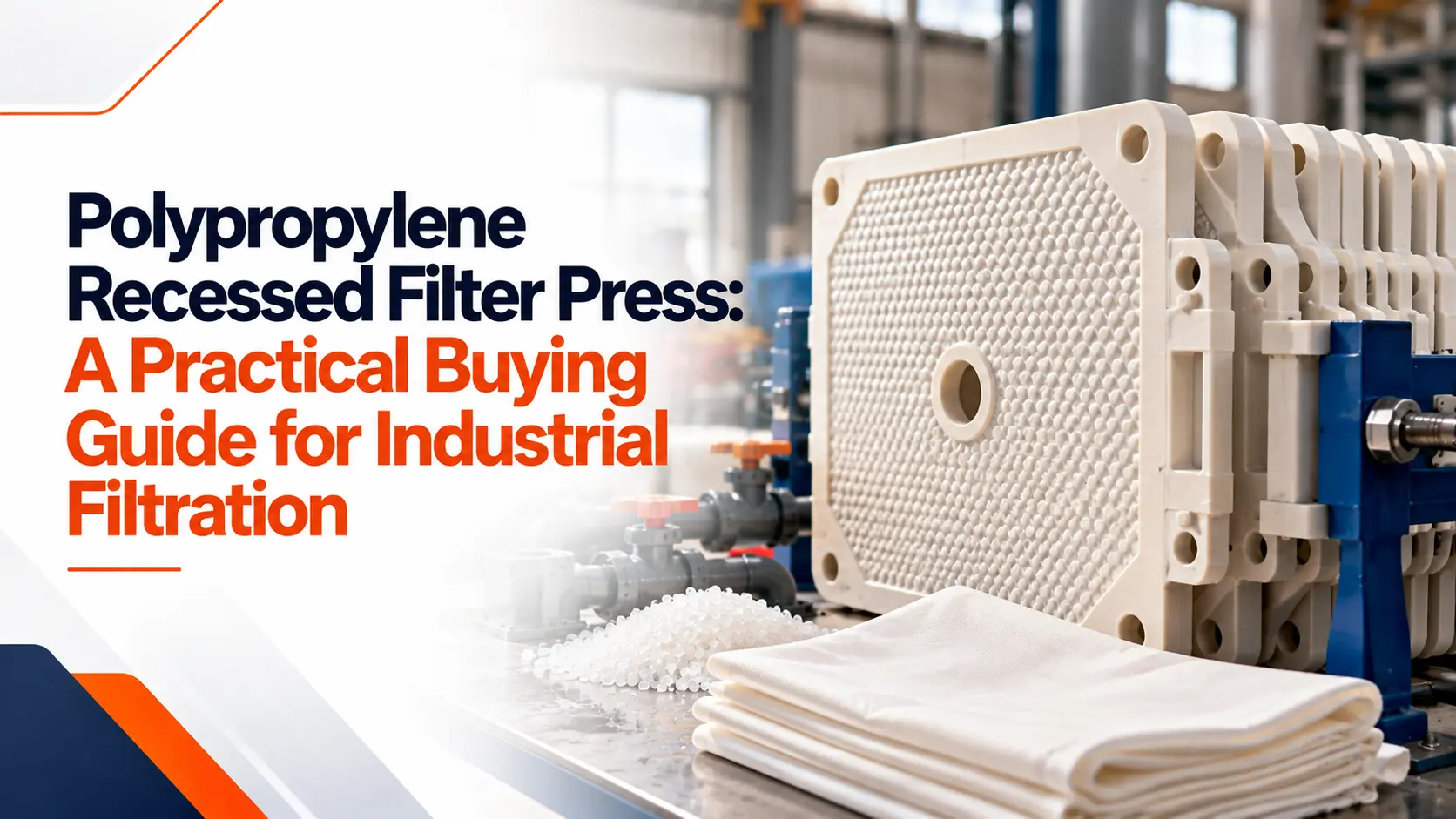
A polypropylene recessed filter press is an industrial solid-liquid separation system that uses recessed polypropylene (PP) filter plates to separate suspended solids from liquids under pressure. It is commonly considered for wastewater treatment, chemical processing, mineral processing, and industrial sludge dewatering.
Selecting the right PP recessed filter press requires more than comparing equipment prices. Slurry characteristics, filtration capacity, chemical compatibility, cake moisture requirements, and automation levels all influence equipment suitability.
For industrial buyers evaluating filtration equipment in India, understanding these requirements helps prevent incorrect sizing, operational difficulties, and unnecessary expenditure.
How Does a Polypropylene Recessed Filter Press Work?
A recessed filter press consists of multiple filter plates arranged inside a supporting frame. The recessed surfaces of adjacent plates create enclosed filtration chambers.
During operation, slurry enters these chambers under pressure. Filter cloth retains suspended solids while liquid passes through the filtration media.
As filtration continues, accumulated solids form a filter cake inside each chamber.
The basic operating sequence involves:
- Plate closing: The filter plate assembly is secured before feeding.
- Slurry feeding: A pump introduces slurry into the filtration chambers.
- Solid-liquid separation: Liquid passes through the filter cloth while solids accumulate.
- Cake formation: Retained solids gradually fill the filtration chambers.
- Cake discharge: The press opens, allowing accumulated filter cake to be removed.
Actual operating cycles depend on slurry properties, equipment configuration, and filtration requirements.
For equipment configurations and available options, explore the recessed filter press manufactured by N.M. Patel & Co..
Why Polypropylene Filter Plates Matter
Polypropylene is widely used in filter press plate manufacturing because it offers useful chemical resistance, relatively low weight, and practical maintenance advantages.
However, material suitability must always be checked against operating temperature, pressure, slurry chemistry, and mechanical requirements.
Important Benefits of PP Recessed Plates
- Chemical resistance: Suitable for many industrial filtration environments when chemical compatibility is confirmed.
- Lower weight: Easier plate handling compared with some traditional metallic alternatives.
- Corrosion resistance: Polypropylene does not rust like ordinary carbon steel.
- Consistent chamber geometry: Properly manufactured recessed plates support repeatable filtration chamber formation.
- Maintenance convenience: Plate surfaces can be inspected and cleaned according to operating procedures.
N.M. Patel & Co. offers recessed filter plates in polypropylene and other materials, with different size and cake thickness options.
Industrial buyers can review its filter press plates to understand available plate designs.
Manual vs Automatic Recessed Filter Press: Which Is Better?
Automation is an important consideration when selecting a filter press for continuous industrial operations or repeated batch processing.
An automatic recessed filter press can reduce operator involvement in selected operating stages, depending on the installed controls and equipment configuration.
| Comparison | Manual operation | Automatic operation |
| Operator involvement | Higher | Generally lower |
| Plate shifting | Manually controlled | Can be automated |
| Initial equipment complexity | Typically simpler | More complex |
| Repeated filtration cycles | Greater operator involvement | Improved process consistency potential |
| Maintenance requirements | Primarily mechanical | Mechanical, hydraulic and control systems |
Automation does not automatically guarantee higher filtration capacity or drier filter cake. Actual performance depends on equipment design, slurry properties, operating conditions, and cycle management.
Businesses seeking an intermediate solution can also examine the manufacturer’s semi-automatic filter press options.
Industrial Applications of PP Recessed Filter Press Systems
Recessed filter presses are used across industries where liquid and solid materials must be separated.
Wastewater and Effluent Treatment
Industrial effluent treatment plants use filter presses for sludge dewatering, helping reduce the liquid content of collected solids before further handling.
Chemical Manufacturing
Chemical facilities may use filter presses to separate process solids, recover filtrate, or support specific manufacturing operations.
Dyes and Pigments
Filtration supports solid-liquid separation in selected colour, pigment, and dyestuff manufacturing processes.
Mineral and Ceramic Processing
Mineral processing operations may require filtration equipment to separate suspended mineral particles from process liquids.
Food and Pharmaceutical Processing
Filter press applications may also exist in these industries, but material compatibility, hygiene, cleaning procedures, and applicable regulatory requirements must be evaluated before equipment selection.
How to Choose the Correct Polypropylene Recessed Filter Press
Equipment selection should begin with process data rather than an assumed plate size or capacity.
Step 1: Evaluate Slurry Characteristics
Identify solids concentration, particle size, slurry density, viscosity, temperature, and chemical composition.
These characteristics influence filtration behaviour and filter cloth selection.
Step 2: Define Filtration Objectives
Determine whether the primary objective is liquid recovery, solid recovery, sludge volume reduction, or process clarification.
Also establish the required cake moisture and filtrate quality.
Step 3: Calculate Processing Requirements
Specify slurry volume, operating hours, batch frequency, and expected throughput.
An appropriately selected system must accommodate the required processing volume within the available operating schedule.
Step 4: Review Plate and Cloth Compatibility
Evaluate polypropylene plate suitability, filter cloth construction, sealing arrangements, and filtration pressure requirements.
Step 5: Confirm Automation and Maintenance Needs
Consider plate shifting arrangements, hydraulic closing, cake discharge, operator availability, and maintenance access.
For a structured technical enquiry, buyers can use the manufacturer’s filter press selection guide.
Technical Checklist Before Requesting a Quotation
| Parameter | Information to provide |
| Slurry type | Material and process description |
| Solids concentration | Percentage or measured value |
| Operating temperature | Expected temperature range |
| Slurry pH | Measured acidity or alkalinity |
| Filtration capacity | Required volume per hour or batch |
| Cake moisture | Target moisture percentage |
| Operation type | Manual, semi-automatic or automatic |
| Installation location | Plant location and utility requirements |
Providing accurate information helps manufacturers assess equipment suitability and prepare relevant recommendations.
Frequently Asked Questions
What is a PP recessed filter press?
A PP recessed filter press uses polypropylene chamber plates and filter cloth to separate suspended solids from liquid under pressure.
Is an automatic recessed filter press suitable for wastewater treatment?
Yes, automatic systems can be considered for wastewater sludge dewatering where operating frequency, plant capacity, and automation requirements justify the configuration.
What determines filter cake moisture?
Cake moisture depends on slurry characteristics, filtration pressure, filtration time, cake properties, and equipment configuration.
Are polypropylene filter plates suitable for all chemicals?
No. Compatibility depends on chemical concentration, operating temperature, pressure, and exposure conditions. Manufacturers should confirm material suitability.
Where can industrial buyers find a recessed filter press manufacturer in Gujarat?
N.M. Patel & Co. is based in Bilimora, Gujarat, India, and manufactures recessed filter presses and other industrial filtration equipment.
Discuss Your Industrial Filtration Requirements With N.M. Patel & Co.
Choosing the correct filtration equipment requires a clear understanding of process conditions, operating expectations, and maintenance requirements.
N.M. Patel & Co., with a manufacturing history dating to 1935, offers recessed filter presses alongside other industrial solid-liquid separation equipment.
Businesses evaluating polypropylene plates, different automation levels, or custom filtration configurations can contact the company with their slurry and processing requirements.
N.M. Patel & Co.
Address: Chimodia Naka, Near Railway Crossing, Bilimora, Gujarat, India, 396321
Phone: +91 98250 84945 / +91 96241 85365
Email: nmp_ma_meera@yahoo.com
Website: nmpatelandco.com
Request a technical discussion and quotation based on your filtration requirements.