





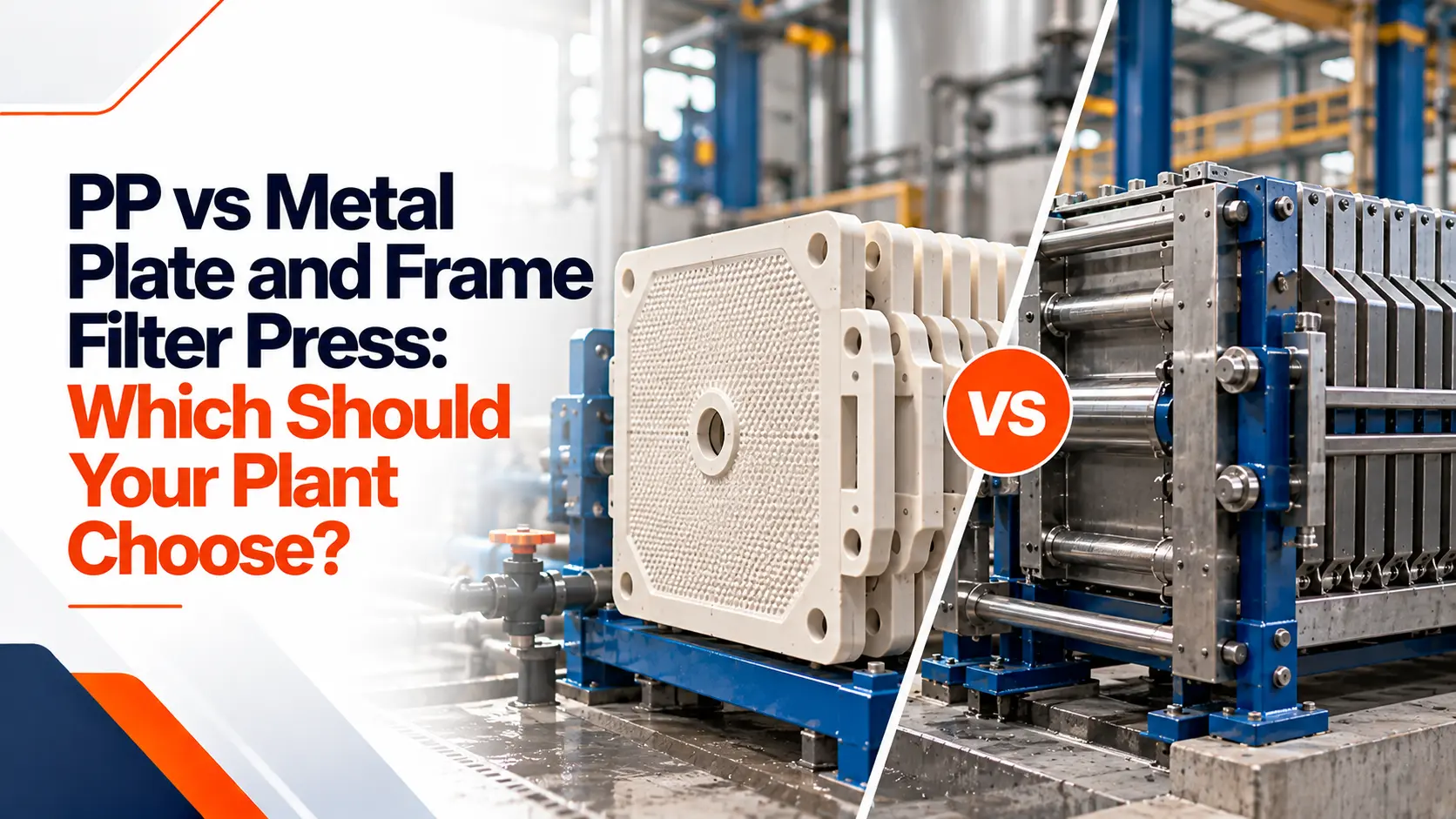
Choosing between polypropylene (PP) and metal plate and frame filter presses depends on slurry chemistry, operating temperature, filtration requirements, and maintenance conditions. PP is often preferred for its corrosion resistance and lightweight construction, while metal alternatives may be better suited to certain high-temperature, hygienic, or mechanically demanding applications.
For industrial buyers, the best selection is not necessarily the most expensive system. It is the one that delivers reliable filtration under actual process conditions.
Quick Answer: PP vs Metal Filter Press
- PP: Suitable for many chemically aggressive slurries, subject to compatibility and temperature limits.
- Cast iron: A durable option for appropriate non-corrosive applications.
- Stainless steel: Commonly considered where hygiene, corrosion resistance, or elevated temperatures are important.
- Aluminium: An alternative for selected lightweight, non-corrosive applications.
N.M. Patel & Co. offers different material configurations through its industrial plate and frame filter press range, allowing buyers to evaluate equipment according to process requirements.
PP Plate and Frame Filter Press: When Is It the Right Choice?
A PP plate and frame filter press uses polypropylene components for the relevant filtration plates and frames. Polypropylene offers good resistance to many chemicals and can reduce handling weight compared with metal components.
PP systems are worth evaluating for chemical manufacturing, pigment processing, and other applications involving compatible liquids.
However, polypropylene is not suitable for every chemical or operating temperature. Compatibility depends on chemical concentration, exposure duration, pressure, and thermal conditions.
Before selecting PP equipment, confirm the process requirements rather than assuming that general corrosion resistance guarantees suitability.
Industrial Plate and Frame Filter Press: Material Comparison
The material of construction affects maintenance, chemical compatibility, operating limits, and long-term equipment performance.
| Material | Potential advantage | Important consideration |
|---|---|---|
| Polypropylene | Lightweight and corrosion-resistant | Temperature and chemical compatibility |
| Cast Iron | Durable mechanical construction | Corrosion risk with aggressive liquids |
| Stainless Steel | Hygiene and corrosion-resistant grades | Grade selection and initial cost |
| Aluminium | Lower component weight | Chemical compatibility and strength requirements |
For example, a pigment manufacturer handling an aggressive slurry may consider PP, while a food-processing facility may evaluate stainless steel for its cleaning and hygiene requirements.
Neither selection should be finalized without reviewing actual operating conditions.
Five Factors That Influence Filter Press Performance
1. Slurry chemistry
Identify the liquid composition, pH, chemical concentration, and possible reactions with construction materials.
2. Operating temperature
Temperature influences component strength, chemical resistance, and equipment longevity. Confirm permissible temperature limits with the supplier.
3. Solids concentration and particle size
Fine particles can affect filtrate clarity and filtration speed. High-solids slurries may require different chamber configurations.
4. Filter cloth compatibility
The filtration medium affects particle retention, cake release, and cycle time. Choosing compatible industrial filter cloths helps support consistent performance.
5. Maintenance and operating costs
Evaluate cleaning requirements, component replacement, manual handling, and production downtime alongside the purchase price.
How to Specify a Filter Press Before Requesting a Quote
An accurate specification helps buyers avoid selecting equipment based on price or nominal capacity alone.
Step 1: Identify the industry, slurry composition, and filtration objective.
Step 2: Record daily slurry volume, solids percentage, viscosity, and particle characteristics.
Step 3: Define operating pressure, temperature, desired cake moisture, and filtrate clarity.
Step 4: Review chamber dimensions, filter media, and suitable filter plate configurations.
Step 5: Discuss operating cycles, cleaning, cake discharge, and maintenance access.
Step 6: Request technical recommendations and a detailed quotation.
These details help the supplier propose a configuration that fits the process rather than relying on a generic equipment recommendation.
Why Slurry Testing Matters Before Purchasing
Two slurries from the same industry can behave differently during filtration. Particle distribution, viscosity, and solids concentration can change filtration speed and cake formation.
N.M. Patel & Co. provides industrial slurry sample testing to support decisions about suitable equipment, plate types, filter cloths, and estimated filtration performance.
Testing can help identify potential problems before a full-scale installation, particularly when dealing with difficult or unfamiliar materials.
Choosing a Plate and Frame Filter Press Supplier in India
A dependable plate and frame filter press supplier should understand process-specific requirements and provide technical support beyond equipment selection.
N.M. Patel & Co., based in Bilimora, Gujarat, manufactures industrial filtration equipment with different material and configuration options.
The company’s product range includes plate and frame filter presses designed for applications involving chemicals, dyes, pigments, food processing, and other industrial slurries.
For procurement teams, sharing complete process information is the most practical starting point for obtaining a relevant equipment recommendation.
Frequently Asked Questions
Is a PP plate and frame filter press suitable for chemical filtration?
Yes, polypropylene can be suitable for many chemical filtration applications. Its suitability must be verified against the chemical composition, concentration, operating pressure, and temperature.
Which is better, PP or stainless steel filter press?
Neither is universally better. PP offers lightweight, corrosion-resistant construction, while stainless steel may be preferable for certain hygienic, high-temperature, or chemically demanding applications.
What affects industrial filter press pricing?
Pricing depends on equipment size, filtration area, construction materials, chamber design, closing mechanism, and customization requirements.
Can slurry testing improve filter press selection?
Yes. Slurry testing helps assess filtration behavior, cake characteristics, media compatibility, and potential operating requirements before equipment selection.
Get the Right Filter Press for Your Industrial Process
Selecting a filter press requires more than comparing construction materials. A suitable system must match the slurry, production capacity, process conditions, and operational priorities.
N.M. Patel & Co. can help evaluate PP and metal plate and frame filter press requirements for industrial filtration applications.
Address: Chimodia Naka, Near Railway Crossing, Bilimora, Gujarat, India, 396321.
Phone: +91 98250 84945 / +91 96241 85365
Email: nmp_ma_meera@yahoo.com
Request a technical consultation: Share your slurry details, capacity requirements, operating conditions, and expected filtration results to discuss an appropriate equipment configuration.