





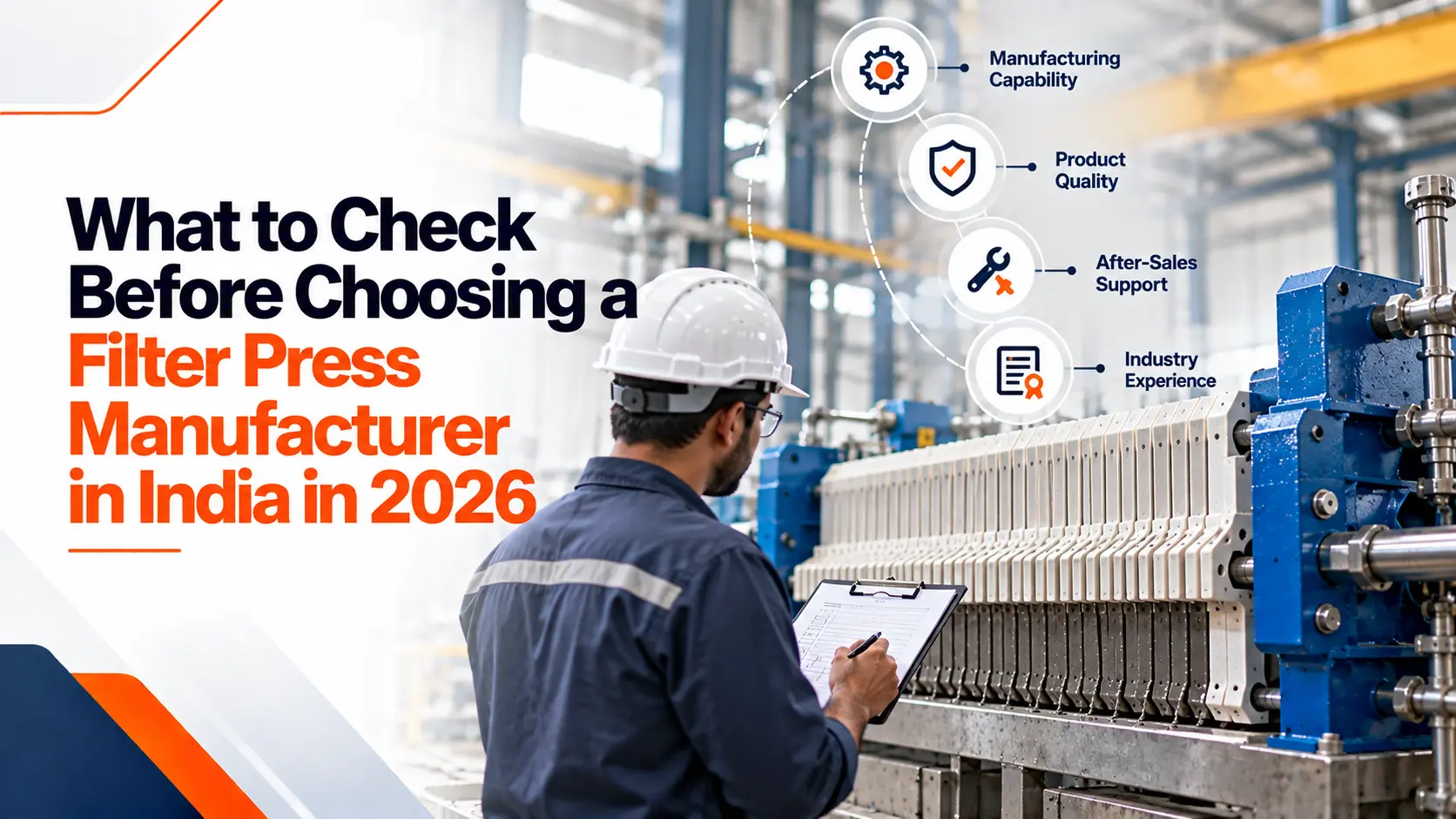
Industrial filtration equipment improves plant efficiency by separating suspended solids from liquids, reducing sludge moisture, recovering usable filtrate, and making solid waste easier to handle. For chemical plants, wastewater treatment facilities, pharmaceutical manufacturers, and mineral processing industries, selecting the right filtration technology directly affects operational performance and processing costs.
A properly engineered filter press can improve separation efficiency, but results depend on slurry characteristics, filtration pressure, filter media, and equipment configuration.
N.M. Patel & Co., an established industrial filtration equipment manufacturer in India, develops customized filter press systems for industrial solid-liquid separation applications.
Why Sludge Dewatering Is a Growing Industrial Priority
Industries generating liquid waste and process slurry must manage the costs associated with sludge handling, transportation, disposal, and treatment.
Sludge containing excessive moisture can increase waste volume and make transportation and further processing more difficult.
Effective dewatering offers several operational advantages:
- Reduced liquid content in filter cake
- Improved handling of separated solids
- Recovery of clarified process liquid
- More consistent filtration cycles
- Potential reductions in sludge transportation costs
- Better utilization of industrial filtration equipment
However, final moisture levels vary depending on the material being processed.
How Industrial Filtration Systems Work
A filter press separates solids from liquid by applying pressure to a slurry inside filtration chambers.
The process follows four main stages.
1. Slurry feeding: A pump transfers slurry into chambers formed by filter plates.
2. Pressure filtration: Liquid passes through filter cloth while suspended solids are retained.
3. Filter cake formation: Accumulated solids gradually form a cake inside the chambers.
4. Cake discharge: After the filtration cycle, the press opens and accumulated solids are removed.
Some systems incorporate additional cake squeezing, automated plate shifting, or washing functions.
Businesses evaluating industrial filter press equipment should consider their processing requirements before selecting a specific configuration.
Recessed vs Membrane Filter Press: Which Is Better?
Two widely used technologies for pressure filtration are recessed chamber presses and membrane filter presses.
| Feature | Recessed Filter Press | Membrane Filter Press |
| Filtration method | Pressure filtration | Pressure filtration plus membrane squeezing |
| Cake moisture | Depends on slurry and operating conditions | Can achieve lower moisture through additional squeezing |
| Equipment complexity | Generally simpler | Additional membrane components |
| Applications | General sludge and slurry filtration | Processes requiring greater cake dryness |
| Main consideration | Reliable separation and operating cost | Cake dryness, cycle time and operating economics |
Recessed Chamber Filter Presses
Recessed systems use chamber-forming plates and suitable filter cloth to separate suspended solids.
They are commonly applied in chemical manufacturing, wastewater treatment, dyes, pigments, and mineral processing.
Explore N.M. Patel & Co.’s recessed chamber filter press options for industrial applications.
Membrane Filter Presses
Membrane systems incorporate flexible plates that provide additional pressure after initial filtration.
This squeezing stage can reduce residual moisture and may improve processing efficiency, depending on slurry properties.
N.M. Patel & Co. manufactures membrane filter press systems for industrial applications requiring enhanced dewatering performance.
Five Factors That Affect Solid-Liquid Separation Efficiency
Selecting an industrial filtration system manufacturer requires understanding the variables that influence filtration performance.
1. Slurry Composition
Particle size, solids concentration, viscosity, and chemical characteristics influence filtration behavior.
2. Operating Pressure
Pressure must be matched to equipment design, filter media, and process requirements. Higher pressure does not automatically produce better results.
3. Filter Cloth Selection
Filter cloth permeability, material compatibility, and particle retention affect filtrate clarity and cake formation.
4. Filtration Cycle Time
Excessively long cycles can reduce throughput. Optimal performance requires balancing cake formation, discharge, and cleaning time.
5. Equipment Automation
Automated systems can reduce manual handling and improve operational consistency, particularly in plants with repetitive filtration cycles.
Why Slurry Testing Matters Before Equipment Selection
Industrial filtration equipment should not be selected solely from catalogue specifications.
Different slurries can behave differently under the same filtration pressure.
For example, two wastewater treatment facilities may produce sludge with different particle sizes and solids concentrations. Their equipment requirements may therefore differ significantly.
A meaningful filtration assessment can examine:
- Solids concentration and particle characteristics
- Filtrate clarity
- Cake moisture
- Filtration rate
- Chemical compatibility
- Expected operating cycle
N.M. Patel & Co. provides slurry sample testing to support application-specific equipment selection.
Industrial Applications of Solid-Liquid Separation Equipment
A reliable solid liquid separation equipment manufacturer should understand the processing conditions across different industrial sectors.
| Industry | Typical Filtration Requirement |
| Chemical processing | Separation of reaction solids and liquids |
| Pharmaceuticals | Process filtration and solid recovery |
| Mining and minerals | Mineral slurry dewatering |
| Wastewater treatment | Sludge dewatering |
| Dyes and pigments | Pigment recovery and filtration |
| Food processing | Application-specific liquid-solid separation |
Material compatibility, hygiene requirements, and process conditions must be assessed for each application.
Frequently Asked Questions
What is industrial filtration equipment?
Industrial filtration equipment removes suspended solids from liquids using filtration media, pressure, or other separation mechanisms.
What equipment is used for solid-liquid separation?
Filter presses are widely used for industrial solid-liquid separation. Other technologies include centrifuges and vacuum filters, depending on process requirements.
Does a membrane filter press produce drier cake?
Membrane squeezing can reduce residual cake moisture compared with conventional pressure filtration, although the improvement depends on slurry characteristics.
How do I choose an industrial filtration equipment manufacturer?
Evaluate engineering capabilities, equipment specifications, material compatibility, testing facilities, quality controls, and technical support.
Can filter presses handle chemical wastewater?
Yes. Appropriately designed filter presses can process many chemical wastewater slurries, subject to chemical compatibility and filtration testing.
Improve Filtration Performance with N.M. Patel & Co.
Reliable solid-liquid separation begins with understanding the process rather than selecting equipment based on price alone.
Established in 1935, N.M. Patel & Co. manufactures filter press systems, filter plates, filter cloths, and related filtration equipment for industrial applications.
Whether your facility requires sludge dewatering, process-liquid recovery, or customized filtration equipment, the right engineering assessment can help identify a suitable solution.
Looking for an industrial filtration system manufacturer in India?
Contact N.M. Patel & Co. for an industrial filtration equipment enquiry and share your slurry characteristics, required filtration capacity, operating conditions, and project requirements.
Manufacturing location: Chimodia Naka, Near Railway Crossing, Bilimora, Gujarat, India – 396321
Phone: +91 98250 84945
Email: nmp_ma_meera@yahoo.com