






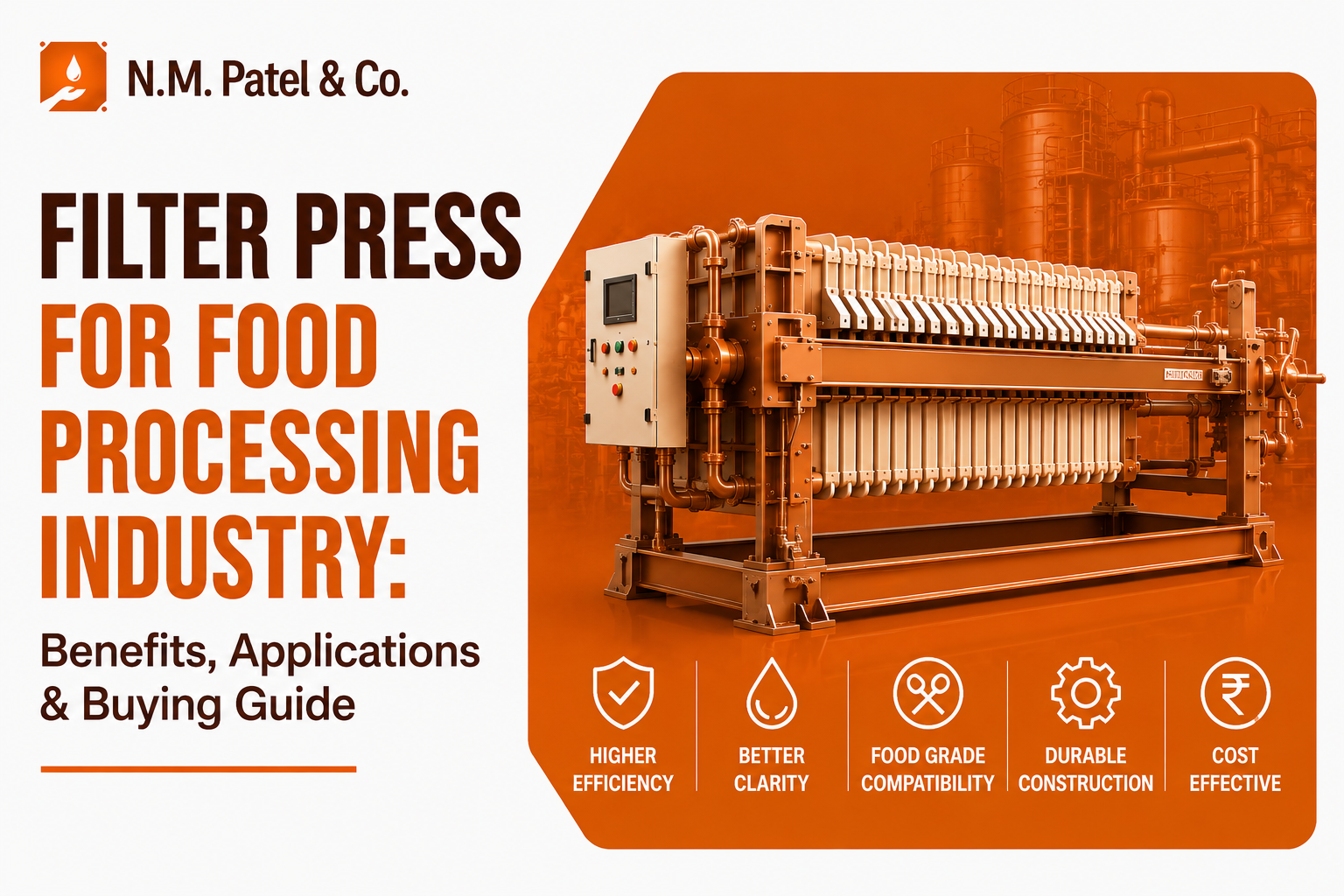
Maintaining product purity, ensuring food safety, and achieving efficient solid-liquid separation are essential requirements in the modern food processing industry. Whether producing edible oils, fruit juices, sugar, starch, dairy products, or beverages, manufacturers rely on advanced filtration systems to improve product quality and maximize production efficiency.
Among the most effective industrial filtration technologies available today is the Filter Press. Designed for high-performance solid-liquid separation, filter presses help food manufacturers remove suspended solids, recover valuable products, reduce waste, and comply with strict hygiene standards.
With decades of experience in industrial filtration solutions, N.M. Patel & Co. manufactures high-quality filter press systems engineered to meet the demanding requirements of food processing industries across India and international markets.
This guide explains how filter presses work in food processing, their advantages, applications, and how to select the right filtration solution for your facility.
What Is a Filter Press?
A filter press is a pressure filtration system that separates solids from liquids using specially designed filter plates and filter cloths.
During the filtration process:
- Food slurry or liquid is pumped into the filter chambers.
- Solid particles are retained on the filter cloth.
- Clean filtrate passes through the cloth and is collected.
- Filter cake is discharged after the filtration cycle.
This process ensures high filtration efficiency while minimizing product loss.
Why Food Processing Industries Use Filter Presses
Food manufacturers require filtration systems that offer:
- High Product Purity
- Efficient Solid Removal
- Hygienic Operation
- Product Recovery
- Low Moisture Filter Cake
- Consistent Filtration Quality
- Reduced Waste
- Compliance with Food Safety Standards
Filter presses help manufacturers improve both production quality and operational efficiency.
Applications in the Food Processing Industry
Filter press machines are widely used for:
Edible Oil Filtration
Removing impurities from crude and refined edible oils.
Fruit Juice Processing
Clarifying juices by removing pulp and suspended solids.
Sugar Industry
Filtering sugar syrup and processing by-products.
Starch Manufacturing
Separating starch from process water efficiently.
Dairy Processing
Filtration of dairy products and recovery of valuable solids.
Beverage Industry
Clarification of beverages before packaging.
Food Ingredient Manufacturing
Processing food additives, flavoring agents, and specialty ingredients.
Benefits of Using a Filter Press in Food Processing
High Filtration Efficiency
Filter presses remove fine suspended particles, improving product clarity and consistency.
Improved Product Quality
Cleaner filtration results in higher-quality food products that meet industry standards.
Maximum Product Recovery
Advanced filtration minimizes valuable product loss during processing.
Hygienic Processing
Food-grade filter presses are designed with materials suitable for sanitary production environments.
Reduced Waste Disposal Costs
Efficient dewatering lowers waste volume and reduces disposal expenses.
Lower Operating Costs
High filtration efficiency helps reduce energy consumption and production losses over time.
Increased Production Capacity
Faster filtration cycles improve overall plant productivity.
Types of Filter Presses Used in Food Industries
Depending on production requirements, manufacturers may choose:
- Plate and Frame Filter Press
- Recessed Chamber Filter Press
- Membrane Filter Press
- Automatic Filter Press
- Manual Filter Press
- Hydraulic Filter Press
The right configuration depends on product type, production capacity, and automation needs.
Key Features of Food-Grade Filter Presses
Food processing equipment should include:
- Food-Grade Construction Materials
- Corrosion Resistance
- Hygienic Design
- Easy Cleaning
- Leak-Proof Operation
- Durable Filter Cloths
- Efficient Hydraulic System
- Reliable Plate Sealing
- Automation Options
- Long Service Life
These features help ensure safe and efficient food production.
Factors to Consider Before Buying
Before selecting a filter press, evaluate:
- Type of Food Product
- Production Capacity
- Filtration Requirements
- Product Viscosity
- Hygiene Standards
- Automation Level
- Filter Plate Size
- Cleaning Requirements
- Available Plant Space
- Future Production Expansion
Choosing the right equipment ensures long-term operational efficiency and regulatory compliance.
Common Buying Mistakes
Avoid these common mistakes:
- Choosing equipment based only on price
- Ignoring food-grade material requirements
- Selecting incorrect filter cloths
- Underestimating production capacity
- Overlooking automation options
- Ignoring cleaning and sanitation requirements
- Choosing suppliers without industry expertise
- Failing to consider lifecycle operating costs
A properly selected filter press delivers better productivity and long-term value.
Why Choose N.M. Patel & Co.?
With decades of experience in industrial filtration, N.M. Patel & Co. manufactures advanced filter press systems designed for demanding food processing applications.
Our product range includes:
- Plate and Frame Filter Press
- Membrane Filter Press
- Recessed Chamber Filter Press
- Automatic Filter Press
- Manual Filter Press
- Hydraulic Filter Press
- Filter Press Plates
- Filter Cloths
- Sludge Dewatering Systems
- Customized Filtration Solutions
Our engineering team works closely with customers to recommend filtration systems that improve efficiency, product quality, and production reliability.
Why Food Manufacturers Trust N.M. Patel & Co.
Customers choose N.M. Patel & Co. because we offer:
- Decades of Filtration Expertise
- Precision Engineering
- Food-Grade Manufacturing Standards
- Customized Filtration Solutions
- Reliable Hydraulic Systems
- Advanced Automation Options
- Competitive Pricing
- Strong Technical Support
- Fast Spare Parts Availability
- Comprehensive After-Sales Service
Our goal is to help food manufacturers achieve higher productivity, superior product quality, and reliable long-term filtration performance.
People Also Search For
- filter press for food processing industry
- food grade filter press
- industrial food filtration system
- filter press machine for food industry
- food processing filtration equipment
- edible oil filter press
- beverage filtration system
- plate and frame filter press
- membrane filter press
- filter press manufacturer India
People Also Ask
Why is a filter press used in the food processing industry?
A filter press efficiently separates solids from liquids, improving product purity, increasing product recovery, reducing waste, and maintaining consistent food quality.
Which food products can be filtered using a filter press?
Filter presses are commonly used for edible oils, fruit juices, sugar syrups, starch, dairy products, beverages, food additives, and various liquid food ingredients.
Are filter presses suitable for hygienic food production?
Yes. Food-grade filter presses are manufactured using materials and designs that support hygienic processing and comply with food industry standards.
Which type of filter press is best for food processing?
The best choice depends on production capacity, product characteristics, automation requirements, and filtration objectives. Plate and Frame, Membrane, and Automatic Filter Presses are commonly used.
Why choose N.M. Patel & Co.?
N.M. Patel & Co. offers high-quality food-grade filter press solutions backed by decades of filtration expertise, customized engineering, reliable technical support, and comprehensive after-sales service.
Frequently Asked Questions
Can filter presses handle continuous food production?
Yes. Automatic filter press systems are designed to support continuous and high-volume food processing operations while maintaining consistent filtration performance.
What materials are used in food-grade filter presses?
Food-grade filter presses typically use corrosion-resistant materials and hygienic components that are compatible with food processing applications and easy to clean.
How often should filter cloths be replaced?
The replacement interval depends on operating conditions, product type, and maintenance practices. Regular inspection and preventive maintenance help maximize filter cloth life.
Do filter presses reduce product waste?
Yes. Efficient solid-liquid separation improves product recovery and minimizes valuable product loss during processing.
Does N.M. Patel & Co. provide customized filtration systems for food manufacturers?
Yes. N.M. Patel & Co. designs and manufactures customized filter press solutions tailored to specific food products, production capacities, filtration requirements, and plant layouts.
Conclusion
A Filter Press is an essential investment for food processing companies seeking higher product purity, efficient solid-liquid separation, reduced waste, and improved production efficiency. Whether processing edible oils, beverages, dairy products, starch, or food ingredients, the right filtration system helps maintain consistent quality while lowering operational costs.
At N.M. Patel & Co., we combine decades of industrial filtration expertise with precision engineering to deliver reliable, food-grade filter press solutions tailored to your production needs. From equipment selection to installation and after-sales support, our team is committed to helping food manufacturers achieve safe, efficient, and sustainable filtration operations.