





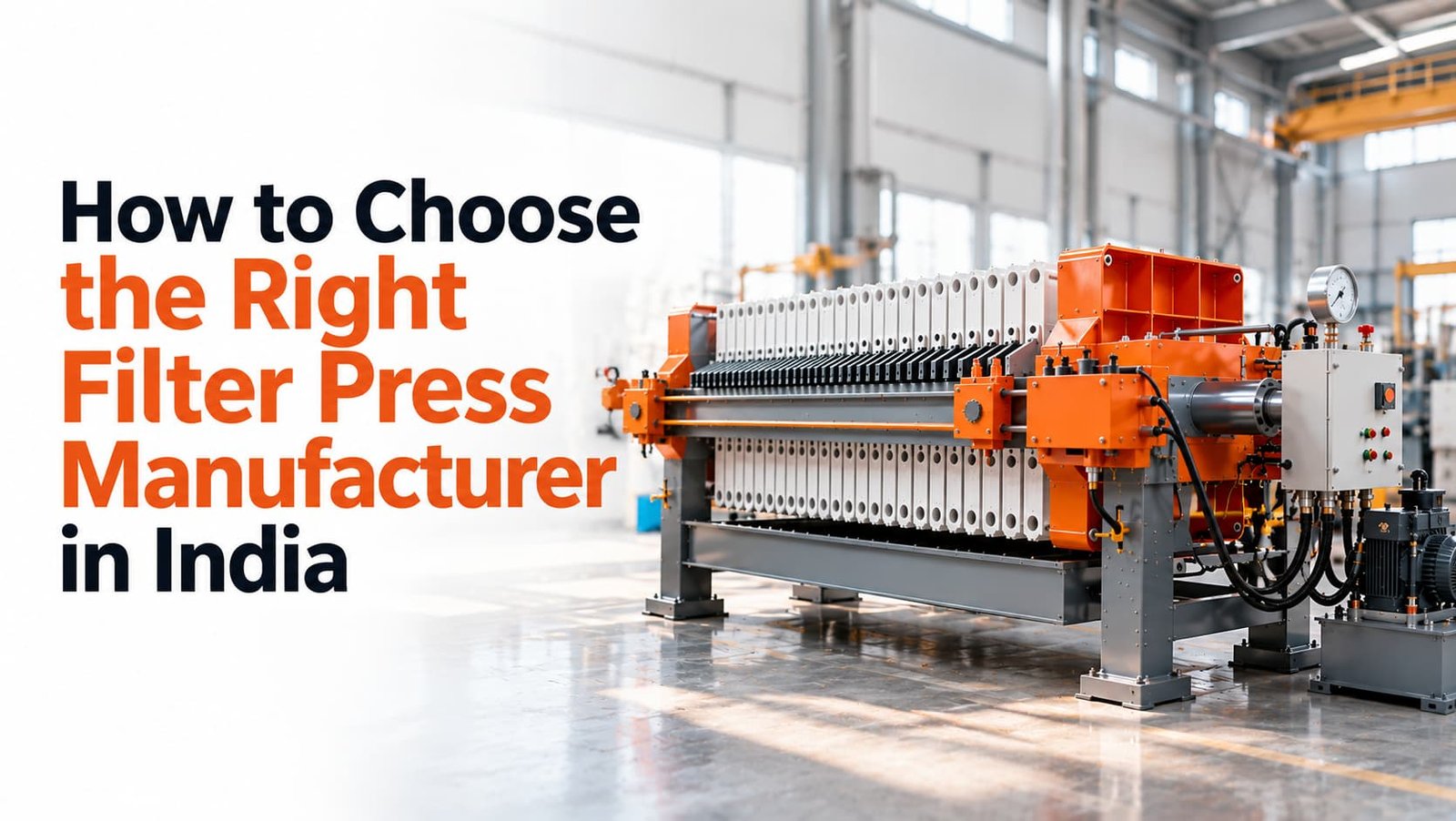
Choosing the right filter press manufacturer in India requires more than comparing machine prices. The right filtration system must match your slurry characteristics, processing capacity, operating pressure, desired cake moisture, chemical environment, automation requirements and long-term production goals.
For industries such as chemicals, pharmaceuticals, mining, food processing, dyes, pigments and wastewater treatment, an incorrectly selected filter press can create longer filtration cycles, excessive maintenance, wet filter cake and unnecessary operating costs.
Before selecting a supplier, evaluate its engineering capabilities, filtration range, customization process, component quality and after-sales support.
Here is a practical framework procurement teams, plant managers and engineers can use when comparing filter press manufacturers in India.
Quick Checklist for Choosing a Filter Press Manufacturer
Before requesting a final quotation, check whether the manufacturer can provide:
- Application-specific filter press selection
- Multiple filter press configurations
- Slurry or sample testing capabilities
- Appropriate filter plate selection
- Correct filter cloth selection
- Manual and automated options
- Custom engineering where required
- Spare parts and replacement components
- Technical support after installation
- Clear machine specifications and operating requirements
Price should be evaluated only after these requirements are understood.
1. Choose a Manufacturer That Understands Your Filtration Process
A filter press is not simply an off-the-shelf industrial machine.
Two plants processing different slurries may require completely different filtration configurations even if their production capacities appear similar.
Before recommending equipment, a competent manufacturer should understand factors such as:
| Selection Factor | Why It Matters |
| Slurry composition | Influences filtration behaviour |
| Solid concentration | Affects cake formation and capacity |
| Particle characteristics | Influences cloth and filtration performance |
| Chemical composition | Determines material compatibility |
| Required cake moisture | Helps determine press configuration |
| Filtration capacity | Influences machine sizing |
| Operating pressure | Affects plates and system design |
| Automation requirement | Determines operating complexity |
| Available plant space | Influences equipment configuration |
This is why businesses should evaluate engineering capability before comparing quotations.
N.M. Patel & Co. states that it provides tailored filtration solutions and supports application evaluation through slurry testing and custom engineering. Businesses evaluating a filter press manufacturer in India should look for this type of process-based approach instead of choosing equipment only by plate size or initial cost.
2. Compare the Type of Filter Press Offered
Not every filtration application requires the same machine.
A manufacturer with a broader filtration portfolio can evaluate the process before recommending the appropriate configuration.
Common options include:
Manual Filter Press
Manual systems can be suitable for relatively straightforward applications where production volumes and automation requirements are limited.
Recessed Chamber Filter Press
Recessed plates form filtration chambers between adjoining plates and are commonly used for industrial solid-liquid separation.
Membrane Filter Press
Membrane systems introduce an additional squeezing stage that can help reduce residual moisture in the filter cake and improve dewatering performance for suitable applications.
Plate and Frame Filter Press
This traditional configuration uses alternating plates and frames and remains relevant for certain specialty filtration processes.
Fully Automatic Filter Press
Plants requiring higher throughput, repeatable cycles and reduced manual intervention may need automation.
N.M. Patel & Co.’s fully automatic filter press systems are described as automating functions including slurry feeding, pressure filtration, cake discharge, plate shifting and cloth washing.
The important point is not to automatically select the most advanced machine. Choose the configuration that best matches your actual process.
3. Ask Whether the Filter Press Can Be Customized
Industrial filtration rarely follows a universal specification.
Your process may have specific requirements relating to:
- Plate dimensions
- Number of chambers
- Materials of construction
- Operating pressure
- Cake thickness
- Filtration area
- Hydraulic systems
- Plate shifting
- Cloth washing
- Drip collection
- Cake discharge
- Conveying
- Control systems
A suitable filter press manufacturer should therefore be able to explain which features are necessary and which would simply increase capital cost without producing meaningful operational benefits.
Customization is especially important when filtration equipment must integrate with existing pumps, tanks, piping, conveyors or process controls.
4. Evaluate Filter Plate Expertise
Filter plates directly influence the filtration chamber, cake formation, filtrate flow and operating conditions.
Depending on the application, a plant may require recessed, membrane, CGR, plate and frame or other specialized plate configurations.
N.M. Patel & Co.’s filter press plate range includes multiple configurations and materials designed around different industrial applications.
When comparing manufacturers, ask:
- Which plate design is recommended for the slurry?
- What material is being proposed?
- What operating pressure is appropriate?
- What cake thickness is expected?
- Is a gasketed or leak-resistant configuration required?
- How easily can replacement plates be sourced?
These questions can expose major differences between seemingly similar quotations.
5. Do Not Ignore Filter Cloth Selection
The filter cloth is one of the most important consumable components in a filter press.
Its material, weave and pore characteristics can influence cake release, filtrate clarity, filtration cycle time and overall performance.
N.M. Patel & Co. offers application-specific filter cloths for filter presses across different press configurations.
When evaluating a supplier, ask how the recommended cloth was selected.
A good answer should consider the slurry and operating requirements rather than simply supplying the same cloth for every application.
6. Compare Automation Based on ROI, Not Trends
Automation is becoming increasingly important in industrial filtration, particularly where businesses want to improve production consistency or reduce repetitive manual activities.
However, the highest level of automation is not automatically the best investment.
Consider whether automation can meaningfully improve:
- Cycle consistency
- Labour requirements
- Operator safety
- Cake discharge
- Plate movement
- Cloth cleaning
- Production throughput
- Process monitoring
For smaller operations, a simpler system may offer a better lifecycle return.
For continuous or high-volume industrial operations, greater automation may justify the additional investment.
The decision should be based on process economics.
7. Evaluate Total Cost of Ownership
One of the biggest mistakes buyers make is choosing the lowest-priced quotation without estimating long-term costs.
Consider:
Total Cost of Ownership = Purchase Cost + Energy + Labour + Consumables + Maintenance + Spare Parts + Downtime
A cheaper machine can become expensive if it requires frequent maintenance, produces inconsistent filtration results or causes production interruptions.
When comparing filter press manufacturers in India, request information about consumables, maintenance requirements and replacement components before making the final decision.
8. Check Industry and Application Experience
A manufacturer should understand how filtration requirements change between industries.
For example, requirements in pharmaceutical or food processing environments can differ significantly from those in mining, pigments, chemicals or wastewater treatment.
Ask prospective suppliers for relevant application experience rather than relying only on general marketing claims.
Useful questions include:
- Have you handled similar slurry characteristics?
- Which configuration would you recommend and why?
- What operating conditions were considered?
- What testing is recommended before manufacturing?
- Which components will require periodic replacement?
Specific technical answers are more useful than broad claims about machine quality.
9. Assess After-Sales Support and Spare Availability
Purchasing a filter press begins a long-term equipment relationship.
Filter cloths wear out. Plates may eventually require replacement. Hydraulic, mechanical and automation components require maintenance.
Before selecting a manufacturer, establish:
- Spare part availability
- Technical support process
- Consumable availability
- Maintenance requirements
- Documentation supplied
- Installation or commissioning support where applicable
Reliable access to parts can be especially important for facilities where filtration equipment is critical to production.
10. Request a Technical Proposal Before Comparing Prices
A quotation containing only machine size and price does not provide enough information for an informed industrial purchase.
Request a technical proposal covering:
- Recommended press type
- Filtration area
- Plate configuration
- Material of construction
- Closing mechanism
- Operating pressure
- Automation scope
- Included accessories
- Utilities required
- Consumables
- Installation requirements
- Optional equipment
Place competing quotations side by side and compare specifications before comparing the final price.
A Simple Filter Press Manufacturer Evaluation Scorecard
| Criteria | Suggested Importance |
| Process understanding | Very High |
| Machine suitability | Very High |
| Engineering capability | Very High |
| Plate and cloth selection | High |
| Customization | High |
| Automation options | Medium to High |
| Spare parts availability | High |
| Technical support | High |
| Initial price | Medium |
| Lifecycle cost | Very High |
The exact weighting will depend on your application, but technical suitability should normally come before purchase price.
Frequently Asked Questions
How do I choose a filter press manufacturer in India?
Start by defining your slurry characteristics, production capacity, cake moisture target, operating conditions and automation requirements. Then compare manufacturers based on engineering capability, machine configuration, components, customization, support and total lifecycle cost.
Which type of filter press should I choose?
The right configuration depends on the filtration process. Options can include manual, recessed chamber, membrane, plate and frame or fully automatic systems. Process testing and engineering evaluation can help determine the appropriate choice.
What should I ask a filter press manufacturer before buying?
Ask about machine sizing, filtration area, plate type, filter cloth, operating pressure, construction materials, automation, expected maintenance, spare parts and support.
Is an automatic filter press always better than a manual filter press?
No. Automation can improve consistency, productivity and reduce manual intervention, but the additional investment needs to be justified by production requirements and lifecycle economics.
Why are filter plates important when choosing a filter press?
Filter plates create the filtration chambers and affect cake formation, filtration performance, pressure capability and overall operation. Plate type and material should therefore match the process conditions.
How important is filter cloth selection?
Very important. Filter cloth characteristics influence solids retention, filtrate clarity, cake release and filtration behaviour. The correct cloth should be selected according to the slurry and press configuration.
Should price be the main factor when comparing filter press manufacturers?
No. Initial price should be considered alongside maintenance, consumables, downtime, energy, labour and expected equipment performance.
Final Takeaway
Choosing the right filter press manufacturer in India is ultimately an engineering and business decision, not simply a price comparison.
Start with the characteristics of the material being filtered. Determine the required output, cake condition, operating pressure and level of automation. Then compare manufacturers based on their ability to configure the entire filtration system around those requirements.
A suitable supplier should be able to explain why a particular press, plate configuration, cloth and automation level fits your process.
That approach helps businesses move beyond purchasing a machine and toward building a reliable filtration system designed for long-term operational performance.