





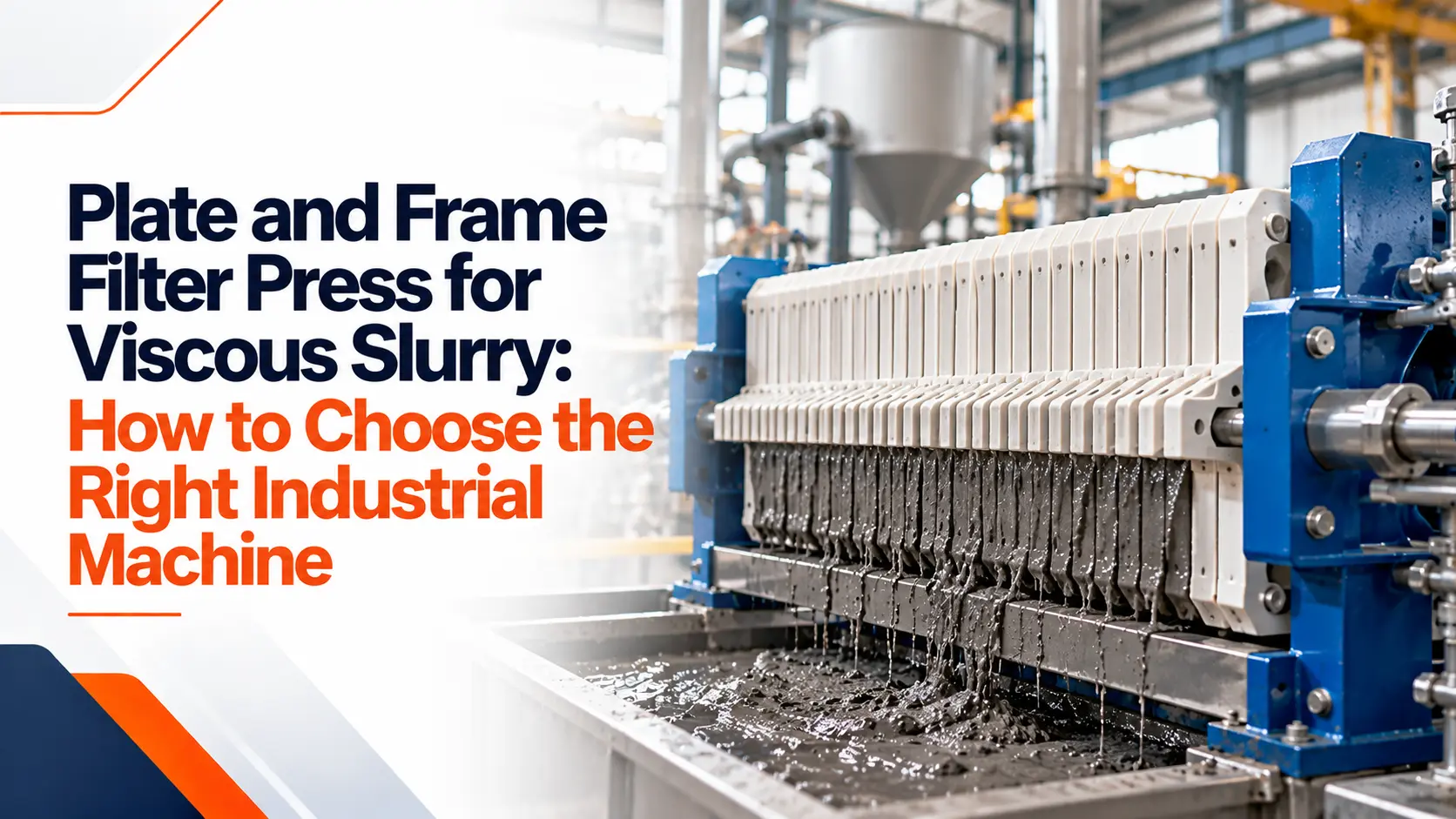
A plate and frame filter press is an effective industrial filtration solution for separating solids from viscous slurries, fine-particle suspensions, and liquids requiring controlled filtration. However, choosing the correct machine depends on slurry characteristics, filtration capacity, filter cloth, operating conditions, and construction materials.
For manufacturers processing chemicals, dyes, pigments, edible oils, and industrial slurries, selecting the right configuration is essential for achieving consistent filtration results.
At N.M. Patel & Co., we manufacture plate and frame filter press systems designed for different industrial separation requirements. Based in Bilimora, Gujarat, our company has been providing filtration equipment since 1935.
This guide explains six important factors to evaluate before investing in a plate frame filter press machine.
Why Choose a Plate and Frame Filter Press for Viscous Slurry?
Viscous slurries present filtration challenges because thick liquids and suspended particles can restrict flow through filtration media.
A plate & frame filter press uses alternating plates and frames to create filtration chambers. Slurry enters these chambers under pressure, while filter cloth retains solids and allows the filtrate to pass through.
Its configurable chamber design makes it suitable for different slurry concentrations and cake thickness requirements.
Key advantages include:
- Controlled separation of solids and liquids
- Configurable filtration chamber dimensions
- Different construction material options
- Access for filter cloth inspection
- Manual cake removal and cleaning
- Suitability for selected viscous and fine-particle applications
Explore our plate and frame filter press machines to understand available configurations.
6 Factors to Consider Before Buying a Plate and Frame Filter Press
1. Understand Slurry Characteristics
The first step is evaluating the material being filtered.
Important parameters include:
- Slurry viscosity
- Solid concentration
- Particle size distribution
- Operating temperature
- Chemical composition
- Required filtrate clarity
For example, a pigment manufacturer handling concentrated slurry may have different filtration requirements from a food-processing company clarifying edible oil.
A representative slurry sample can help determine appropriate equipment specifications.
2. Select the Right Material of Construction
Construction materials influence chemical compatibility, durability, and operating suitability.
N.M. Patel & Co. offers different material options for plate and frame filtration systems.
| Material | Typical Selection Consideration |
| Cast Iron | General industrial use with compatible non-corrosive slurries |
| Polypropylene | Corrosion resistance for compatible chemical applications |
| Stainless Steel | Hygiene, chemical compatibility, and suitable temperature conditions |
| Aluminium | Selected lightweight or non-corrosive applications |
The final selection should consider operating temperature, chemical exposure, and process safety.
3. Choose Suitable Filter Cloth
Filter cloth selection directly affects filtrate clarity, cake formation, and filtration cycle performance.
An unsuitable cloth may cause excessive particle passage, premature clogging, or difficult cake removal.
Evaluate cloth material, permeability, weave, and compatibility with the slurry.
Our industrial filter press cloth solutions include different materials and constructions for application-specific filtration requirements.
4. Calculate Filtration Capacity
A plate frame filter press machine should be sized according to the volume of slurry that must be processed.
Consider the required filtration rate, solids concentration, expected cycle duration, and available operating hours.
A larger machine is not automatically more efficient. The filtration area and chamber capacity must match the actual process.
5. Evaluate Cake Thickness and Discharge
Filter cake thickness influences chamber capacity, filtration resistance, and discharge requirements.
Plate and frame systems allow different frame dimensions to accommodate selected cake thickness requirements.
However, thicker cakes can increase filtration resistance, depending on slurry characteristics.
Review the available filter press plate configurations when evaluating equipment options.
6. Review Operation and Maintenance
Plate and frame systems commonly require manual intervention during cake discharge and cloth inspection.
Before purchasing, evaluate operator availability, cleaning procedures, production schedules, and maintenance access.
At N.M. Patel & Co., we offer manual and semi-automatic configurations suited to different filtration requirements.
Industrial Applications of Plate & Frame Filter Press Machines
Plate and frame filtration is used across industries where controlled separation is necessary.
Chemical and Pigment Manufacturing
Fine chemical processing, pigments, dyes, and paint-related applications may require filtration of concentrated suspensions.
Machine selection depends on slurry composition and required separation performance.
Food and Beverage Processing
Edible oil filtration, beverage clarification, and starch processing are among the applications identified for plate and frame systems.
Suitable construction materials and documented hygiene requirements are important considerations.
Pharmaceutical Processing
Selected pharmaceutical processes require controlled filtration and appropriate material compatibility.
Equipment specifications should be evaluated against process requirements and applicable quality standards.
Ceramics and Minerals
Ceramic and mineral processing may involve concentrated slurries containing suspended particles that require effective solid-liquid separation.
Plate and Frame vs Recessed Chamber Filter Press
Both systems separate suspended solids from liquids, but their chamber designs differ.
| Feature | Plate and Frame | Recessed Chamber |
| Chamber construction | Separate plates and frames | Recessed filter plates |
| Cake thickness | Determined by frame configuration | Determined by chamber design |
| Cake discharge | Commonly manual | Manual or automated options |
| Typical consideration | Flexible batch filtration | General industrial dewatering |
| Selection basis | Slurry and process requirements | Slurry and process requirements |
Neither technology is universally better. The appropriate design depends on filtration tests, required capacity, maintenance needs, and automation preferences.
Why Choose N.M. Patel & Co. for Industrial Filtration?
Established in 1935, N.M. Patel & Co. manufactures industrial filtration equipment for various solid-liquid separation applications.
Our product portfolio includes plate and frame, recessed chamber, membrane, manual, and automatic filter press systems.
We also offer filter plates, filter cloths, accessories, and application-based engineering solutions.
Our team can evaluate slurry characteristics, filtration requirements, construction materials, and operating conditions to help identify suitable equipment.
Frequently Asked Questions
What is a plate and frame filter press used for?
A plate and frame filter press separates suspended solids from liquids. Our machines are used in selected chemical, pharmaceutical, food-processing, pigment, and mineral filtration applications.
Is a plate frame filter press machine suitable for thick slurry?
Yes. Plate and frame systems can be suitable for viscous slurries. We recommend evaluating viscosity, particle characteristics, filtration resistance, and capacity before selecting a configuration.
Which material is best for a plate and frame filter press?
The right material depends on chemical compatibility, temperature, and operating conditions. We offer options including cast iron, polypropylene, stainless steel, and aluminium.
Can filter cloth affect filtration efficiency?
Yes. Filter cloth permeability, material, and weave affect filtration performance, particle retention, and cake release. We can help identify suitable cloth options for your application.
Does N.M. Patel & Co. manufacture customized filter presses?
Yes. We manufacture configurable filter press systems based on filtration capacity, slurry characteristics, construction materials, and process requirements.
Find the Right Plate and Frame Filter Press for Your Process
Choosing a plate and frame filter press requires careful consideration of slurry properties, filtration capacity, construction materials, and maintenance requirements.
At N.M. Patel & Co., we help industrial buyers evaluate suitable filtration solutions for their operating needs.
Company: N.M. Patel & Co.
Address: Chimodia Naka, Near Railway Crossing, Bilimora, Gujarat 396321, India
Phone: +91 98250 84945 / +91 96241 85365
Email: nmp_ma_meera@yahoo.com / nmpmameera09@gmail.com
Website: https://nmpatelandco.com/
Planning to purchase a plate frame filter press machine?
Contact N.M. Patel & Co. with your slurry characteristics, filtration capacity, and operating requirements to discuss a suitable industrial filtration solution.