






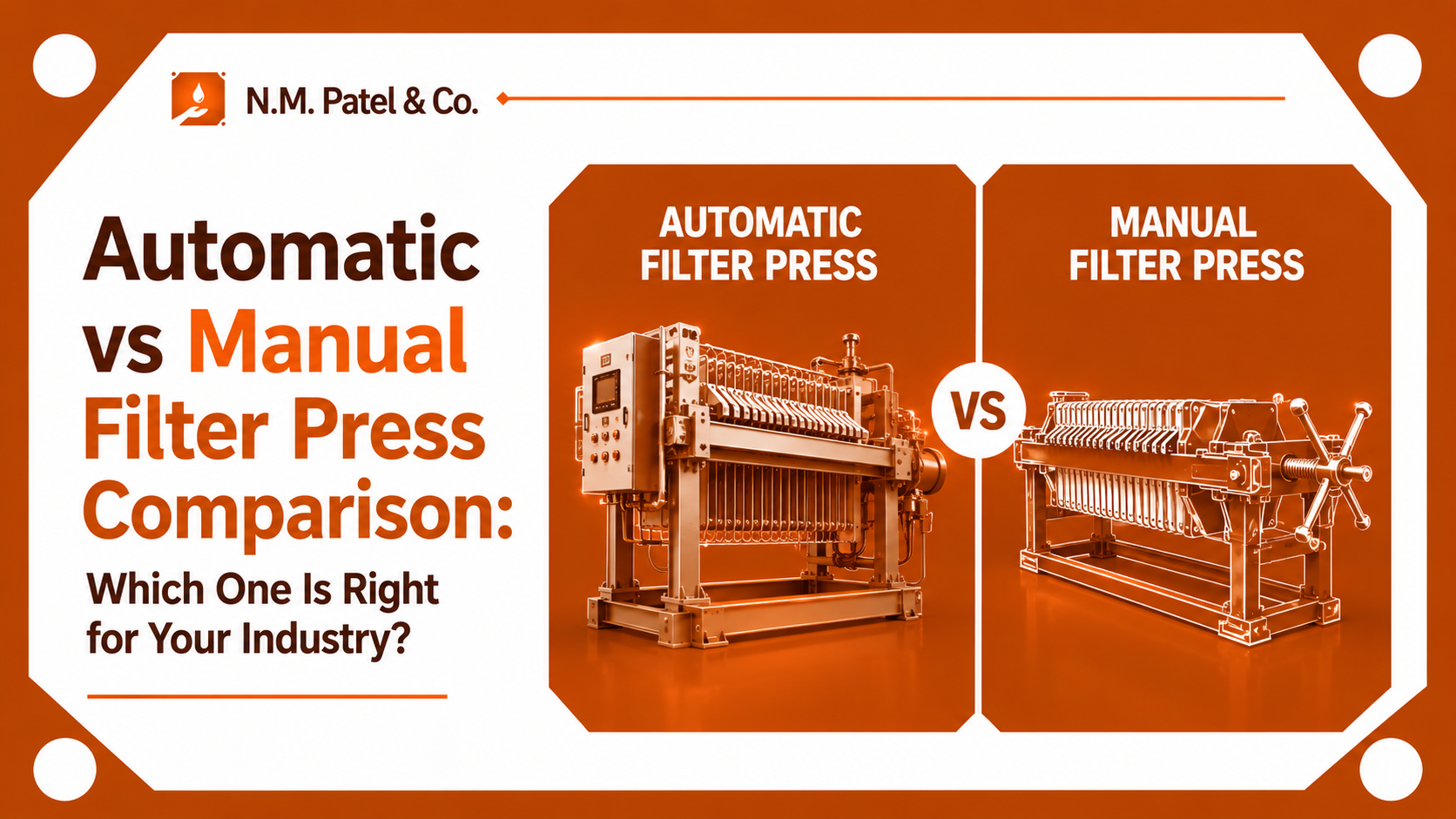
Filter press machines are among the most efficient solid-liquid separation systems used across industries such as chemicals, pharmaceuticals, mining, food processing, textiles, and wastewater treatment. However, one of the most common questions buyers ask before investing is:
Should I choose an Automatic Filter Press or a Manual Filter Press?
While both machines perform the same fundamental filtration process, they differ significantly in automation, productivity, labor requirements, operating costs, and production capacity.
Choosing the wrong type of filter press can increase operational expenses, reduce production efficiency, and create unnecessary downtime. Selecting the right solution depends on your production volume, budget, labor availability, and long-term operational goals.
With decades of experience in industrial filtration solutions, N.M. Patel & Co. helps manufacturers choose the most suitable filter press systems based on their application, filtration requirements, and production capacity.
This guide compares automatic and manual filter presses to help you make an informed investment.
What Is a Filter Press?
A filter press is an industrial filtration machine used to separate solids from liquids by applying pressure through a series of filter plates and filter cloths.
The filtration process generally includes:
- Slurry Feeding
- Pressure Filtration
- Cake Formation
- Liquid Filtrate Collection
- Cake Discharge
- Filter Cloth Cleaning
Filter presses are widely recognized for producing high solid recovery, low moisture filter cakes, and clear filtrate.
What Is a Manual Filter Press?
A manual filter press requires operators to manually open the filter plates and remove the filter cake after each filtration cycle.
Typical features include:
- Manual Plate Opening
- Manual Cake Discharge
- Hydraulic Closing System
- Simple Mechanical Design
- Lower Initial Investment
Manual filter presses are ideal for smaller production facilities with lower filtration volumes.
What Is an Automatic Filter Press?
An automatic filter press automates many stages of the filtration cycle, significantly reducing manual labor.
Automation features may include:
- Automatic Plate Shifting
- Automatic Cake Discharge
- Automatic Cloth Washing
- PLC Control System
- Automatic Hydraulic Operation
- Remote Monitoring
- Intelligent Process Control
These machines are designed for continuous industrial production with minimal operator intervention.
Automatic vs Manual Filter Press: Key Differences
| Feature | Automatic Filter Press | Manual Filter Press |
| Operation | Fully or Semi-Automated | Manual |
| Labor Requirement | Low | High |
| Productivity | Very High | Moderate |
| Filtration Speed | Faster | Slower |
| Cake Discharge | Automatic | Manual |
| Maintenance | Moderate | Simple |
| Initial Investment | Higher | Lower |
| Operating Cost | Lower Over Time | Higher Due to Labor |
| Production Capacity | Large Scale | Small to Medium Scale |
| Best For | Continuous Industrial Operations | Small Batch Production |
Advantages of an Automatic Filter Press
Automatic systems offer several operational advantages.
Higher Productivity
Automation reduces downtime between filtration cycles, increasing production capacity.
Lower Labor Costs
Automatic plate shifting and cake discharge significantly reduce manual handling.
Faster Cycle Times
Automated operations complete filtration cycles more quickly, improving plant efficiency.
Improved Safety
Reduced operator involvement minimizes workplace risks.
Consistent Performance
PLC-controlled operations ensure repeatable filtration results.
Suitable for Continuous Production
Automatic filter presses are ideal for industries operating around the clock.
Advantages of a Manual Filter Press
Manual filter presses continue to be a practical solution for many businesses.
Lower Initial Investment
Manual systems generally require less upfront capital.
Easy Operation
Simple mechanical construction makes operation straightforward.
Low Maintenance
With fewer automated components, maintenance requirements are relatively minimal.
Ideal for Small Production
Businesses with lower daily filtration volumes can achieve excellent performance without investing in automation.
Reliable Filtration
Despite requiring manual operation, manual filter presses still provide excellent solid-liquid separation.
Which Industries Prefer Automatic Filter Presses?
Automatic filter presses are commonly used in:
Chemical Manufacturing
Continuous production with minimal downtime.
Mining Industry
Large-scale mineral slurry dewatering.
Pharmaceutical Manufacturing
High-volume filtration with process consistency.
Food & Beverage Industry
Automated filtration for hygienic production environments.
Municipal Wastewater Treatment
Efficient sludge dewatering and high-capacity operation.
Large Industrial Plants
Facilities requiring continuous production and reduced labor costs.
Which Industries Use Manual Filter Presses?
Manual systems are widely used in:
- Small Chemical Plants
- Pilot Production Facilities
- Ceramic Manufacturing
- Educational Laboratories
- Small Textile Units
- Research & Development Facilities
- Small Food Processing Units
- Limited Batch Production Operations
Factors to Consider Before Choosing
Before selecting a filter press, evaluate:
- Daily Production Volume
- Slurry Characteristics
- Cake Moisture Requirements
- Labor Availability
- Budget
- Maintenance Resources
- Automation Requirements
- Future Expansion Plans
- Plant Space
- Operating Costs
A proper evaluation ensures the selected machine aligns with both current and future production needs.
Common Buying Mistakes
Avoid these common mistakes when purchasing a filter press:
- Choosing only based on purchase price
- Ignoring future production growth
- Underestimating labor costs
- Selecting incorrect plate sizes
- Overlooking automation requirements
- Ignoring maintenance support
- Choosing suppliers without technical expertise
- Failing to assess total cost of ownership
A well-planned investment delivers greater long-term value and operational efficiency.
Why Choose N.M. Patel & Co.?
With decades of experience in industrial filtration, N.M. Patel & Co. is a trusted manufacturer and supplier of high-performance filter press solutions across India and international markets.
Our filtration solutions include:
- Automatic Filter Press
- Manual Filter Press
- Membrane Filter Press
- Recessed Chamber Filter Press
- Plate and Frame Filter Press
- Hydraulic Filter Press
- Filter Press Plates
- Filter Cloths
- Sludge Dewatering Systems
- Customized Filtration Solutions
We work closely with customers to recommend the right filtration system based on industry requirements, slurry characteristics, production goals, and operational efficiency.
Why Industries Trust N.M. Patel & Co.
Customers choose N.M. Patel & Co. because we offer:
- Decades of Filtration Expertise
- High-Quality Manufacturing
- Customized Engineering Solutions
- Reliable Hydraulic Systems
- Advanced Automation Options
- Competitive Pricing
- Strong Technical Support
- Fast Spare Parts Availability
- Comprehensive After-Sales Service
- Long-Term Customer Partnerships
Our focus is on delivering filtration systems that maximize productivity, minimize downtime, and reduce operating costs.
People Also Search For
- Automatic vs Manual Filter Press
- automatic filter press machine
- manual filter press
- filter press comparison
- industrial filtration equipment
- membrane filter press
- plate and frame filter press
- sludge dewatering system
- filter press manufacturer India
- hydraulic filter press machine
People Also Ask
What is the difference between an automatic and a manual filter press?
An automatic filter press performs functions such as plate opening, cake discharge, and cloth washing automatically, while a manual filter press requires operator involvement for these tasks.
Which filter press is better for large industries?
Automatic filter presses are generally preferred for large-scale industrial operations because they increase productivity, reduce labor costs, and support continuous production.
Is a manual filter press suitable for small businesses?
Yes. Manual filter presses are ideal for businesses with lower production volumes and limited automation requirements due to their lower initial investment and simple operation.
Does an automatic filter press reduce operating costs?
Yes. Although the initial investment is higher, automatic filter presses typically reduce long-term operating costs by minimizing labor requirements, shortening cycle times, and improving overall efficiency.
Why choose N.M. Patel & Co.?
N.M. Patel & Co. offers a complete range of automatic and manual filter press solutions, customized engineering, advanced manufacturing, expert technical guidance, and dependable after-sales support to help industries achieve efficient and reliable filtration.
Frequently Asked Questions
Which filter press requires less maintenance?
Manual filter presses generally have simpler mechanical systems and may require less maintenance, while automatic systems include additional automation components that need periodic servicing.
Can a manual filter press be upgraded to automation?
Depending on the machine design and operational requirements, certain manual filter presses can be upgraded with automation features. Consult your equipment supplier for compatibility.
Which filter press offers faster production?
Automatic filter presses typically deliver faster cycle times because operations such as plate shifting and cake discharge are automated.
Which industries benefit most from automation?
Industries with continuous production, high filtration volumes, and labor-intensive operations—such as mining, chemicals, pharmaceuticals, and wastewater treatment—benefit the most from automatic filter presses.
Does N.M. Patel & Co. provide customized filter press solutions?
Yes. N.M. Patel & Co. designs and manufactures customized filtration systems tailored to your industry, slurry characteristics, production capacity, and operational requirements.
Conclusion
Both automatic and manual filter presses offer reliable solid-liquid separation, but the right choice depends on your production volume, operational goals, labor availability, and budget. Manual filter presses are a practical option for small-scale and batch operations, while automatic filter presses provide higher productivity, lower labor costs, and greater efficiency for continuous industrial processes.
At N.M. Patel & Co., we help businesses select the ideal filtration solution through expert consultation, customized engineering, and high-quality manufacturing. Whether you need a compact manual system or a fully automated filtration solution, our team is committed to delivering equipment that maximizes performance, reliability, and long-term return on investment.