






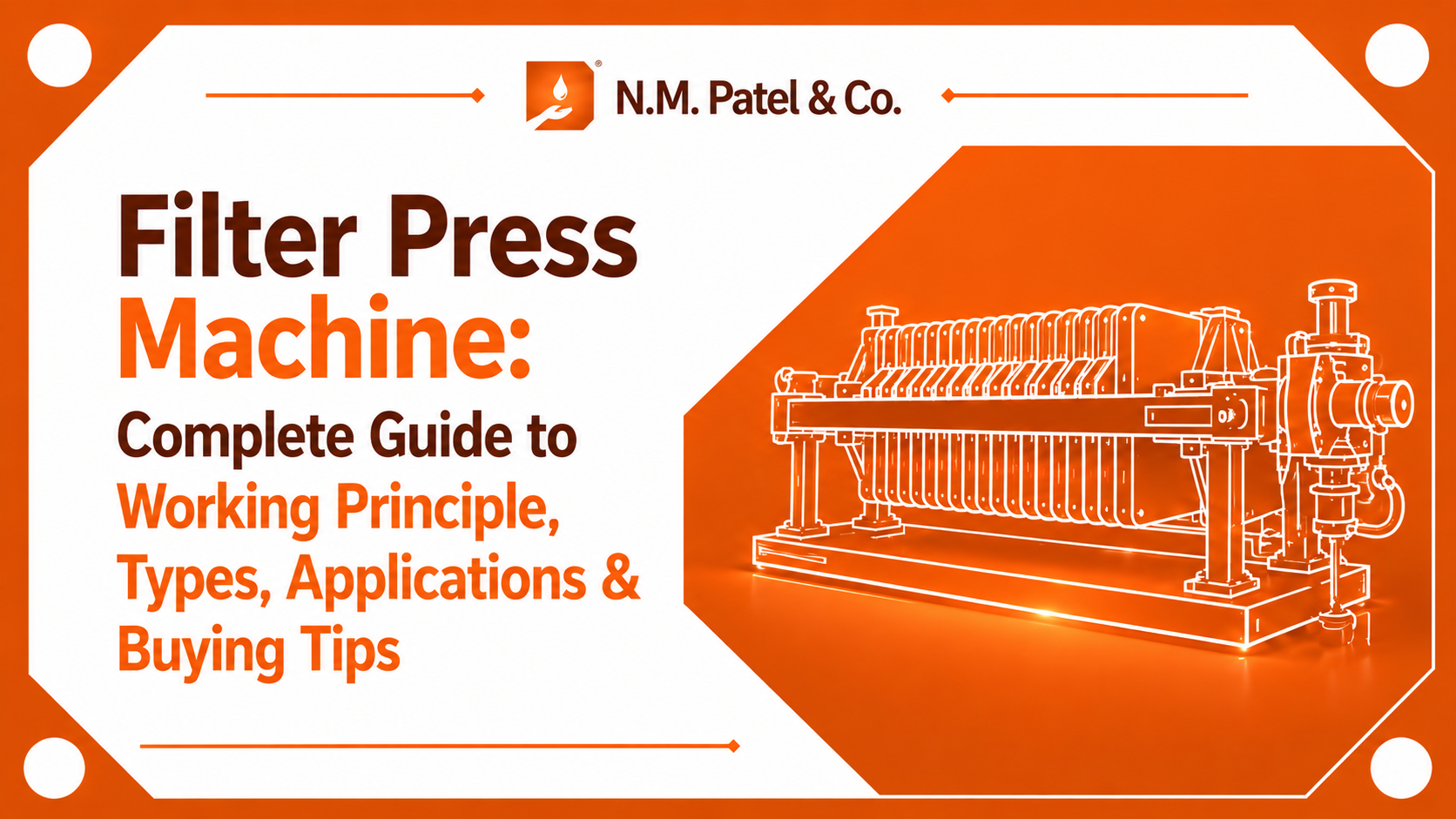
Efficient solid-liquid separation is critical for industries that handle slurry, wastewater, chemicals, minerals, pharmaceuticals, or food products. Among the most reliable filtration systems available today, the filter press machine remains one of the most effective solutions for producing clear filtrate while minimizing waste volume.
Whether your goal is sludge dewatering, product recovery, or wastewater treatment, selecting the right filter press machine can significantly improve productivity, reduce disposal costs, and enhance operational efficiency.
With nearly 90 years of engineering excellence and more than 12,000 successful installations, N.M. Patel & Co. has become one of India’s trusted manufacturers of industrial filter press machines, delivering customized filtration solutions across diverse industries.
This guide explains how filter press machines work, the different types available, their applications, advantages, and key factors to consider before making an investment.
What Is a Filter Press Machine?
A filter press machine is an industrial filtration system designed to separate solids from liquids using pressure filtration.
The machine consists of multiple filter plates covered with filter cloth. Slurry is pumped into the chambers, where liquid passes through the cloth while solid particles remain inside, gradually forming a filter cake.
Once filtration is complete, the filter cake is discharged, and the system is prepared for the next filtration cycle.
How Does a Filter Press Machine Work?
The filtration process generally follows these steps:
Step 1: Slurry Feeding
A slurry pump transfers the mixture into the filter press chambers under controlled pressure.
Step 2: Filtration
The filter cloth allows liquid to pass while retaining suspended solids.
Step 3: Cake Formation
Solid particles accumulate inside the chambers, creating a compact filter cake.
Step 4: Optional Membrane Squeezing
For membrane filter presses, flexible membranes apply additional pressure to reduce cake moisture and improve dewatering efficiency.
Step 5: Cake Discharge
After filtration, the plates open and the filter cake is discharged for disposal, recycling, or further processing.
Main Components of a Filter Press Machine
A complete filter press system includes:
- Machine Frame
- Hydraulic Closing System
- Filter Plates
- Filter Cloth
- Feed Pump
- Hydraulic Power Pack
- Control Panel
- Drip Tray (Optional)
- Plate Shifting System
- Cloth Washing System
- Filtrate Collection System
Each component contributes to efficient, reliable, and consistent filtration performance.
Types of Filter Press Machines
Different industries require different filtration solutions.
Recessed Chamber Filter Press
Ideal for general industrial filtration, offering reliable performance and low maintenance for a wide range of applications.
Membrane Filter Press
Uses membrane plates to squeeze the filter cake after filtration, resulting in lower moisture content, shorter cycle times, and improved product recovery.
Plate and Frame Filter Press
Commonly used where high filtration clarity and fine particle separation are required, especially in pharmaceutical and food processing industries.
Automatic Filter Press
Equipped with PLC controls, automatic plate shifting, cloth washing, and hydraulic operation to improve productivity while reducing manual intervention.
Manual & Semi-Automatic Filter Press
Suitable for smaller production capacities and applications where full automation is not required.
Advantages of Filter Press Machines
Modern filter press machines provide several operational benefits:
- High solid-liquid separation efficiency
- Low residual moisture in filter cake
- Clear filtrate quality
- Reduced waste disposal costs
- Lower operating expenses
- Long equipment life
- High production reliability
- Energy-efficient operation
- Easy maintenance
- Automation-ready design
These benefits make filter presses one of the most cost-effective industrial filtration systems available.
Industrial Applications
Filter press machines are widely used across multiple industries.
Chemical Industry
- Pigments
- Resins
- Catalysts
- Specialty chemicals
Pharmaceutical Industry
- API production
- Fine chemicals
- Sterile filtration
- Product recovery
Food & Beverage
- Sugar processing
- Edible oil filtration
- Beverage clarification
- Starch production
Mining & Minerals
- Mineral concentrates
- Tailings dewatering
- Metal recovery
Wastewater Treatment
- Industrial sludge dewatering
- Municipal wastewater
- Effluent treatment plants
Ceramics & Pigments
- Clay processing
- Ceramic slurry filtration
- Color pigment manufacturing
How to Choose the Right Filter Press Machine
Before purchasing a filter press, evaluate the following:
Slurry Characteristics
Understand particle size, solid concentration, viscosity, and chemical composition.
Filtration Capacity
Select equipment based on daily production requirements.
Cake Moisture Requirement
Lower moisture requirements may justify investing in a membrane filter press.
Automation Level
Determine whether manual, semi-automatic, or fully automatic operation best suits your facility.
Construction Material
Choose materials compatible with your process chemicals and operating conditions.
Future Expansion
Consider equipment that can accommodate future production growth.
Importance of Filter Cloth Selection
Filter cloth plays a major role in filtration performance.
The correct filter cloth improves:
- Filtration speed
- Cake release
- Filtrate clarity
- Equipment efficiency
- Operating cost
Experienced manufacturers recommend cloth materials based on slurry testing and process conditions.
Why Choose N.M. Patel & Co.?
N.M. Patel & Co. has been manufacturing industrial filtration equipment since 1935, serving customers across India and international markets with reliable, high-performance filter press solutions.
Our product range includes:
- Recessed Chamber Filter Press
- Membrane Filter Press
- Plate & Frame Filter Press
- Automatic Filter Press
- Semi-Automatic Filter Press
- Stainless Steel Filter Press
- Filter Plates
- Filter Cloths
- Hydraulic Systems
- Auxiliary Filtration Equipment
Every system is engineered to meet specific process requirements while maximizing filtration efficiency and minimizing operational costs.
Why Industries Trust N.M. Patel & Co.
Customers choose us because of our:
- Nearly 90 years of manufacturing expertise
- 12,000+ successful installations
- Customized filtration solutions
- Advanced automation capabilities
- High-quality manufacturing standards
- Comprehensive after-sales support
- Reliable spare parts availability
- Strong engineering and application expertise
From design and manufacturing to installation and technical support, we provide complete filtration solutions for demanding industrial applications.
People Also Search For
- filter press machine
- industrial filter press machine
- filter press manufacturer India
- membrane filter press
- plate and frame filter press
- recessed chamber filter press
- automatic filter press
- sludge dewatering filter press
- industrial filtration equipment
- filter press supplier
People Also Ask
What is a filter press machine?
A filter press machine is an industrial filtration system that separates solids from liquids by pumping slurry into filter chambers under pressure, producing a dry filter cake and clear filtrate.
Which industries use filter press machines?
Chemical, pharmaceutical, food processing, mining, wastewater treatment, ceramic, pigment, and metallurgy industries commonly use filter press machines.
What is the difference between membrane and recessed chamber filter presses?
Membrane filter presses use flexible membranes to squeeze the filter cake, resulting in lower moisture content and shorter filtration cycles compared to recessed chamber filter presses.
How long does a filter press machine last?
With proper maintenance and quality components, industrial filter press machines can operate efficiently for many years, delivering reliable performance in demanding applications.
Why choose N.M. Patel & Co.?
N.M. Patel & Co. combines decades of engineering expertise, customized filtration solutions, advanced automation, high-quality manufacturing, and dependable after-sales support to deliver efficient industrial filtration systems.
Frequently Asked Questions
Can filter press machines be customized?
Yes. Filter presses can be customized based on filtration capacity, plate size, automation level, operating pressure, construction material, and specific process requirements.
How do I determine the correct filter press size?
The ideal size depends on slurry characteristics, daily production volume, filtration cycle time, and desired cake moisture. Slurry testing helps identify the most suitable configuration.
Is automation available for filter press machines?
Yes. Modern systems include PLC controls, automatic plate shifting, hydraulic closing systems, cloth washing units, drip trays, and remote monitoring options.
What maintenance does a filter press require?
Routine maintenance includes inspecting filter cloths, hydraulic systems, seals, plates, pumps, and cleaning the equipment to ensure consistent filtration performance.
Does N.M. Patel & Co. provide technical support?
Yes. N.M. Patel & Co. offers installation assistance, application engineering, slurry testing, spare parts, preventive maintenance, and after-sales support to maximize equipment performance.
Conclusion
A filter press machine is one of the most efficient and reliable solutions for industrial solid-liquid separation. Choosing the right machine—and the right manufacturing partner—can significantly improve productivity, reduce operating costs, and enhance process performance.
With nearly 90 years of filtration expertise, 12,000+ successful installations, and a complete range of customized filter press solutions, N.M. Patel & Co. continues to help industries achieve dependable, cost-effective, and high-performance filtration for applications across chemicals, pharmaceuticals, mining, food processing, and wastewater treatment.