





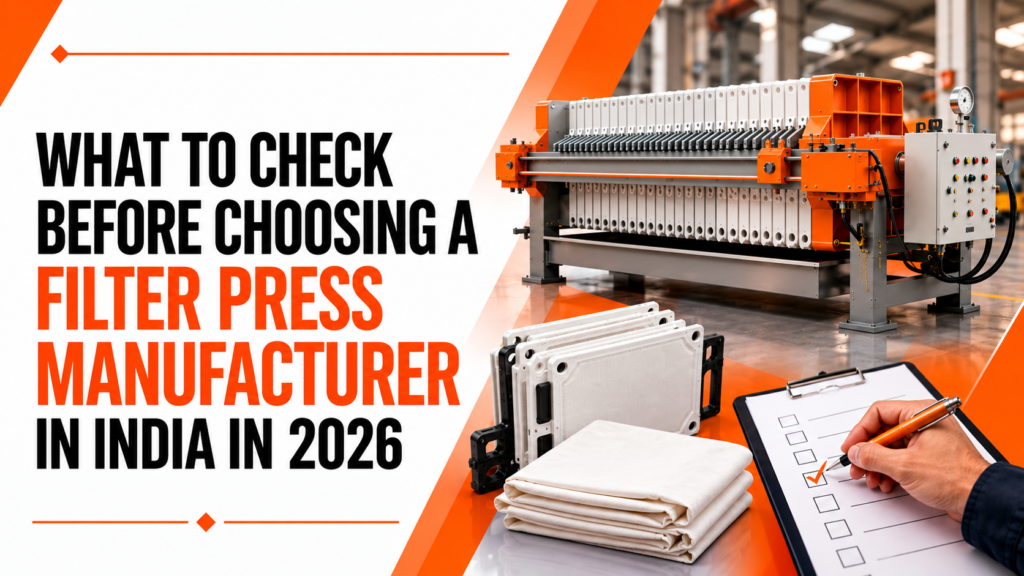
Choosing a filter press manufacturer is not simply a matter of comparing machine prices. The right filtration system depends on your slurry, solids concentration, filtration capacity, required cake moisture, operating pressure, material compatibility and desired level of automation.
For industrial buyers searching for a filter press manufacturer in India, the most useful approach is to evaluate engineering capability before comparing quotations.
A capable manufacturer should be able to understand the material being filtered, test the slurry when required, determine an appropriate filtration configuration, recommend suitable plates and filter cloths, and provide technical support after installation.
N.M. Patel & Co. has been involved in filtration technology since 1935, with its development progressing from wooden filtration equipment to polypropylene recessed plates, membrane technology and automated filter press systems.
Before sending an enquiry to filter press manufacturers in India, evaluate these points:
- Experience with your specific slurry and industry
- Ability to perform slurry testing
- Filter press sizing and engineering capability
- Range of filter press technologies
- Filter plate and cloth selection expertise
- Material compatibility
- Manual, semi-automatic and fully automatic options
- Custom engineering capabilities
- Installation and commissioning support
- Spare parts and after-sales support
The important question is not simply, “Who manufactures filter presses?”
The better question is, “Who can engineer a filtration system around my actual process conditions?”
A filter press operates as part of a process, not as an isolated machine.
Two factories may process similar products but still require different filtration configurations because their slurry concentration, particle characteristics, temperature, production volume and cake moisture targets differ.
Poor equipment selection can result in:
- Longer filtration cycles
- Wet filter cake
- Poor filtrate clarity
- Frequent cloth blinding
- Excessive operator involvement
- Higher maintenance
- Production bottlenecks
- Unnecessary energy consumption
This is why buyers should evaluate engineering capabilities rather than choosing equipment based only on machine dimensions or purchase price.
| Factor to Check | Why It Matters | What the Buyer Should Ask |
| Slurry evaluation | Slurry behavior influences filtration performance | Can you test our actual slurry? |
| Capacity engineering | Incorrect sizing can create bottlenecks | How will you calculate required capacity? |
| Filter press type | Different processes need different configurations | Why are you recommending this design? |
| Filter plate selection | Plate design affects cake formation and operation | Which plate type suits our application? |
| Filter cloth selection | Cloth affects clarity, cycle time and cake release | How will the cloth be selected? |
| Material compatibility | Chemicals and temperature affect component life | Is the proposed MOC compatible with our process? |
| Automation | Automation can reduce repetitive manual operations | Which functions can be automated? |
| Testing | Testing reduces assumptions before final selection | Can our sample be evaluated before manufacturing? |
| Service | Downtime can be costly | What support is available after installation? |
| Spare parts | Long-term availability affects maintainability | Are replacement components readily available? |
This checklist provides procurement teams with a more useful comparison than evaluating quotations only by price.
1. Start With the Slurry, Not the Machine
One of the most important steps when selecting a filter press is understanding what actually needs to be filtered.
Relevant process information can include:
- Slurry composition
- Percentage of solids
- Particle characteristics
- Viscosity
- Temperature
- pH
- Chemical properties
- Required filtrate clarity
- Desired cake moisture
- Daily processing requirement
N.M. Patel & Co. offers industrial slurry sample testing to evaluate factors such as solids content, filtration rate, cake formation, moisture, filtrate clarity and compatibility with different cloth and plate options.
Testing an actual process sample can provide stronger engineering evidence than selecting a machine from generic capacity figures alone.
Why Is Slurry Testing Important?
Imagine two plants that each need to process the same daily volume.
Plant A handles a slurry with relatively permeable solids.
Plant B processes fine particles that form a dense cake with greater filtration resistance.
Their daily volumes may be identical, but the optimum filtration area, cloth, cycle time and machine configuration may differ substantially.
This is why a technically capable filter press manufacturer in India should ask about the process before recommending equipment.
2. Check Whether the Manufacturer Can Calculate the Right Capacity
Bigger does not automatically mean better.
An undersized machine can restrict production. An unnecessarily oversized system can increase capital expenditure and occupy additional plant space without delivering proportional benefits.
Filter press capacity depends on multiple variables, including:
- Slurry volume
- Solids concentration
- Filtration area
- Chamber volume
- Cake thickness
- Filtration rate
- Cycle duration
- Number of cycles per shift or day
- Cake moisture target
- Operational downtime
This means capacity selection should be based on process engineering rather than a single universal machine-size chart.
3. Compare Filter Press Technologies, Not Just Manufacturers
Industrial buyers researching filter press manufacturers in India should also determine which filtration technology suits the application.
Common configurations include recessed chamber, membrane, plate and frame, manual, semi-automatic, stainless steel and fully automatic filter presses.
Recessed Chamber Filter Press
A recessed filter press uses recessed plates that create chambers for cake formation.
This configuration can be considered for many conventional solid-liquid separation and dewatering applications where dependable operation and relatively straightforward maintenance are priorities.
Membrane Filter Press
Membrane systems introduce an additional squeezing stage after initial cake formation.
They can be considered where lower residual cake moisture, improved dewatering or specific cycle-performance requirements justify the additional technology.
Plate and Frame Filter Press
Plate and frame systems provide another established filtration configuration and may suit particular process, product recovery or filtration requirements.
Fully Automatic Filter Press
Automation can cover functions such as slurry feeding, plate shifting, cake discharge, cloth washing, valves, hydraulic controls and process monitoring.
The correct choice depends on the process rather than which technology sounds most advanced.
4. Ask How the Filter Cloth Will Be Selected
The filter cloth is one of the most important interfaces between the slurry and filtration system.
Cloth selection can influence:
- Filtrate clarity
- Cake release
- Filtration resistance
- Cycle time
- Cloth life
- Product recovery
- Maintenance frequency
A manufacturer should therefore consider the process media and filtration objective when recommending cloth construction and material.
Treating filter cloth as a generic consumable can undermine the performance of an otherwise correctly designed machine.
5. Evaluate Material Compatibility
Industrial filtration environments vary considerably.
A system used for wastewater sludge may have different construction requirements from equipment handling pharmaceuticals, food products, acidic chemicals or high-temperature process streams.
Depending on the application, engineers may need to evaluate the materials used for:
- Filter plates
- Filter cloths
- Piping
- Wetted components
- Drip trays
- Frames
- Valves
- Seals and related components
Material selection should be tied to chemical compatibility, temperature, hygiene requirements and operating environment.
6. Decide How Much Automation You Actually Need
Automation is increasingly important in industrial filtration, but the correct level depends on production conditions.
A smaller batch operation may not require the same automation as a high-throughput facility operating multiple shifts.
Modern systems can incorporate:
- Automatic plate shifting
- Cloth washing
- Hydraulic closing
- Automated valves
- Drip trays
- Cake handling
- Conveyors
- PLC controls
- Process monitoring
- Safety systems
N.M. Patel & Co.’s fully automatic filter press systems can integrate functions including automated feeding, pressure filtration, plate shifting, cloth washing and cake handling.
The business case for automation should consider labor requirements, cycle frequency, throughput, safety and total operating cost.
7. Look Beyond the Initial Filter Press Price
The lowest quotation is not necessarily the lowest-cost filtration solution.
Industrial buyers should consider total lifecycle implications.
Initial Cost
This includes the machine, controls, accessories, installation requirements and any supporting systems.
Operating Cost
Consider energy, labor, compressed air, wash water and other process requirements.
Consumable Cost
Filter cloth and other wear components will require replacement during the equipment lifecycle.
Maintenance Cost
Accessibility, component quality and serviceability affect long-term expenditure.
Downtime Cost
A cheaper system can become expensive if production stops frequently because of reliability problems or unavailable parts.
A procurement comparison should therefore consider total value over the expected operating life rather than purchase price alone.
8. Check the Manufacturer’s Engineering History
Experience becomes particularly useful when it reflects actual development in filtration technology.
N.M. Patel & Co.’s documented history dates to 1935. The company’s technology timeline includes wooden filtration equipment, cast iron structures, polypropylene recessed and plate-and-frame systems, automatic plate shifting, CGR plates, high-pressure membrane technology, fully automatic systems and later robotic filtration technologies.
This historical development matters because industrial filtration has moved far beyond a basic mechanical press.
Today’s projects may combine mechanical engineering, hydraulic systems, plate and cloth selection, process controls, automation and application-specific design.
9. Ask What Happens After Installation
A filtration project does not finish when equipment leaves the manufacturing facility.
Before placing an order, buyers should ask:
- Who assists with commissioning?
- Is operator training available?
- How are technical problems diagnosed?
- Are filter cloths and plates available later?
- Are hydraulic and automation components serviceable?
- How quickly can replacement parts be supplied?
- Can the system be modified if production requirements change?
After-sales capability is particularly important for plants where filtration downtime affects the complete production line.
10. Prepare the Right Information Before Requesting a Quote
A detailed enquiry helps the manufacturer recommend a more appropriate system.
Before contacting a filter press manufacturer, prepare as much of the following information as possible:
| Information | Example |
| Industry | Chemical, pharmaceutical, mining, food, wastewater |
| Material | Description of slurry |
| Daily volume | Litres or m³/day |
| Solids concentration | Percentage |
| Temperature | Operating temperature |
| pH | Process pH |
| Required cake moisture | Target if known |
| Filtrate requirement | Required clarity or recovery |
| Operating hours | Hours/shifts per day |
| Automation preference | Manual, semi-auto or automatic |
| Plant limitations | Space, height or utility restrictions |
If some of these parameters are unknown, sample testing and engineering evaluation can help establish appropriate design assumptions.
Questions to Ask a Filter Press Manufacturer Before Ordering
Use these questions during technical and commercial discussions:
- Have you handled slurry similar to ours?
- Can you test our slurry before final equipment selection?
- How did you calculate the proposed filtration area and capacity?
- Why are you recommending this filter press configuration?
- Which plate type will be used?
- How will you select the filter cloth?
- What cake moisture can reasonably be expected from our process?
- Which components are exposed to the process material?
- What automation options are appropriate for our production volume?
- What routine maintenance will be required?
- Which consumables should we keep in stock?
- What technical support is available after commissioning?
A manufacturer that can answer these questions with application-specific reasoning gives buyers substantially more information for making a procurement decision.
How N.M. Patel & Co. Approaches Industrial Filtration
N.M. Patel & Co. has developed filtration technology since 1935 and today works across multiple filter press configurations and industrial applications.
Its current filtration capabilities include recessed, membrane, plate and frame, stainless steel, manual and automated filter press systems, along with filter plates, filter cloths and supporting automation.
For buyers looking for a filter press manufacturer in India, the key advantage of an engineering-led approach is that equipment selection can begin with process requirements rather than a predetermined machine.
Businesses planning a new installation, capacity expansion or replacement system can contact N.M. Patel & Co. with their slurry details and operating requirements for technical discussion.
Key Takeaways for Industrial Buyers
Before selecting a filter press manufacturer, remember:
- Do not compare manufacturers on price alone.
- Start with slurry characteristics and production objectives.
- Verify capacity calculations before finalizing machine size.
- Match the filter press technology to the process.
- Treat plate and filter cloth selection as engineering decisions.
- Evaluate chemical and temperature compatibility.
- Choose automation according to actual operating requirements.
- Consider maintenance, consumables and downtime in lifecycle cost.
- Verify technical support and spare-part availability.
- Provide detailed process data when requesting a quotation.
For industrial procurement teams comparing filter press manufacturers in India, these checks can turn a basic equipment purchase into a better-engineered filtration investment.
Frequently Asked Questions
What should I look for in a filter press manufacturer?
Look for application engineering capability, slurry testing, appropriate equipment sizing, multiple filtration technologies, plate and cloth expertise, customization, automation options and dependable technical support. The manufacturer should recommend equipment based on process requirements rather than machine size alone.
How do I choose a filter press manufacturer in India?
Begin by sharing your slurry properties, processing volume, cake moisture requirement, operating conditions and automation needs. Compare manufacturers on their ability to engineer and support the complete filtration process, not simply their quoted equipment price.
What information does a filter press manufacturer need for a quotation?
Useful information includes slurry composition, solids percentage, daily volume, temperature, pH, desired cake moisture, filtrate requirements, operating hours, available plant space and preferred automation level.
Should slurry be tested before buying a filter press?
Testing can be particularly valuable when filtration behavior is unknown or process performance is critical. It can help establish filtration rate, cake behavior, suitable filter cloth, plate configuration and operating conditions.
Which type of filter press is best for industrial use?
There is no single best configuration for every application. Recessed, membrane, plate and frame, manual and automatic systems address different process requirements. Selection should be based on slurry characteristics, throughput, cake moisture, operating conditions and automation requirements.
Is an automatic filter press always better than a manual system?
No. Automation can reduce repetitive manual work and improve consistency in suitable high-throughput applications, while simpler systems may remain appropriate for smaller or less frequent filtration duties.
Why is filter cloth selection important?
Filter cloth influences particle retention, filtrate clarity, filtration resistance, cake release and cycle performance. The appropriate cloth depends on the material being processed and the required filtration result.
How can I compare quotations from different filter press manufacturers?
Normalize the quotations before comparing them. Check filtration area, chamber capacity, plate specifications, cloth, materials of construction, hydraulic system, controls, automation, accessories, commissioning, warranties, consumables and after-sales support.
Does N.M. Patel & Co. manufacture filter presses in India?
Yes. N.M. Patel & Co. describes itself as an Indian manufacturer and supplier of industrial filtration equipment, with a documented filtration history dating to 1935 and manufacturing development across several filter press technologies.
How can I request a filter press recommendation?
Prepare your process and slurry information first. Providing solids concentration, daily volume, temperature, pH, desired cake condition and operating requirements gives engineers a stronger basis for recommending a suitable configuration.
Final Word
Choosing among filter press manufacturers in India should be an engineering decision before it becomes a purchasing decision.
Machine price matters, but filtration performance ultimately depends on whether the press is correctly matched to the slurry, capacity, cake requirements, materials and operating environment.
A strong procurement process therefore begins with process data, moves through testing and equipment selection, and finishes with lifecycle support.
For companies currently evaluating a filter press manufacturer in India, gathering the right process information before requesting quotations is one of the simplest ways to improve the quality of the final filtration solution.