





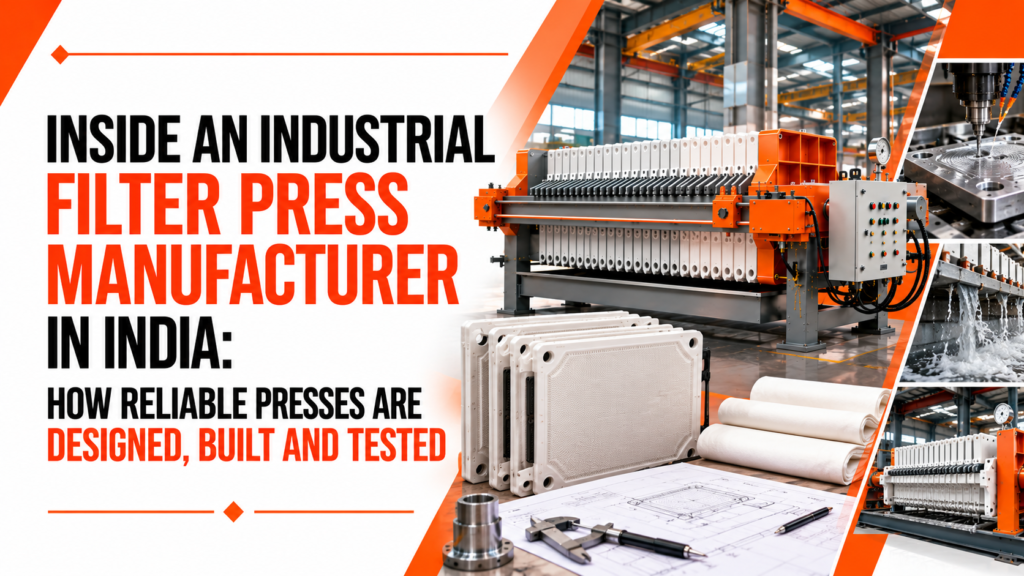
A dependable industrial filter press manufacturer in India controls every critical stage under one roof. That covers process design, frame fabrication, plate selection, hydraulics, automation and final pressure testing. When one company owns all of these steps, you get a press that is sized for your slurry, seals without leaks, and runs for years with predictable maintenance. When steps are outsourced and stitched together, problems usually show up after commissioning, when they cost the most to fix.
What separates top manufacturers from the rest
- Engineering starts with your slurry data, not a catalogue model.
- Plates are made from virgin polypropylene with machined sealing faces.
- The hydraulic system holds closing pressure steadily through the full cycle.
- Every press is pressure tested and run before dispatch.
How an Industrial Filter Press Is Built, Stage by Stage
Most buyers only see the finished machine. Here’s what happens before it reaches your plant, and what to look for at each stage.
Stage 1: Process Design and Sizing
Engineers start with your daily sludge volume, solids percentage, particle size, pH and temperature. From this, they calculate the filtration area, the plate size, the number of chambers and the cycle time. A press sized from guesswork either chokes on volume or wastes capital on capacity you never use.
Stage 2: Frame Fabrication
The frame carries enormous closing force, so its design decides how long the press lasts. Good manufacturers use heavy structural steel, weld it to engineered drawings, and sandblast it before coating. An epoxy or polyurethane paint system protects it in corrosive plant environments. For food and pharma duty, stainless steel cladding or full SS construction is common.
Stage 3: Filter Plates
Plates are the heart of the press. Quality plates are moulded from virgin polypropylene and then CNC machined, so the sealing surfaces sit perfectly flat. Uneven plates leak, spray slurry and wear out cloths early. Depending on your sludge, a manufacturer will specify recessed chamber plates or membrane plates.
Stage 4: Hydraulic Power Pack
The hydraulic cylinder closes and locks the plate pack. A well-built power pack reaches its set pressure quickly and holds it without constant pump cycling. Pressure gauges, safety relief valves and auto pressure-holding circuits are signs of thoughtful engineering.
Stage 5: Automation and Controls
Automation now ranges from simple push-button hydraulics to fully automatic systems. A fully automatic press includes:
- PLC control
- Automatic plate shifting
- Cloth washing
- Drip trays
- Cake discharge interlocks
Safety light curtains protect operators during plate movement.
Stage 6: Testing Before Dispatch
Serious industrial filter press manufacturers hydro test the press and dry run the complete cycle. They also check plate alignment and give the buyer a test report. Many offer a factory acceptance test, so you can see your press operate before it ships.
Component Quality Checklist
Use this table when you visit a factory or review a technical proposal.
| Component | What to Check | Why It Matters |
| Frame | Steel section size, sandblasting, coating system | Prevents bending and corrosion over years of cycles |
| Plates | Virgin PP, machined sealing faces, rated pressure | Stops leaks and protects filter cloths |
| Filter cloth | Material and weave matched to your solids | Controls filtrate clarity and cycle speed |
| Hydraulics | Pressure holding, relief valves, reputable pump brand | Ensures safe, consistent closing force |
| Controls | PLC brand, interlocks, safety curtains | Protects operators and cuts manual effort |
| Testing | Hydro test report, trial run, FAT option | Proves the press works before it arrives |
What’s Changing for Filter Press Manufacturing in 2026
Three shifts are reshaping how presses are built in India.
The first is automation. Labour costs keep rising and skilled operators are hard to keep. Plants that once accepted manual plate shifting now ask for automatic shifters and cloth washing as standard.
The second is drier cake for compliance. Effluent norms keep tightening, and many sectors are moving toward Zero Liquid Discharge. As a result, demand is rising for automatic and membrane filter press systems that squeeze more water out of the sludge. That also cuts disposal weight and cost.
The third is local manufacturing. More buyers now prefer presses designed and built in India. Spares arrive faster, service engineers are closer, and there is no import delay when a plate or seal needs replacing.
Myths vs Facts About Industrial Filter Presses
Myth: All filter presses perform about the same.
Fact: Plate quality, cloth selection and sizing change results dramatically. Two presses with the same plate count can produce very different cake dryness and cycle times.
Myth: A bigger press is always the safer choice.
Fact: An oversized press runs partly empty chambers, which can cause uneven cakes and plate damage. Correct sizing beats extra capacity.
Myth: Automation only makes sense for large plants.
Fact: Even mid-sized units running two or three shifts often recover the cost of automation through labour savings and fewer cloth replacements.
Myth: Imported presses are always better built.
Fact: Many Indian manufacturers now build to the same engineering standards. They also offer faster service and spares at local prices.
Which Configuration Fits Your Industry?
| Industry | Typical Slurry | Common Configuration |
| Textile and dyeing | Chemical sludge, colour effluent | Membrane press for drier cake |
| Chemicals and pigments | Fine, sometimes corrosive solids | PP recessed or membrane plates |
| Pharma and food | Clarification, hygiene critical | SS construction, plate and frame or recessed |
| Ceramics and tiles | Clay and glaze slurry | Heavy-duty recessed chamber press |
| Mining and minerals | High solids, abrasive particles | Large automatic press with robust frame |
| Municipal and ETP | Biological and mixed sludge | Membrane press with conditioning system |
Frequently Asked Questions
What does an industrial filter press manufacturer do?
It designs, fabricates, assembles and tests filter presses that separate solids from liquids. A good manufacturer also sizes the press, recommends cloths and supports installation and maintenance.
How do I compare industrial filter press manufacturers in India?
Visit the factory if you can, review plate and frame specifications, ask for test reports, and speak with customers in your industry. Check spares availability and service response times too.
How long does it take to manufacture an industrial filter press?
Lead time depends on size, plate type and automation level. Standard models ship faster than custom automatic systems. Confirm the timeline in writing with your quote.
Can a manufacturer customise a press for my plant layout?
Yes. Experienced manufacturers adjust frame length, discharge height, feed connections and automation level to fit your space and process.
Talk to Engineers Who Build Your Press
The best way to judge a manufacturer is to see how it works. N M Patel & Co. engineers can review your slurry details, recommend the right press configuration, and walk you through how your machine will be built and tested. Share your requirements with our team and get a proposal engineered for your plant.