





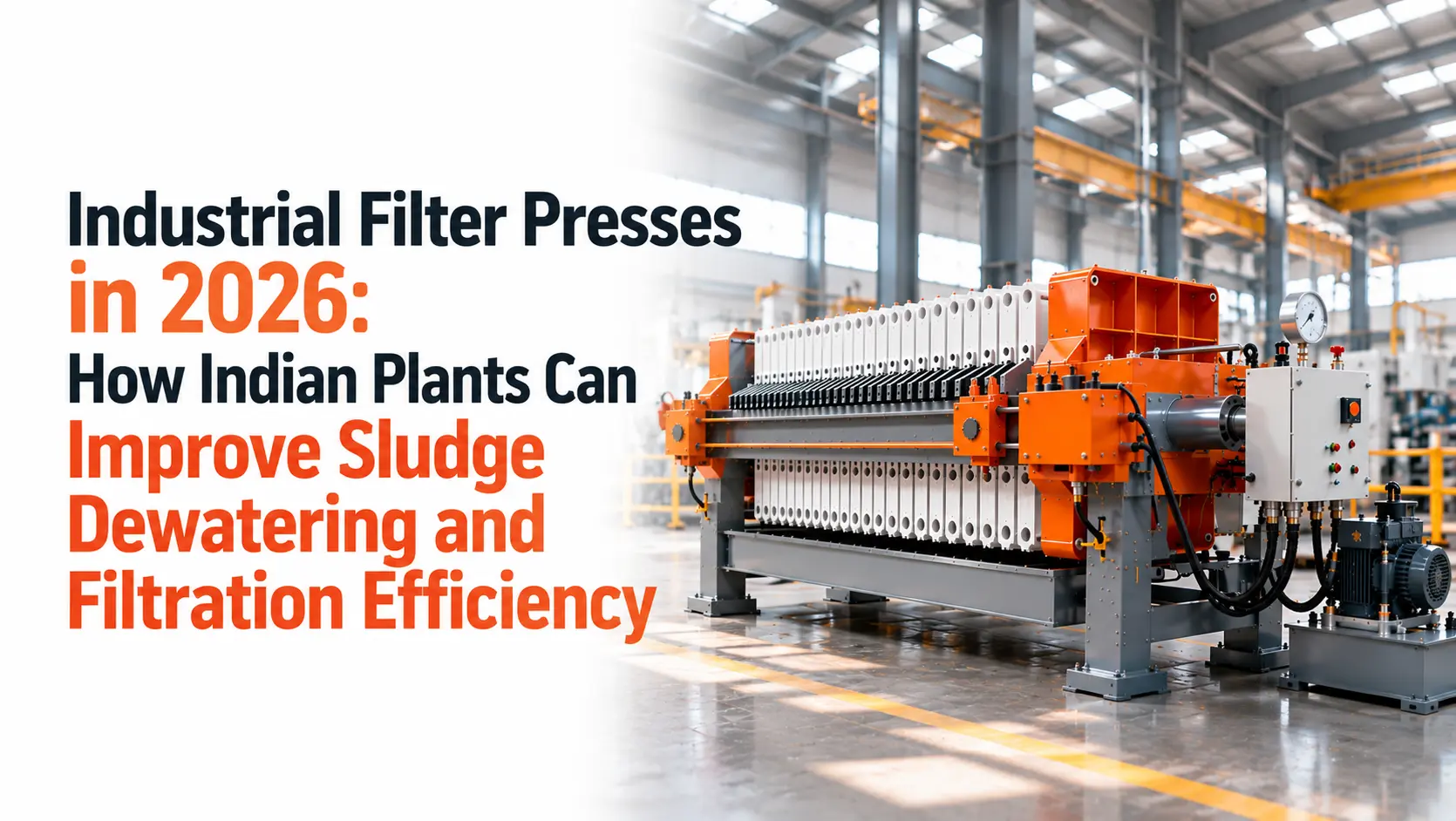
Industrial plants across India are under increasing pressure to improve wastewater handling, reduce sludge volume, recover useful liquids and operate filtration systems more efficiently.
For many applications, a filter press remains an important mechanical solid-liquid separation technology because it uses pressure filtration to retain solids as filter cake while allowing filtered liquid to pass through the filter media.
Choosing the right industrial filter press manufacturer is therefore not simply an equipment-purchasing decision. The press must match the slurry characteristics, required capacity, operating conditions, desired cake properties and level of automation required by the plant.
N.M. Patel & Co. manufactures filter press systems in India for industrial filtration applications and states that its product range includes recessed, membrane, plate and frame, stainless steel and automated filter press configurations.
Businesses evaluating equipment can review the company’s industrial filter press manufacturing capabilities before selecting a configuration for their application.
Quick Answer: What Should Industries Look for in a Filter Press in 2026?
An industrial filtration system should be selected according to the actual process rather than machine size alone.
Important factors include:
- Slurry composition
- Percentage of solids
- Particle characteristics
- Required filtration capacity
- Desired filter cake moisture
- Filtrate clarity requirements
- Chemical compatibility
- Operating pressure
- Cycle time
- Filter cloth selection
- Available manpower
- Required automation level
- Maintenance accessibility
The right machine configuration can improve filtration consistency while reducing unnecessary manual handling and operational delays.
Why Sludge Dewatering Is Becoming More Important
Industrial wastewater treatment does not end when contaminants are transferred from water into sludge.
That sludge still has to be handled.
Removing excess water from sludge can make subsequent handling, transportation and disposal more manageable. CPCB technical material specifically discusses mechanical sludge dewatering as a means of reducing the water content of sludge before subsequent treatment or handling.
This makes dewatering performance an important consideration for industries operating ETPs, wastewater treatment facilities and other solid-liquid separation processes.
A properly selected filter press can help create a more concentrated filter cake while recovering filtrate for the next stage of the process, depending on the application.
How Does an Industrial Filter Press Work?
Although configurations differ, pressure filtration generally follows a straightforward sequence.
Step 1: Plate Closing
Filter plates are closed together to form filtration chambers.
Step 2: Slurry Feeding
The slurry is pumped into the chambers under controlled pressure.
Step 3: Solid-Liquid Separation
Liquid passes through the filter cloth while suspended solids are retained inside the chambers.
Step 4: Cake Formation
Retained solids gradually build into a filter cake as filtration continues.
Step 5: Cake Discharge
After the filtration cycle, the plates are opened and the accumulated cake is removed.
More advanced presses can automate several parts of this cycle.
Industrial Filter Press Manufacturer in India: Which Type of Press Should You Choose?
There is no single filter press design suitable for every industrial process.
The selection should depend on the nature of the material being filtered.
| Filter Press Type | Typical Strength |
| Recessed chamber filter press | General industrial solid-liquid separation |
| Membrane filter press | Applications requiring additional cake squeezing |
| Plate and frame filter press | Flexible chamber configuration and controlled filtration |
| Semi-automatic filter press | Reduced operator effort with partial automation |
| Fully automatic filter press | Higher-volume operations requiring reduced manual intervention |
| Stainless steel configuration | Applications where process conditions require suitable corrosion or hygiene characteristics |
An experienced industrial filter press manufacturer in India should therefore evaluate process information before recommending a machine.
Why Recessed Chamber Filter Presses Remain Important
Recessed chamber presses use moulded recessed plates that form filtration chambers when the plates are closed.
They are used across a range of industrial solid-liquid separation processes because their design supports cake formation within the recessed chambers.
N.M. Patel & Co. lists applications including:
- Effluent and sludge dewatering
- Chemical processing
- Pharmaceutical processing
- Food and beverage production
- Ceramic and mineral processing
- Dyestuff and pigment filtration
Plants evaluating this configuration can review the company’s recessed filter press systems for further technical information.
When Does a Membrane Filter Press Make Sense?
A membrane filter press adds another stage after primary filtration.
Flexible membrane plates can apply additional pressure to the formed filter cake. This additional squeezing may help reduce residual cake moisture and improve process performance where lower cake moisture is important.
However, a membrane press should not automatically be selected simply because it is more advanced.
The decision should depend on:
- Material characteristics
- Moisture target
- Cycle requirements
- Operating costs
- Process economics
Equipment selection should always be process-led.
Automation Is Changing Industrial Filtration
One of the important developments in industrial filtration is the movement toward greater process automation.
A fully automatic filter press can automate functions such as:
- Slurry feeding
- Pressure filtration
- Plate shifting
- Cake discharge
- Cloth washing
- Selected auxiliary functions
Automation can be especially valuable where a facility handles repeated filtration cycles and wants to reduce operator involvement.
N.M. Patel & Co.’s fully automatic filter press is designed around automated operation for industrial filtration processes.
Manual vs Semi-Automatic vs Fully Automatic Filter Press
| Configuration | Operator Involvement | Best Considered For |
| Manual | Higher | Smaller or less frequent filtration operations |
| Semi-automatic | Moderate | Plants seeking partial automation |
| Fully automatic | Lower | Repetitive or larger-scale industrial filtration |
Automation should be selected based on plant requirements rather than treated as a universal upgrade.
What Industrial Filter Press Manufacturers Need to Know Before Quoting
One of the biggest mistakes buyers make is asking:
“What is the price of a filter press?”
before providing enough process information.
Two plants with the same required throughput may still need different machines.
An industrial filter press manufacturer may need information such as:
- Type of slurry
- Solids concentration
- Required throughput
- Particle characteristics
- Slurry temperature
- Chemical composition
- Target cake moisture
- Required filtrate clarity
- Available operating pressure
- Automation requirements
This information helps reduce the risk of choosing equipment that looks correct on paper but performs poorly with the actual material.
Filter Cloth Is Critical to Filtration Performance
The filter cloth should not be treated as a minor consumable.
It acts as the filtration medium and can influence:
- Filtrate clarity
- Cake release
- Cycle time
- Filtration resistance
- Overall separation performance
Different slurries require different cloth characteristics.
N.M. Patel & Co. describes filter cloth selection as an important part of filtration performance, alongside plate and system configuration.
This is one reason sample testing can be valuable before final machine specification.
Why Sample Testing Matters Before Filter Press Selection
Actual slurry behaviour can differ significantly from assumptions based only on industry type.
Sample testing can help evaluate:
- Filtration behaviour
- Cake formation
- Filtrate characteristics
- Suitable filter media
- Likely cycle performance
For difficult or unfamiliar slurries, this information can support better equipment sizing and configuration decisions.
It can also reduce the risk of over-specifying or under-specifying a system.
Where Are Industrial Filter Presses Used?
Filter presses are used wherever a process requires pressure-based solid-liquid separation.
Typical industries include:
Chemical Processing
Filtration can be used to separate solids from process liquids and chemical slurries.
Pharmaceuticals
Applications may require controlled filtration and suitable materials of construction depending on the process.
Mining and Minerals
Filter presses can support dewatering of mineral slurries and other solids-heavy streams.
Food Processing
Certain food and beverage applications use filtration where hygienic process conditions and appropriate equipment materials are required.
Textiles and Dyestuffs
Filter presses can be used for process streams containing pigments, dyes and other suspended solids.
Industrial Wastewater Treatment
ETP and wastewater applications may require dewatering of generated sludge before subsequent handling or disposal.
How to Evaluate Industrial Filter Press Manufacturers
A manufacturer should be evaluated on engineering capability rather than price alone.
Consider the following:
Process Knowledge
Can the manufacturer explain why a particular press configuration suits your slurry?
Product Range
Can different plate configurations, materials and automation levels be supplied?
Testing Capability
Can representative slurry samples be evaluated where necessary?
Custom Engineering
Can the system be adapted to plant-specific requirements?
Components and Support
Are plates, cloth, automation systems and related filtration components available?
Experience
Has the company supplied filtration equipment across relevant industrial applications?
N.M. Patel & Co. states that it has operated since 1935 and reports thousands of filter press installations across its history.
How Industrial Plants Can Improve Filtration Efficiency
Buying new equipment is not always the only answer.
Plants should first review the entire filtration cycle.
A practical optimisation process includes:
- Analyse slurry characteristics.
- Inspect filter cloth condition and suitability.
- Review pressure and feed consistency.
- Check cake formation across chambers.
- Measure actual cycle time.
- Identify manual bottlenecks.
- Review plate condition.
- Evaluate whether automation is commercially justified.
- Compare current capacity with production requirements.
- Determine whether refurbishment, modification or replacement offers the best value.
N.M. Patel & Co. also lists filter press refurbishment among its services, so older equipment may sometimes have an upgrade path rather than requiring immediate full replacement.
Frequently Asked Questions
What is an industrial filter press?
An industrial filter press is pressure-filtration equipment used to separate suspended solids from liquids. Filter cloth retains solid material while filtrate passes through the filtration system.
Who manufactures industrial filter presses in India?
Multiple companies manufacture filtration equipment in India. N.M. Patel & Co., based in Bilimora, Gujarat, manufactures industrial filter press systems and states that it has been involved in filtration equipment since 1935.
What industries use filter press machines?
Applications include chemical processing, pharmaceuticals, mining, food processing, textiles, pigments, minerals and industrial wastewater treatment.
Is a membrane filter press better than a recessed filter press?
Not universally. Membrane presses provide an additional squeezing stage, while recessed presses are widely used for general pressure filtration. The correct choice depends on slurry characteristics and process requirements.
What information is needed to select a filter press?
Useful information includes slurry type, solids percentage, required capacity, operating pressure, temperature, chemical compatibility, desired cake moisture and required automation level.
What is a fully automatic filter press?
A fully automatic filter press automates several stages of the filtration cycle, potentially including feeding, filtration, plate shifting, cake discharge and cloth washing.
Can filter presses be used for wastewater sludge?
Yes. Filter presses are used for sludge dewatering and solid-liquid separation in industrial wastewater and effluent treatment applications.
Why is filter cloth selection important?
The cloth forms the primary filtration medium, so its properties influence solids retention, filtrate quality, cake release and cycle performance.
Choosing the Right Industrial Filter Press Manufacturer
The best filter press is not necessarily the largest machine or the most automated configuration.
It is the system that matches the actual filtration process.
Before requesting a quotation, industries should document slurry characteristics, capacity requirements, operating conditions and desired filtration outcomes. This gives the manufacturer enough information to engineer an appropriate solution.
For companies comparing industrial filter press manufacturers, N.M. Patel & Co. offers multiple filtration configurations along with plates, filter cloth and automation systems. Businesses can also review its plate and frame filter press range when comparing filtration technologies for specific industrial applications.
A well-selected filtration system can support more consistent solid-liquid separation, practical sludge handling and better utilisation of plant resources without relying on unnecessary equipment complexity.