





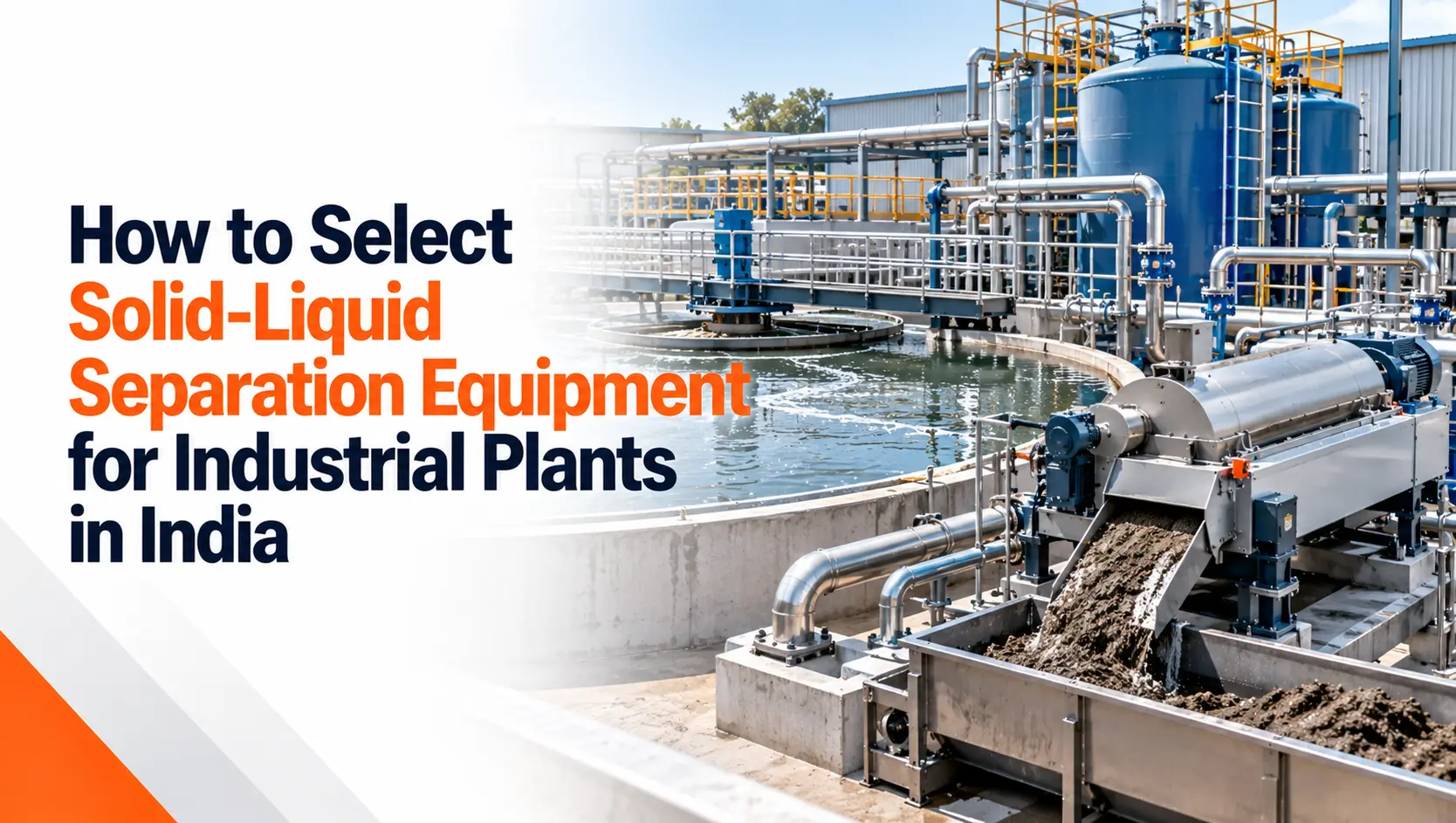
Choosing the right solid liquid separation equipment manufacturer requires evaluating slurry characteristics, filtration capacity, cake dryness, operating pressure, and long-term maintenance requirements. For industrial plants in India, a correctly selected filter press system can support efficient solids recovery, liquid clarification, and sludge dewatering.
However, filtration equipment should never be selected on machine capacity or purchase price alone. The relationship between process conditions, filtration media, and equipment configuration determines how effectively a system performs.
This guide explains what industrial buyers should evaluate before purchasing a filter press.
Why Solid-Liquid Separation Matters in Industrial Manufacturing
Solid-liquid separation removes suspended solids from process liquids through mechanical or physical methods.
In a filter press, slurry enters filtration chambers under pressure. The filter cloth retains solids while liquid passes through as filtrate. The accumulated solids form a filter cake that is removed after the filtration cycle.
This process is relevant to industries including:
- Chemical and pharmaceutical manufacturing.
- Mineral and pigment processing.
- Food and beverage production.
- Industrial wastewater treatment.
- Dye and specialty chemical manufacturing.
- Sludge dewatering operations.
Effective separation can support material recovery, improved process consistency, and more manageable waste streams.
The actual results depend on the composition and behaviour of the material being processed.
1. Understand Your Slurry Before Selecting Equipment
The most important purchasing decision begins with understanding the slurry.
Two liquids containing similar percentages of suspended solids can behave differently during filtration because of particle size, compressibility, viscosity, and chemical composition.
Buyers should establish the following operating parameters:
| Process parameter | Why it matters |
| Solids concentration | Influences cake formation and filtration loading |
| Particle size | Affects retention and filter media selection |
| Slurry viscosity | Influences flow resistance and cycle duration |
| Operating temperature | Affects material compatibility |
| Chemical composition | Determines corrosion-resistance requirements |
| Required cake moisture | Helps determine dewatering requirements |
Providing accurate process data allows manufacturers to recommend suitable configurations instead of relying on general equipment specifications.
2. Compare Filter Press Technologies
A reliable filter press system manufacturer should help industrial buyers understand the differences between available configurations.
Recessed Chamber Filter Press
A recessed chamber filter press uses specially designed plates to create chambers where solids accumulate.
This configuration is commonly considered for industrial dewatering and general pressure filtration.
N.M. Patel & Co. manufactures recessed filter press systems for applications involving chemicals, minerals, dyes, and wastewater treatment.
Membrane Filter Press
Membrane systems incorporate flexible membranes that apply additional pressure to the filter cake after initial filtration.
This secondary squeezing stage can reduce retained moisture in suitable applications.
Businesses seeking improved cake dryness can evaluate membrane filter press technology.
Plate and Frame Filter Press
Plate and frame systems use alternating plates and frames to create filtration chambers.
They may suit processes requiring particular cake configurations or filtration characteristics.
Fully Automatic Filter Press
Automatic systems can incorporate functions such as plate shifting, cake discharge, and cloth washing.
These configurations may be appropriate when processing volume, labour requirements, and operating schedules justify automation.
3. Evaluate the Total Cost of Industrial Filtration Solutions in India
Industrial filtration equipment should be evaluated using total operating cost rather than purchase price alone.
Important expenses include:
- Initial equipment investment.
- Pumping energy and supporting utilities.
- Filter cloth replacement.
- Routine maintenance and spare parts.
- Operator involvement.
- Downtime associated with filtration cycles.
- Cake handling and disposal.
A lower-cost machine may become more expensive over time if it requires frequent maintenance or delivers unsuitable filtration performance.
Similarly, automation may justify its additional investment where reduced manual handling or improved operating consistency creates measurable value.
4. Why Filter Cloth and Plate Selection Matters
Filter cloth is an essential component of pressure filtration.
Its characteristics influence particle retention, filtrate clarity, cake release, and operating resistance.
Choosing an unsuitable cloth can contribute to clogging, increased cleaning requirements, or inefficient filtration.
Filter plate selection is equally important.
Plate materials and construction must be compatible with process temperature, pressure, and chemical exposure.
Before purchasing, ask whether the proposed materials are suitable for the actual slurry and cleaning procedures.
Buyers can review N.M. Patel & Co.’s broader industrial filtration equipment range when comparing components and complete systems.
5. Request Filtration Testing Before Finalizing Equipment
An equipment proposal becomes more useful when supported by representative slurry testing.
Testing can help estimate filtration behaviour, cake formation, filtrate quality, and the suitability of different filter media.
A practical evaluation process involves:
- Collecting a representative slurry sample.
- Recording operating conditions and production requirements.
- Performing appropriate filtration trials.
- Reviewing filtrate clarity and cake characteristics.
- Comparing equipment configurations against process objectives.
Pilot trials are particularly valuable when material properties vary or when an existing filtration process produces inconsistent results.
N.M. Patel & Co. lists slurry sample testing and on-site pilot filter press testing among its services.
6. Selecting a Solid Liquid Separation Equipment Manufacturer in India
Industrial buyers should assess a manufacturer’s technical knowledge, product range, customization capabilities, and service support.
The right supplier should be able to discuss process requirements rather than recommending equipment based only on standard catalogue descriptions.
N.M. Patel & Co., established in 1935, is based in Bilimora, Gujarat. Its product portfolio covers multiple filter press configurations, along with filter plates, filter cloths, and auxiliary equipment.
The company also provides filtration-related consultation and refurbishment services.
These capabilities are relevant when comparing industrial filtration solutions in India for new installations or improvements to existing facilities.
Frequently Asked Questions
What equipment is used for industrial solid-liquid separation?
Filter presses are commonly used for pressure-based separation of suspended solids from liquids. Other technologies may be suitable depending on the application and required results.
How do I choose a filter press system manufacturer?
Evaluate technical expertise, slurry testing capabilities, materials, available configurations, maintenance support, and the suitability of the proposed equipment.
What is the difference between recessed and membrane filter presses?
Recessed chamber systems separate solids through pressure filtration, while membrane systems add a squeezing stage that can improve cake dewatering.
Which industries require industrial filtration solutions?
Chemical processing, pharmaceuticals, mining, food production, pigments, and wastewater treatment are among the industries using filtration equipment.
Can filtration testing improve equipment selection?
Yes. Representative testing helps manufacturers assess filtration behaviour and develop recommendations suited to actual process conditions.
Discuss Your Filtration Requirements With N.M. Patel & Co.
Selecting industrial filtration equipment requires a clear understanding of the material being processed, desired separation results, and operating conditions.
N.M. Patel & Co. manufactures filter press equipment and provides supporting filtration services for industrial applications.
Company: N.M. Patel & Co.
Address: Chimodia Naka, Near Railway Crossing, Bilimora, Gujarat 396321, India
Phone: +91 98250 84945 / +91 96241 85365
Email: nmp_ma_meera@yahoo.com
Request a technical consultation: Contact N.M. Patel & Co. with your slurry characteristics, required capacity, and filtration objectives to discuss suitable equipment options.