





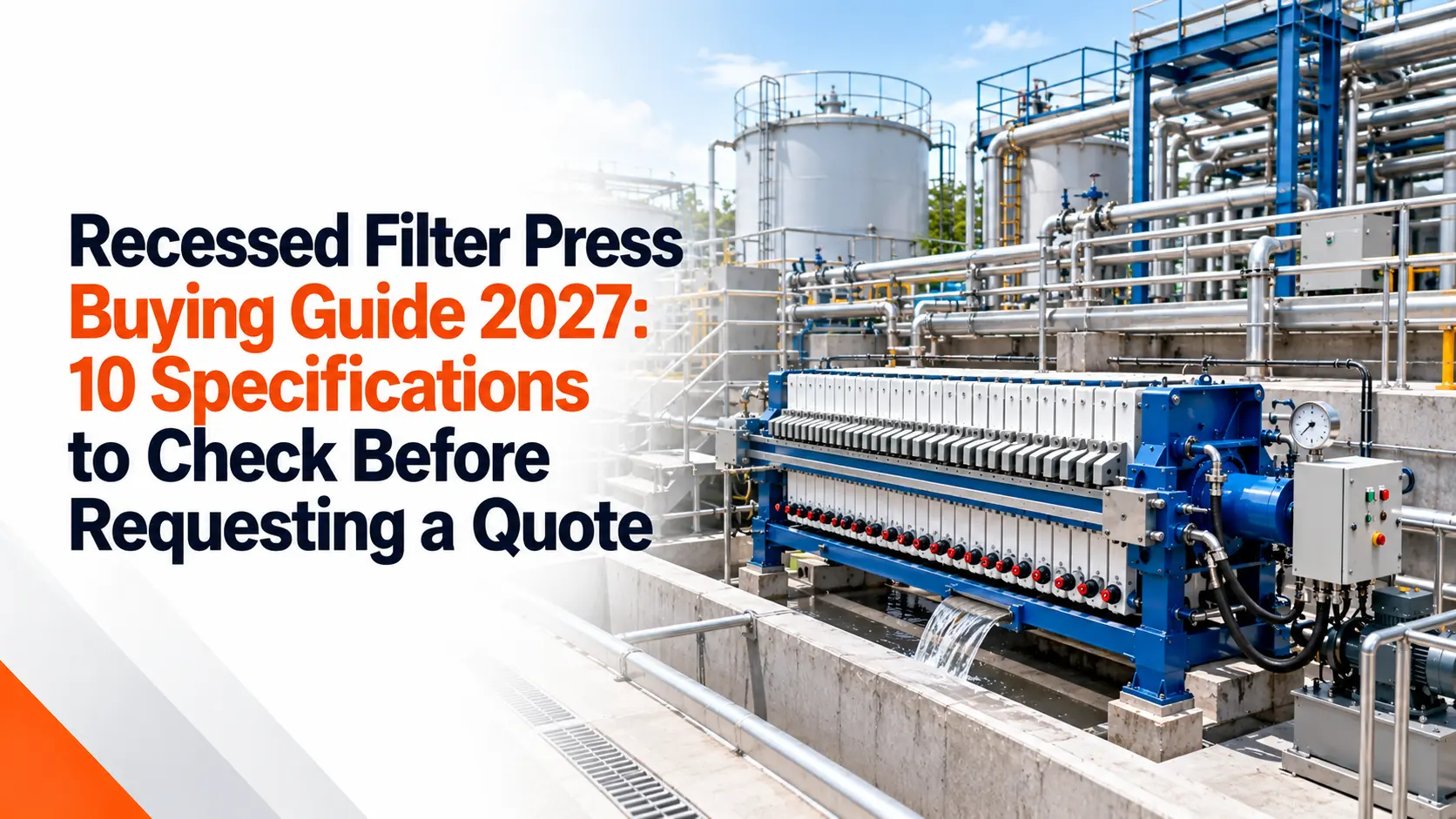
A recessed filter press is an industrial solid-liquid separation machine that uses recessed chamber plates and filter cloth to separate suspended solids from slurry under pressure. Before purchasing one, buyers should evaluate slurry characteristics, filtration capacity, chamber volume, plate material, operating pressure, cake moisture requirements, and automation options.
For chemical manufacturers, wastewater treatment plants, mineral processors, and other industrial facilities, selecting the correct recessed filter press machine can improve filtration consistency and reduce unnecessary operating costs.
This guide explains the technical information procurement teams should prepare before requesting a quotation in 2027.
What Is a Recessed Chamber Filter Press?
A recessed chamber filter press consists of multiple filter plates with recessed surfaces. When the plates are compressed together, they form chambers that retain solids during filtration.
Slurry enters these chambers under controlled pressure. Liquid passes through filter cloth while solids accumulate to form filter cakes.
Once filtration is complete and the system has been safely depressurised, the plates are opened to discharge the accumulated solids.
Unlike membrane filter presses, conventional recessed chamber systems do not include a separate membrane-squeezing stage.
N.M. Patel & Co. manufactures recessed filter press machines with different plate sizes, capacities, and operating configurations for industrial applications.
10 Specifications to Check Before Buying a Recessed Filter Press
1. Slurry Characteristics
Every filtration project should begin with an understanding of the material being processed.
Important properties include solids concentration, particle size, slurry viscosity, temperature, pH, and chemical composition.
These characteristics affect filtration resistance, plate compatibility, filter cloth selection, and cleaning requirements.
Representative slurry testing is often necessary before finalising equipment specifications.
2. Required Processing Capacity
Determine the slurry volume or mass that must be processed within a defined operating period.
Capacity should account for the complete filtration cycle, including filling, filtration, discharge, and cleaning.
A machine’s nominal chamber volume alone cannot establish its actual daily throughput.
3. Filter Plate Material
Recessed chamber filter presses commonly use polypropylene plates because of their corrosion resistance and practical handling characteristics.
However, material suitability depends on the slurry’s chemical composition, temperature, operating pressure, and equipment design.
N.M. Patel & Co. offers different filter press plate configurations for industrial applications.
Buyers should verify plate compatibility with the intended operating conditions.
4. Chamber Volume and Cake Thickness
The available chamber volume determines how much cake can accumulate during a filtration cycle.
A deeper chamber may accommodate more solids, but thicker cakes can increase filtration resistance and affect cycle duration.
N.M. Patel & Co. lists recessed plate cake thickness options between 25 mm and 50 mm.
The appropriate option should be established through process evaluation.
5. Operating Pressure
Operating pressure influences filtrate flow, cake formation, and equipment loading.
Higher pressure does not always provide better filtration because certain compressible cakes become less permeable as pressure increases.
The selected pressure must remain within the approved ratings of the plates, frame, piping, and associated equipment.
6. Filter Cloth Selection
Filter cloth plays an essential role in particle retention and liquid drainage.
Cloth performance depends on material, weave, permeability, particle characteristics, and chemical compatibility.
Polypropylene, polyester, and other materials may be appropriate for different applications.
Buyers can review available industrial filter cloth options when considering replacement requirements and filtration performance.
7. Automation Requirements
Recessed filter presses may be supplied with manual, semi-automatic, or fully automatic operating arrangements.
Automation requirements can involve hydraulic closing, plate shifting, cloth washing, and cake handling.
The appropriate configuration depends on operating frequency, available labour, plant layout, and process requirements.
8. Filtrate Quality
Not every filtration process has identical liquid-quality requirements.
Some facilities prioritise sludge dewatering, while others need clearer filtrate for subsequent processing.
Specify the expected filtrate characteristics and any applicable process acceptance criteria.
These requirements influence cloth selection, filtration conditions, and possible downstream treatment.
9. Installation Space
Procurement teams should assess the available floor area, access routes, foundation requirements, and maintenance clearance.
Space must also be provided for plate opening, filter cake discharge, piping, and auxiliary equipment.
The final layout should follow approved engineering drawings and relevant safety requirements.
10. Maintenance and Spare Parts
Routine maintenance affects equipment reliability and operating costs.
Before purchasing, clarify the availability of replacement filter cloths, plates, hydraulic components, and other service items.
Buyers should also assess operator training, maintenance documentation, and applicable warranty terms.
Recessed Filter Press Specification Checklist
| Specification | Information to provide |
| Application | Wastewater, chemical, mineral, or other process |
| Slurry details | Solids percentage, viscosity, pH, temperature |
| Processing requirement | Slurry volume or mass per hour or day |
| Cake requirement | Target moisture and discharge characteristics |
| Plate configuration | Required material and chamber arrangement |
| Operating conditions | Pressure, temperature, duty cycle |
| Automation | Manual, semi-automatic, or automatic |
| Installation | Available space and utility requirements |
Providing these details can help manufacturers prepare more relevant technical proposals.
Industrial Applications of Recessed Filter Press Machines
Recessed chamber filter presses are used in multiple industries requiring solid-liquid separation.
Wastewater treatment: Dewatering sludge generated during industrial effluent treatment.
Chemical processing: Separating suspended solids from suitable chemical slurries.
Dyes and pigments: Recovering solids and clarifying process liquids.
Minerals and ceramics: Removing liquid from mineral suspensions and ceramic processing materials.
Food and beverage: Processing suitable products using appropriately specified filtration equipment.
Actual suitability depends on the material characteristics, hygiene requirements, and operating conditions.
Recessed Filter Press Manufacturer in Gujarat, India
N.M. Patel & Co. is an Indian filter press manufacturer with a manufacturing history dating to 1935.
The company produces recessed chamber filter presses, filtration plates, filter cloths, and related industrial filtration equipment.
Its manufacturing infrastructure includes fabrication, machining, moulding, and equipment assembly facilities.
Recessed filter presses are available in customised configurations for different industrial requirements.
Company Address and Contact Details
Company: N.M. Patel & Co.
Address: Chimodia Naka, Near Railway Crossing, Bilimora, Gujarat 396321, India.
Phone: +91 9825084945 / +91 9624185365
Email: nmp_ma_meera@yahoo.com
For a technical quotation, buyers can contact N.M. Patel & Co. through its official company website and provide their process requirements.
Frequently Asked Questions
What is the main advantage of a recessed chamber filter press?
A recessed chamber filter press provides pressure-based solid-liquid separation using chambers formed directly by recessed plates. It can be a practical solution for many industrial dewatering applications.
How do I choose the correct recessed filter press capacity?
Capacity selection depends on slurry solids concentration, required throughput, cake characteristics, filtration behaviour, and total cycle time.
Are polypropylene plates suitable for every slurry?
No. Polypropylene has useful chemical resistance, but suitability must be verified against operating temperature, pressure, and the specific substances being processed.
Can a recessed filter press operate automatically?
Yes. Recessed chamber filter presses can incorporate automated functions depending on equipment configuration.
What information is required for a filter press quotation?
Manufacturers typically need slurry characteristics, processing capacity, operating conditions, required filtrate quality, cake moisture targets, and automation preferences.
Conclusion
Purchasing a recessed filter press requires careful evaluation of process conditions rather than selecting equipment based on price or plate size alone.
By preparing accurate slurry data, capacity requirements, and equipment specifications, industrial buyers can make more informed purchasing decisions.
N.M. Patel & Co. offers recessed chamber filtration equipment for businesses seeking application-specific solid-liquid separation solutions.