






Introduction
Filter press downtime can quickly affect production schedules, labor efficiency, maintenance costs, and overall plant productivity.
In manually operated filtration systems, many stages of the filtration cycle depend on operator intervention. Plate movement, slurry feeding, pressure monitoring, cake discharge, washing, and other operations may require manual control.
Automation can reduce this dependency by controlling important parts of the filter press cycle more consistently.
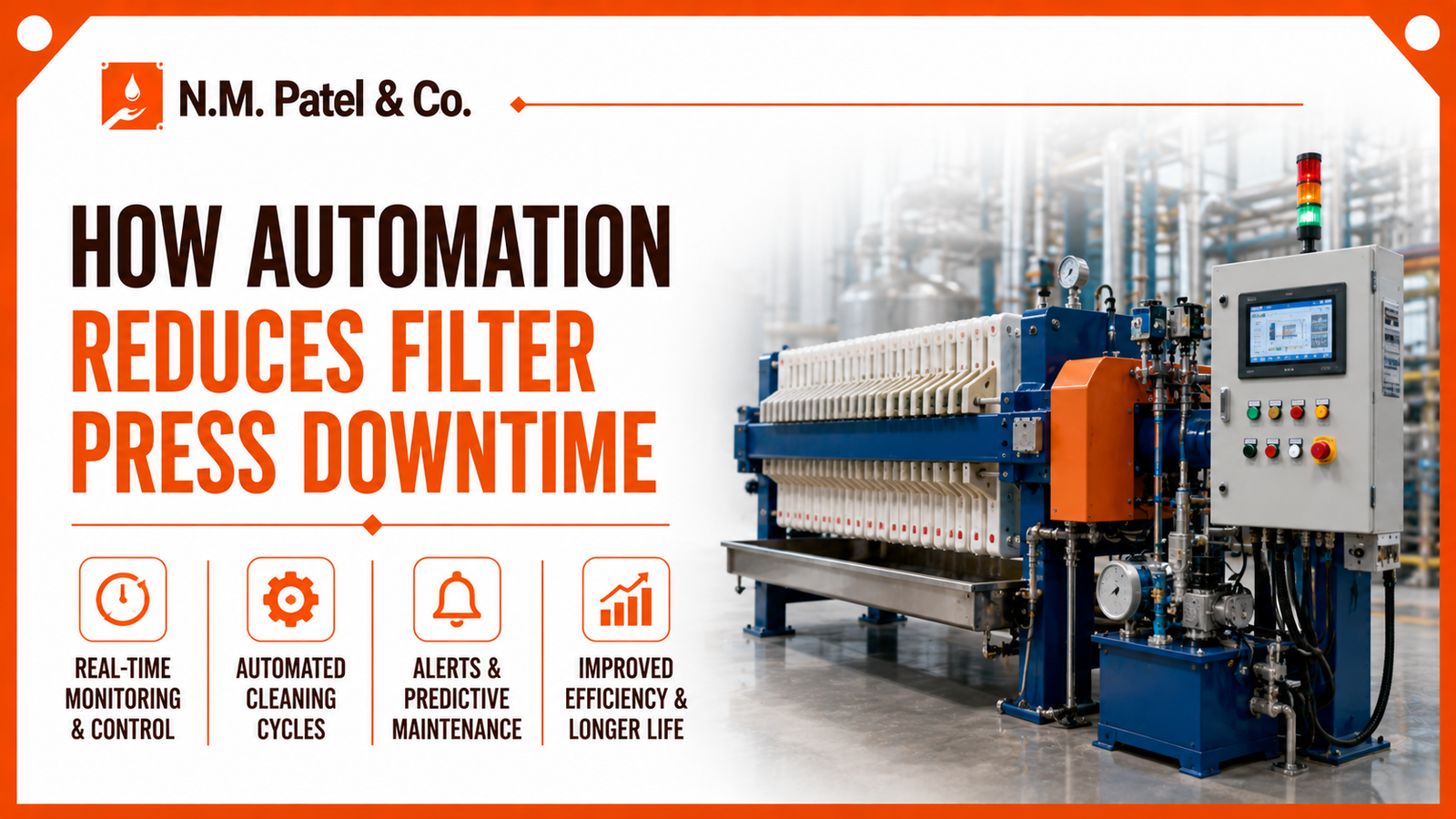
An automated filter press can use sensors, control systems, hydraulic controls, automated valves, and programmed sequences to monitor and manage filtration operations.
The objective is not simply to remove operators from the process.
The objective is to make the filtration cycle more consistent, predictable, measurable, and easier to monitor.
For industrial facilities handling large volumes of slurry, automation can become an important part of reducing avoidable downtime and improving filter press utilization.
Quick Answer
Filter press automation reduces downtime by automating repetitive operations, monitoring operating conditions, improving cycle consistency, detecting abnormal conditions, and reducing manual errors. Automated controls can help manage filtration, plate movement, pressure, cake discharge, washing, and other process stages, allowing operators to identify problems earlier and maintain more consistent production cycles.
Key Takeaways
- Automation can reduce manual intervention during filter press operation.
- Consistent cycle control can improve equipment utilization.
- Sensors can help monitor important operating conditions.
- Automated systems can identify abnormal operating conditions earlier.
- Automatic cake discharge can reduce cycle delays.
- Automated cleaning can improve operational consistency.
- Preventive maintenance becomes easier with monitoring data.
- Automation does not eliminate the need for inspection and maintenance.
- The right level of automation depends on the application and production requirements.
What Causes Filter Press Downtime?
Quick Answer
Filter press downtime can result from equipment failures, inconsistent operation, filter cloth problems, hydraulic issues, blocked lines, excessive manual intervention, cleaning requirements, and delays during cake discharge or other stages of the filtration cycle.
Common causes include:
| Downtime Cause | Potential Effect |
| Filter Cloth Blinding | Reduced filtration performance |
| Hydraulic Problems | Plate movement delays |
| Pump Issues | Interrupted slurry feeding |
| Valve Problems | Incorrect flow control |
| Manual Plate Handling | Longer cycle times |
| Cake Discharge Delays | Production interruptions |
| Excessive Pressure | Equipment/process problems |
| Poor Cleaning | Reduced filtration performance |
| Unexpected Maintenance | Unplanned downtime |
| Operator Error | Incorrect process operation |
Not every downtime event can be prevented through automation.
However, automation can reduce several sources of avoidable operational delays.
What Is Filter Press Automation?
Quick Answer
Filter press automation involves using control systems, sensors, actuators, hydraulic systems, valves, and programmed sequences to automatically manage selected stages of filter press operation.
Depending on the equipment configuration, automation may control:
- Plate closing
- Slurry feeding
- Filtration pressure
- Filtrate flow
- Plate opening
- Cake discharge
- Filter cloth washing
- Air blow
- Hydraulic operation
- Process alarms
The level of automation can range from basic controls to highly automated filtration systems.
How Automation Reduces Filter Press Downtime
Quick Answer
Automation reduces downtime primarily by making filtration cycles more consistent, reducing manual intervention, monitoring operating conditions, and allowing operators to identify potential problems earlier.
1. Reduces Manual Intervention
Manual operation requires operators to perform repetitive tasks during every filtration cycle.
Automation can control these tasks according to programmed sequences.
This can reduce:
- Waiting time
- Manual errors
- Inconsistent cycle execution
- Unnecessary operator intervention
The operator can instead monitor the overall process and respond when intervention is required.
2. Creates Consistent Filtration Cycles
A manual filtration process can vary from one cycle to another.
Automation can establish predefined operating sequences.
For example:
Plate Closing → Slurry Feeding → Pressure Filtration → Filtration Completion → Plate Opening → Cake Discharge → Cleaning → Next Cycle
Consistent sequencing can help reduce unnecessary delays between stages.
3. Improves Pressure Monitoring
Pressure is an important operating parameter in a filter press.
Automated systems can monitor pressure and trigger appropriate control actions when preset conditions are reached.
This can help operators identify:
- Abnormal pressure increases
- Insufficient pressure
- Unexpected pressure changes
- Potential process problems
Pressure monitoring should be configured according to the specific filter press and process requirements.
4. Automates Cake Discharge
Cake discharge can become a significant part of the overall filtration cycle.
In manually operated systems, plate opening and cake removal can take additional time.
Automated plate shifting and discharge sequences can help make this stage more consistent.
This can potentially reduce the time between filtration cycles.
5. Automates Filter Cloth Washing
Filter cloth condition can directly affect filtration performance.
Over time, accumulated material can cause cloth blinding.
Automated washing systems can perform programmed cleaning sequences based on the process requirements.
This can help:
- Maintain filtration performance
- Reduce manual cleaning time
- Improve cycle consistency
- Support longer operating periods between manual interventions
Cleaning frequency should be determined according to the slurry and filtration process.
Role of Sensors in Filter Press Automation
Quick Answer
Sensors provide automated systems with information about operating conditions. This information can be used by the control system to monitor processes, trigger alarms, and execute programmed actions.
Depending on the system, sensors may monitor:
- Pressure
- Flow
- Hydraulic conditions
- Position
- Temperature
- Filtrate conditions
- Other process parameters
Why Monitoring Matters
Without monitoring, an abnormal condition may only become obvious after production has already been affected.
With automated monitoring, the control system can provide an early indication of a problem.
For example:
Abnormal Condition → Sensor Detection → Control System Alert → Operator Inspection → Corrective Action
Early detection can potentially prevent a small operational issue from becoming a longer production interruption.
Automated Cake Discharge
Quick Answer
Automated cake discharge can reduce downtime by making the plate-opening and cake-removal stage more systematic and repeatable.
After filtration is completed, the filter press must discharge the accumulated cake before the next cycle can begin.
Automation can assist with:
- Plate movement
- Plate separation
- Cake discharge sequence
- Discharge monitoring
- Resetting the system for the next cycle
This is especially useful for plants where the filter press operates through frequent filtration cycles.
Automation and Preventive Maintenance
Quick Answer
Automation can support preventive maintenance by providing operational information that helps identify abnormal equipment behavior before a failure causes extended downtime.
Instead of relying only on scheduled maintenance, plants can also monitor equipment performance.
Potential indicators include:
- Increasing cycle time
- Unusual pressure behavior
- Repeated alarms
- Hydraulic abnormalities
- Reduced flow
- Increased cleaning frequency
- Repeated operating interruptions
For example:
Normal Cycle → Performance Monitoring → Deviation Detected → Inspection → Maintenance → Avoid Larger Failure
Automation therefore becomes not only an operational tool but also a source of useful maintenance information.
Manual vs Automated Filter Press
Quick Answer
Manual and automated filter presses can both perform effective filtration, but automation can provide greater consistency and reduce the amount of repetitive operator intervention required.
| Factor | Manual Filter Press | Automated Filter Press |
| Operator Intervention | Higher | Lower |
| Cycle Consistency | Operator dependent | Program controlled |
| Pressure Monitoring | Manual/limited | Automated monitoring |
| Cake Discharge | Manual | Can be automated |
| Cleaning | Manual/semi-automatic | Can be programmed |
| Process Monitoring | Limited | Higher |
| Repetitive Tasks | More manual | More automated |
| Production Scale | Suitable for some applications | Well suited to repetitive operations |
| Maintenance Monitoring | Primarily manual | Can include system data |
| Initial Investment | Generally lower | Generally higher |
The appropriate option depends on production volume, labor availability, process requirements, and the desired level of automation.
Benefits of Automating a Filter Press
Quick Answer
Filter press automation can improve operational consistency, reduce repetitive manual work, support process monitoring, and potentially reduce avoidable downtime.
Improved Productivity
Automated cycles can reduce delays between filtration stages.
Better Process Consistency
Programmed sequences can help maintain repeatable operating conditions.
Reduced Operator Workload
Automation can take over repetitive tasks while operators supervise the process.
Faster Problem Identification
Sensors and alarms can alert operators to abnormal conditions.
Better Equipment Utilization
Reducing unnecessary waiting periods can allow the filter press to spend more time performing productive filtration cycles.
Improved Safety
Reducing manual interaction with moving equipment and process components can help minimize certain operational risks when the system is appropriately designed and safeguarded.
How to Choose the Right Automation Level
Quick Answer
The right automation level depends on production volume, filtration frequency, labor requirements, process complexity, equipment configuration, and the business objective for automation.
Not every filter press requires complete automation.
A plant may choose:
Basic Automation
Suitable for applications requiring:
- Automated hydraulic operation
- Basic controls
- Pressure monitoring
- Simple alarms
Semi-Automatic Operation
May include:
- Automated filtration sequences
- Automatic plate movement
- Automated cake discharge
- Automated washing
Fully Automated Operation
May integrate:
- PLC control
- Sensors
- Automatic valves
- Automated plate shifting
- Cake discharge
- Cloth washing
- Process monitoring
- Alarm systems
- Data collection
The right approach is to automate the operations where automation provides measurable value.
Important Factors Before Automating a Filter Press
Before implementing automation, businesses should evaluate:
| Factor | Why It Matters |
| Slurry Characteristics | Determines filtration behavior |
| Production Volume | Influences automation requirements |
| Cycle Frequency | Helps determine ROI |
| Existing Equipment | Determines integration requirements |
| Labor Requirements | Identifies manual tasks suitable for automation |
| Maintenance Capability | Determines support requirements |
| Safety Requirements | Influences control system design |
| Process Monitoring | Determines sensor requirements |
| Cleaning Requirements | Influences washing automation |
| Future Expansion | Helps with scalable system design |
Automation should be designed around the complete filtration process rather than added as an isolated feature.
Why Choose N.M. Patel & Co.?
Quick Answer
N.M. Patel & Co. provides industrial filtration solutions designed around application-specific requirements. Filter press automation should be selected according to the filtration process, equipment configuration, production requirements, and desired level of operational control.
When evaluating automation, important considerations include:
- Filter press size
- Slurry characteristics
- Required filtration capacity
- Cycle frequency
- Cake discharge requirements
- Cleaning requirements
- Pressure monitoring
- Hydraulic operation
- Sensor requirements
- PLC/control system requirements
- Safety considerations
A process-focused approach can help businesses identify which parts of their filtration operation would benefit most from automation.
Contact N.M. Patel & Co. to discuss your filter press automation and industrial filtration requirements.
Frequently Asked Questions
How does automation reduce filter press downtime?
Automation reduces downtime by controlling repetitive operations, maintaining consistent filtration sequences, monitoring operating conditions, and alerting operators to abnormal conditions.
Can automation reduce filter press cycle time?
Automation can reduce avoidable delays between different stages of the filtration cycle. However, actual cycle time also depends on slurry characteristics, filtration pressure, cake formation, filter cloth, pump performance, and other process factors.
Can filter press cake discharge be automated?
Yes. Depending on the filter press design, plate movement and cake discharge operations can be automated to reduce manual intervention and improve cycle consistency.
Can automation help with filter press maintenance?
Yes. Monitoring operating parameters and system alarms can help identify abnormal conditions and support preventive maintenance. Automation does not replace physical inspection and scheduled maintenance.
Is a fully automatic filter press better than a manual filter press?
Not necessarily for every application. The appropriate level of automation depends on production volume, cycle frequency, labor requirements, process complexity, and investment considerations.
What components are used in filter press automation?
Depending on the system, automation can include PLCs, sensors, hydraulic controls, automated valves, actuators, control panels, alarms, and other process-monitoring components.
Conclusion
Filter press automation can play an important role in reducing avoidable downtime and improving filtration productivity.
By automating repetitive operations such as plate movement, slurry feeding, pressure monitoring, cake discharge, and cloth washing, businesses can achieve more consistent filtration cycles and reduce unnecessary manual intervention.
Automation can also provide valuable process information that helps operators identify abnormal conditions earlier and support preventive maintenance.
However, automation is not a replacement for proper equipment selection, filter cloth maintenance, pump maintenance, cleaning, inspection, and process optimization.
The most effective approach is to identify the actual causes of downtime and automate the stages where automation can deliver measurable operational benefits.
For industrial filtration applications, N.M. Patel & Co. can help businesses evaluate their filter press requirements and determine an appropriate level of automation.