






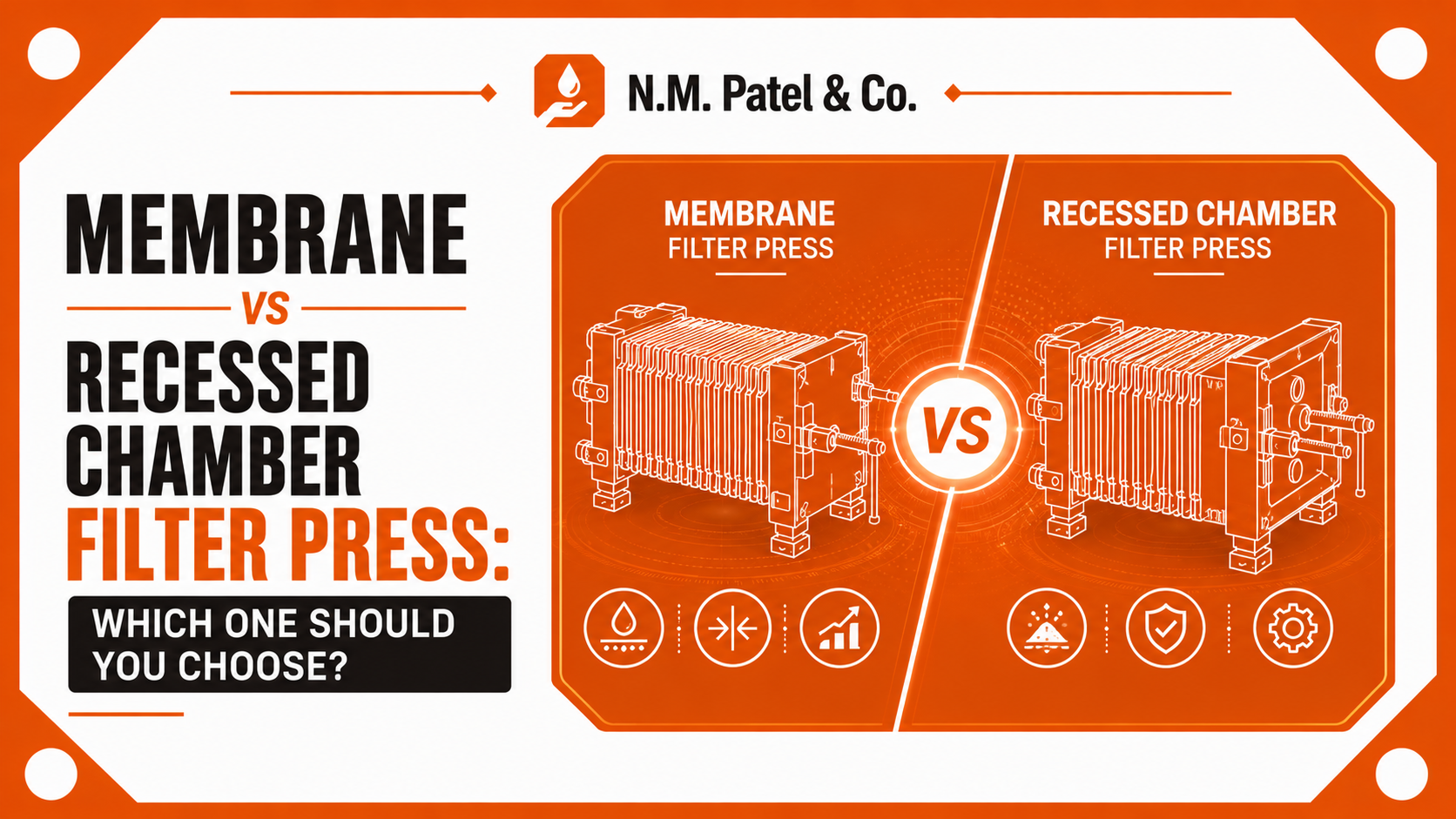
Selecting the right filter press is crucial for achieving efficient solid-liquid separation, reducing operating costs, and maximizing productivity. Among the most popular industrial filtration systems are the Membrane Filter Press and the Recessed Chamber Filter Press.
Although both machines are designed to separate solids from liquids under pressure, they differ significantly in their construction, filtration process, cake dryness, operating costs, and suitable applications.
If you’re planning to invest in a new filtration system, understanding the differences between a membrane vs recessed chamber filter press will help you choose the best solution for your production requirements.
What Is a Membrane Filter Press?
A Membrane Filter Press is an advanced filtration system that uses flexible membrane plates along with recessed chamber plates.
After the filtration cycle is complete, compressed air or water is introduced behind the membrane plates, causing them to expand and squeeze the filter cake.
This additional squeezing process removes more moisture from the cake, resulting in:
- Higher solid content
- Lower moisture levels
- Shorter drying time
- Reduced disposal costs
Because of these advantages, membrane filter presses are widely used in industries where dry filter cake is essential.
What Is a Recessed Chamber Filter Press?
A Recessed Chamber Filter Press consists of recessed filter plates that form filtration chambers when pressed together.
Slurry is pumped into these chambers under pressure, where solids accumulate to form a filter cake while the liquid passes through the filter cloth.
Unlike membrane presses, recessed chamber filter presses do not include a secondary squeezing stage. Once filtration is complete, the filter cake is discharged directly.
These machines are widely used because of their simple design, reliable operation, and lower initial investment.
Membrane vs Recessed Chamber Filter Press: Quick Comparison
| Feature | Membrane Filter Press | Recessed Chamber Filter Press |
| Filtration Method | Filtration + Membrane Squeezing | Pressure Filtration Only |
| Cake Moisture | Very Low | Moderate |
| Cake Dryness | Excellent | Good |
| Filtration Cycle | Faster overall drying | Standard |
| Operating Cost | Slightly Higher | Lower |
| Initial Investment | Higher | Lower |
| Automation | High | Moderate |
| Productivity | Higher | High |
| Best For | High-value filtration | General industrial filtration |
Working Principle Comparison
Membrane Filter Press
The process includes two stages:
Stage 1 – Filtration
Slurry enters the filtration chambers, where solids are retained and liquid passes through the filter cloth.
Stage 2 – Membrane Squeezing
Compressed air or water inflates the membrane plates, squeezing the filter cake to remove additional moisture.
The result is a much drier cake compared to conventional filtration.
Recessed Chamber Filter Press
The process is simpler.
- Slurry enters the recessed chambers.
- Solids form the filter cake.
- Liquid passes through the filter cloth.
- Once filtration ends, the cake is discharged.
No additional squeezing stage is performed.
Construction Differences
Membrane Filter Press
Main components include:
- Membrane plates
- Chamber plates
- Hydraulic closing system
- Feed pump
- Air or water squeezing system
- Filter cloth
- Filtrate collection system
Recessed Chamber Filter Press
Main components include:
- Recessed filter plates
- Hydraulic system
- Feed pump
- Filter cloth
- Filtrate outlet
- Cake discharge mechanism
The simpler construction results in lower maintenance requirements.
Cake Dryness Comparison
One of the biggest differences is the final moisture content.
Membrane Filter Press
Provides:
- Lower residual moisture
- Better cake compression
- Reduced drying costs
- Easier transportation and disposal
This is especially important in industries where disposal costs depend on filter cake weight.
Recessed Chamber Filter Press
Produces good-quality filter cake but with relatively higher moisture content because there is no secondary compression stage.
Filtration Efficiency
Both machines provide excellent filtration performance.
However:
Membrane Filter Press
Offers:
- Higher solids recovery
- Improved filtration efficiency
- Better cake washing
- Lower moisture content
Recessed Chamber Filter Press
Provides:
- Reliable filtration
- Consistent performance
- Lower operating complexity
It remains one of the most widely used industrial filtration systems.
Operating Costs
Membrane Filter Press
Operating costs are slightly higher due to:
- Membrane squeezing system
- Compressed air or water usage
- Additional components
However, lower disposal and drying costs often offset the higher operating expenses.
Recessed Chamber Filter Press
Benefits include:
- Lower maintenance
- Lower operating costs
- Fewer moving parts
- Simpler servicing
For many industries, this offers an excellent balance between performance and cost.
Initial Investment
Membrane Filter Press
Higher purchase cost because of:
- Specialized membrane plates
- Advanced hydraulic systems
- Additional squeezing equipment
Recessed Chamber Filter Press
Lower initial investment makes it suitable for businesses with moderate production requirements and limited budgets.
Industries Using Membrane Filter Press
Membrane filter presses are commonly used in:
Pharmaceutical Industry
- API production
- Chemical filtration
- Fine chemicals
Food Processing
- Sugar processing
- Beverage clarification
- Edible oils
Mining Industry
- Mineral concentrates
- Precious metals
- Tailings dewatering
Chemical Industry
- Specialty chemicals
- Pigments
- Catalyst recovery
Wastewater Treatment
- Sludge dewatering
- Industrial effluent treatment
Industries Using Recessed Chamber Filter Press
Recessed chamber filter presses are widely used in:
- Chemical plants
- Ceramics
- Textile processing
- Dye manufacturing
- Paper industry
- Food processing
- General manufacturing
- Industrial wastewater treatment
Advantages of Membrane Filter Press
- Lower cake moisture
- Improved solids recovery
- Reduced drying costs
- Faster production cycles
- Higher filtration efficiency
- Better automation
- Reduced waste disposal costs
Advantages of Recessed Chamber Filter Press
- Lower purchase cost
- Simple construction
- Easy maintenance
- Reliable operation
- Lower operating expenses
- Long service life
Which Filter Press Should You Choose?
Choose a Membrane Filter Press if you need:
- Very dry filter cake
- High-value product recovery
- Reduced disposal costs
- High production efficiency
- Advanced automation
Choose a Recessed Chamber Filter Press if you require:
- Reliable filtration
- Lower investment
- Simple maintenance
- General industrial filtration
- Cost-effective operation
Factors to Consider Before Buying
Before selecting a filter press, evaluate:
- Production capacity
- Slurry characteristics
- Moisture requirements
- Cake disposal costs
- Available floor space
- Operating pressure
- Automation requirements
- Maintenance capabilities
- Future production expansion
A careful evaluation ensures you choose the most cost-effective filtration solution.
Common Buying Mistakes
Avoid these common errors:
Buying Based Only on Initial Cost
The lowest-priced machine may have higher long-term operating expenses.
Ignoring Cake Moisture Requirements
Industries with strict moisture specifications should consider membrane technology.
Choosing the Wrong Capacity
Undersized equipment can reduce productivity, while oversized systems increase unnecessary costs.
Ignoring After-Sales Support
Reliable technical support and spare parts availability are essential for long-term performance.
Why Choose N.M. Patel & Co.?
With decades of expertise in industrial filtration, N.M. Patel & Co. is a trusted manufacturer of high-performance filter press systems in India.
We offer:
- Membrane Filter Press
- Recessed Chamber Filter Press
- Plate & Frame Filter Press
- Fully Automatic Filter Press
- Hydraulic Filter Press
- Filter Press Spare Parts
- Filter Cloths
- Installation & Commissioning
- Preventive Maintenance
- Technical Support
Our engineering team works closely with customers to recommend filtration solutions based on process requirements, production capacity, and long-term operational goals. Whether you need a standard system or a customized solution, N.M. Patel & Co. delivers reliable equipment designed for efficiency, durability, and consistent performance.
People Also Search For
- membrane vs recessed chamber filter press
- membrane filter press vs chamber filter press
- filter press manufacturer India
- membrane filter press working
- recessed chamber filter press
- industrial filtration equipment
- sludge dewatering filter press
- automatic filter press
- filter press supplier India
- industrial filter press comparison
People Also Ask
What is the difference between a membrane filter press and a recessed chamber filter press?
A membrane filter press includes an additional membrane squeezing stage that reduces cake moisture after filtration, while a recessed chamber filter press relies only on pressure filtration.
Which filter press produces drier filter cake?
Membrane filter presses produce significantly drier filter cakes because of the secondary membrane compression process.
Is a membrane filter press worth the higher cost?
For industries where lower cake moisture reduces drying, handling, or disposal costs, the higher initial investment often delivers a better long-term return.
Which industries use recessed chamber filter presses?
They are widely used in chemical processing, food production, ceramics, textiles, paper manufacturing, and wastewater treatment.
Why choose N.M. Patel & Co.?
N.M. Patel & Co. manufactures high-quality membrane and recessed chamber filter presses backed by engineering expertise, customized solutions, reliable after-sales service, and decades of experience in industrial filtration.
Frequently Asked Questions
Can a membrane filter press improve production efficiency?
Yes. By reducing filter cake moisture and shortening drying times, membrane filter presses can improve overall process efficiency.
Which filter press is easier to maintain?
Recessed chamber filter presses have a simpler design with fewer components, making them generally easier and less expensive to maintain.
Which filter press is better for sludge dewatering?
Both are suitable, but membrane filter presses are often preferred when lower sludge moisture content is required.
How do I select the right filter press?
Consider slurry characteristics, filtration capacity, desired cake moisture, automation needs, operating costs, and long-term production goals before making a decision.
Does N.M. Patel & Co. provide customized filtration systems?
Yes. N.M. Patel & Co. offers customized filter press solutions tailored to specific industrial applications, process requirements, and production capacities.
Conclusion
Choosing between a membrane vs recessed chamber filter press depends on your filtration objectives, production requirements, and operating budget. Membrane filter presses are ideal for applications that demand low-moisture filter cakes and higher process efficiency, while recessed chamber filter presses offer a dependable and cost-effective solution for general industrial filtration.
At N.M. Patel & Co., we combine decades of engineering expertise with high-quality manufacturing to deliver filtration systems that meet the evolving needs of industries across India. Whether you need a membrane filter press, a recessed chamber filter press, or a customized filtration solution, our team is committed to helping you improve productivity, reduce operating costs, and achieve reliable long-term performance.